Editor’s note: This article was edited after publication to reflect the the proposed police building referendum price tag was $47 million and that Mayor Megan Sladek’s quote read that housing is the most profitable thing to build.
“Yay! I’m relieved!”
Surrounded by more than a dozen supporters in her home — the oldest in the city — Oviedo Mayor Megan Sladek beamed as she learned that she would be serving a third term, defeating challengers Brady Duke and Judith Dolores Smith on Tuesday.
Sladek won with 4,149 votes (54.27%) to Duke’s 3,102 (40.58%) and Smith’s 394 (5.15%). The voter turnout was larger than many expected — including Sladek and poll workers — with Sladek’s total and the 7,645 mayoral votes the highest in any of her three elections.
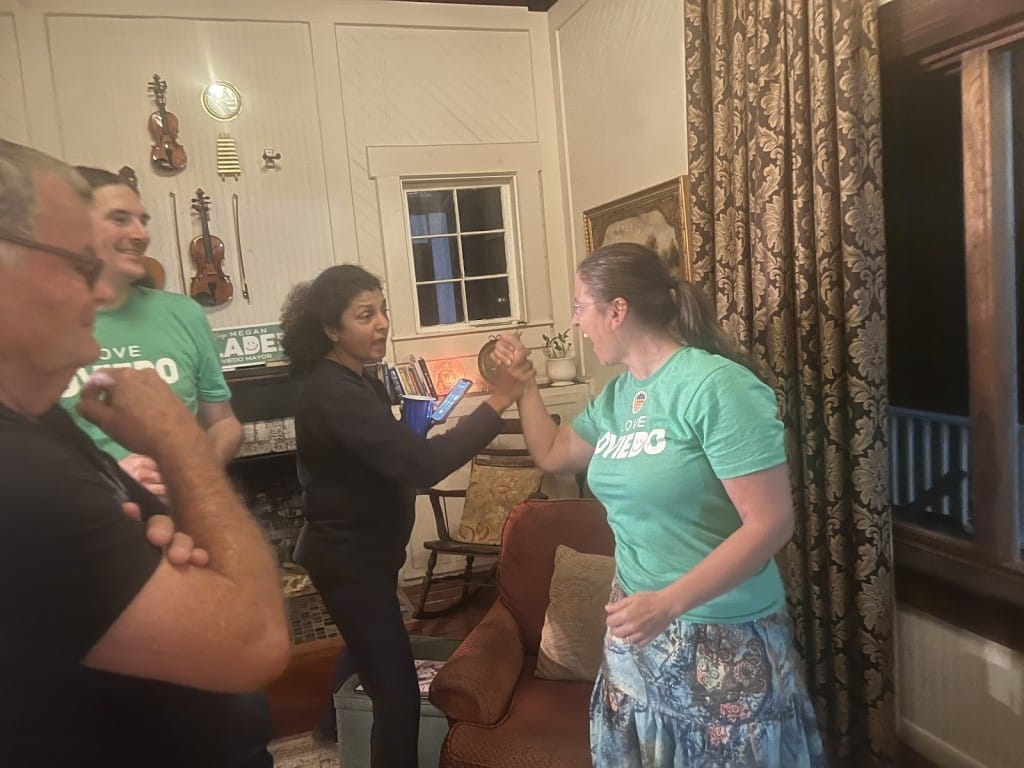
“I’m surprised [at the turnout],” she said. “I’m really glad that it’s a bigger turnout than we’ve ever had before.”
Sladek’s victory marked the third consecutive three-way race for her, with turnout increasing each time. In 2019, 6,600 votes were cast for mayor and she won 44% of them. In 2021, of 7,010 total votes, Sladek won 67% of them.
With the win, the Oviedo mayor looks to continue pushing ideas to reshape the city’s future.
“We had a lot of very difficult discussions the last two years,” she said. “And for people to have reelected me in spite of these discussions, it speaks to our community’s willingness to do some innovative things.”
Among those plans include completing the land development code updates and shifting the city away from car-based mobility to other alternatives.
Police station referendum fails
Unlike Sladek’s bid to be retained as Oviedo mayor, the hotly debated $47 million police station referendum failed at the polls, with 4,775 (63.62%) voting against vs. 2,731 (36.38%) voting in favor.
Voters rejected taking on more debt for a modernized police station, which would have come atop $11.4 million in bonds already approved by voters in 2016 to complete the proposed 47,000 square-foot headquarters.
“Forty-seven million dollars would double the city’s debt,” Sladek, who voted against the referendum, said. “The more I talk to people from other law enforcement jurisdictions, we don’t know what law enforcement is going to look like 30 years from now, so to build a building that is use-specific, based on the assumption that people for the next 30 years — while we’re paying for this — are going to occupy space in that style building, we might not even need [it].”

Among the issues with the current station, cited by officials, are a lack of space, its age and the lack of necessary training facilities.
A 2017 space-needs study commissioned by the city determined Oviedo needed a building at least twice the size of the current 20,000 square-foot one, which the department moved into in 1990, and needs new roofing, windows and updated ADA compliance features. A new station may have included a K-9 facility, de-escalation training areas, new classrooms, areas for community outreach and events, officer wellness systems, an up-to-date fitness center and a more efficient emergency operations center, Oviedo Police Chief Dale Coleman said.
“I personally have walked through that building more than once, and it is not something I would want anybody to work in,” Oviedo Councilmember Natalie Teuchert said. “It needs a lot of work. So whether you’re a police officer or any of our staff, we need to take care of the building.”
Deputy Chief Michael Beavers said the building’s space is dysfunctional and also not compliant with the Americans With Disabilities Act.
Based on current estimates, the cost to repay the police station bond, for a person who owns property with a $200,000 taxable value (not what the property would sell for), would have been $156.23 annually, and for a person who owns property with a $300,000 taxable value, the cost would have been $234.35, though Oviedo finance director Jerry Boop cautioned that the rate would have decreased with rising property values and future refinancing.
The stakes of the referendum were high, because the city must now go back to the drawing board to decide if and how to upgrade the police facility.
“We regroup and figure out what we can do,” Coleman said in July when asked about the possibility of it not passing. “I’m not a give-up kind of person. If that’s not the direction the citizens want us to go, then we’ll figure out a different direction to go that is acceptable.
Multiple options for the buildings were discussed at the Oviedo City Council’s June 28 working session. The other options included renovations of the existing public safety building with an additional, smaller annex built alongside, to larger renovations and construction plans, ranging in estimates from $33 million to $63 million, and even using parts of the Oviedo Mall for the station.
“There’s a lot of alternatives,” the Oviedo Mayor said. “I’m looking forward to discussing it with my colleagues.”
Business tax exemption referendum falls
The tax exemption referendum, which was mistakenly left off the ballot in 2022 and asked voters to decide whether the city can grant tax exemptions to new and expanding businesses that are expected to create full-time jobs in Oviedo also fell at the polls, with 4,768 (63.68%) voting no and2,720 (36.32%) voting yes.
“The language was not very clear, and no harm, no foul,” Sladek said. “I don’t think there’s any place where a business that would meet those criteria is likely to go, because the number-one-most profitable thing to build in Oviedo is housing.”