What now? That is the question Oviedo officials are grappling with after the hotly debated $47 million new police station referendum failed at the polls on Nov. 7. The referendum would have added $35.5 million in bonds to the $11.4 million passed in 2016. Nearly 64% of voters rejected the added debt.
“The need didn’t go away, so we’ve got to do something,” Oviedo City Council member Keith Britton said. “And frankly, I don’t know what the next step will be.”
A 2017 space-needs study commissioned by the city determined Oviedo needed a building at least twice the size of the current 20,000 square-foot one, which the department moved into in 1990, and needs new roofing, windows and updated ADA compliance features. A planned new station could have included a K-9 facility, de-escalation training areas, new classrooms, areas for community outreach and events, officer wellness systems, an up-to-date fitness center and a more efficient emergency operations center, Oviedo Police Chief Dale Coleman said.
“I was just disappointed because I believe the men and women of the police department do a good job with serving the City of Oviedo and the citizens of Oviedo,” Coleman said. “I think they deserve a better working environment, a better training environment. That’s what I would want, and that’s what I’m going to move toward.”
However, following the failed police station referendum, the question of what to do about the aging station remains.
“Whatever the answer is, it’s not nothing,” Oviedo Council member Natalie Teuchert said. “We’re doing something. … We have to get creative.
“I personally don’t want our employees sitting in a building that is in that condition. It’s not good,” she said.

Going back to the table, officials want to include the community in the process.
Teuchert’s in favor of “a whole new approach,” by bringing in a citizen-led group comprised of people with knowledge and expertise in certain fields, such as construction, to figure out more cost-effective ways of building the station.
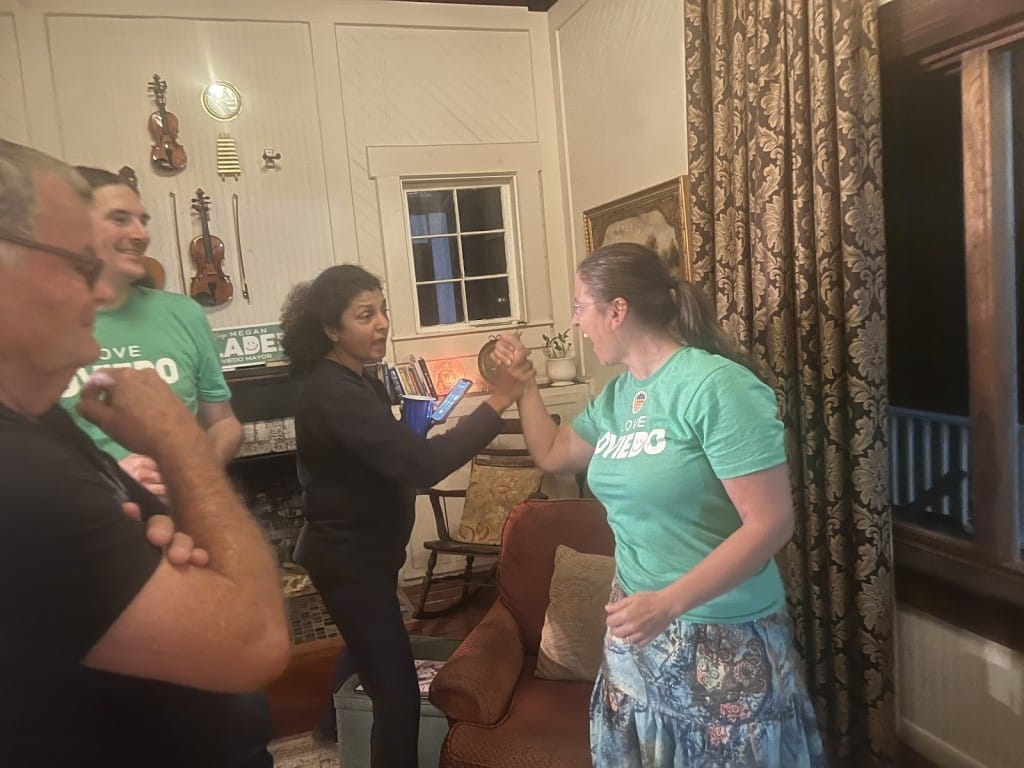
Oviedo Mayor Megan Sladek agreed, saying “Let’s get you all together and talk about what is a practical path forward.”
A phased approach could be on the table, such as building a similar-sized building to the current one to start, and adding over time, or retrofitting the current one. Additionally, Britton said, a more definitive design plan and detailed estimate could help lower the cost.
While the police station referendum asked for the additional funds, a full engineering and design report, which Coleman said would have cost $3 million, was not done.
“We didn’t want to spend $3 million until we were sure people were willing to vote for a building,” he said. “In retrospect, we saved the city $3 million.”
While a brand-new 47,000-square-foot complex may be out of reach, Coleman said he is open to all options.
“Let’s figure out another way, and another way may be something totally different,” he said.
For Sladek at least, the idea of reconsidering where the station would be located is enticing.
Sladek has been an advocate of considering a relocation to a space at the Oviedo Mall, which is seeing new housing developments in the works throughout the property.
The mall plan would be a $9 million purchase that would include 4.5 acres of land, the closed Sears department store building and Sears automotive building.
The city would have the option to renovate the existing buildings or demolish them and build a new station.
“I think it was not a wise move for us not to run the math on the mall because people needed to know before they approved a big number that a smaller number truly was not possible,” Sladek said. “Even if it’s not sensible [to renovate the buildings], I still think it makes sense to move the entire location of City Hall to a more compact campus.
“I think it’s a way bigger conversation than just what do we do with the police [station],” she said. “It’s what makes sense for the overall needs of this city for the next two decades.”

Others on the City Council, however, are not in agreement on utilizing the mall as a new location.
“I’m not necessarily interested in the mall,” Britton said. “I don’t want to bail out the mall. They’re asking a lot of money for that and I’m not sure it’s cost effective.”
While $9 million for the land and buildings is a more reasonable price tag than the referendum number, it may not be what it seems at the surface.
“I know a lot of people floated that it’d be cheaper,” Teuchert said. “It’d be more expensive. … The problem with that is we would essentially have to knock down the Sears building and start from scratch. So that’s building the same police department that we already looked at plus $9 million we have to pay for the land.”
Aside from the potential high cost, Coleman said the mall location has a number of other hurdles, including lack of parking spaces in the direct vicinity, not enough outside storage and lack of secure entrances and exits.
One thing city officials agree on is the reason for the failed vote: the price tag.
“I think cost scared people away,” Britton said. “Although if we wait any longer, the cost may go up. So it’s just shortsightedness, in my opinion.
“I didn’t see a lot of support coming out of the mayor.”
Sladek, who voted against the referendum, said she was undecided until hearing from voters at a forum just before the election.
“I was neutral the whole time,” she said. “One of my colleagues, at least — possibly more — think that I single-handedly tanked the whole thing, which is just an absolutely ridiculous suggestion. I voted on the very last day on purpose.
“People just want it to be something more modest,” she said. “It was perceived by many as a Taj Mahal request.”
The current state of the economy may have been on voters’ minds at the ballot box as they cast their votes.
“Costs are high right now. Inflation’s high. People are struggling,” Teuchert said. “It was a big ask, and we know that there [weren’t] five out of five people [on City Council] who supported it. So that’s a problem, as well, as far as having it unified.”
Sladek, Britton and Teuchert all said they understand the urgency of the discussions and hope to start working on alternatives early in 2024.
“This is not a small thing, but I personally would love us to have a plan and decision going forward into next year’s election,” Teuchert said.
And while the police station referendum failed, it doesn’t mean the possibility of a new station has.
“The need is still here. This was not just a want, this was a need,” Coleman said. “I’m still hopeful we’re going to come away in the future with something as good or better than what we were hoping for.”
Sorry for the interruption but please take 1 minute to read this. The news depends on it.
Did you know each article on Oviedo Community News takes anywhere from 10-15 hours to produce and edit and costs between $325 and $600? Your support makes it possible.
We believe that access to local news is a right, not a privilege, which is why our journalism is free for everyone. But we rely on readers like you to keep this work going. Your contribution keeps us independent and dedicated to our community.
If you believe in the value of local journalism, please make a tax-deductible contribution today or choose a monthly gift to help us plan for the future.
Thank you for supporting Oviedo Community News!
With gratitude,
Megan Stokes, OCN editor-in-chief
Thank you for reading! Before you go...
We are interested about hearing news in our community! Let us know what's happening!
Share a story!