CLARIFICATION: An earlier version of this story did not clearly differentiate the individual stormwater fee as a component of the water and sewer bill. That is now shown via two graphs below.
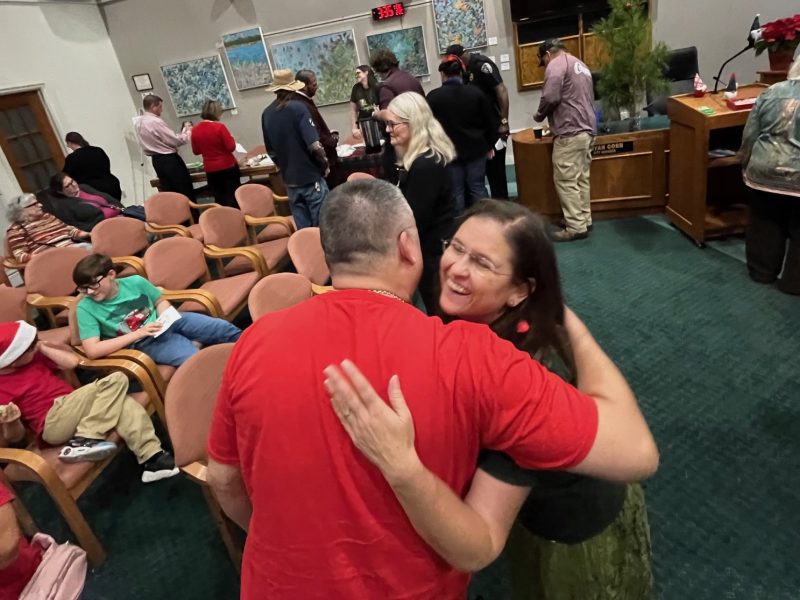
In an unusually packed room for a work session, where the Oviedo City Council usually talks over issues weeks before deciding them, the Council did just that Monday night, but surrounded by residents who were able to weigh in during a public comment portion of the meeting. The twist: many who spoke endorsed the idea of a property tax increase, and some also supported a large hike in water rates to pay for an upgrade to the system.
“As citizens, if we believe that quality of life is important then by all means we have to fund it,” resident Fred Larson said during the public comment portion of the meeting.
Council proposes raising millage rate
With city budget season in full swing as finance departments work toward a deadline in September, the Council found itself grappling with an unusual request in recent years: raising the millage rate. That’s the rate that forms a partial component of property owners’ total property taxes. The millage rate is the tax rate where one mill equals one dollar assessed for every $1,000 in taxable property value. For fiscal year 2023-2024, the operating millage rate was set at 5.34 mills. The proposed new rate is 5.954, or $1,786.20 for a home with $300,000 in taxable value. That increase would help set the city up to handle current and future issues, Oviedo City Manager Bryan Cobb said.
“We’ve had challenges this year that we haven’t seen in quite a while,” he said.

Finance Director Jerry Boop laid out one of the city’s biggest challenges: the number of homes in the city that qualify for the Save Our Homes Assessment Limitation and other tax exemptions. Since 2012 that number has continued to rise and even accelerate. The value of the total homestead exemptions in the city has increased by 97% since 2019, Boop said. The exemptions that added up to $2 million in 2012 are now costing the city more than $15 million.
Currently exempted homes account for 39% of the city’s tax base, Boop said. That doesn’t mean those homeowners don’t pay taxes, but that they’re capped at a maximum of 3% property tax increase per year for homesteaded residents under the Save Our Homes exemption. But with inflation exceeding 3% from 2021-2023, the city fell behind even more.
Meanwhile, city expenses have gone up as costs for everything from insurance to wages to healthcare have increased, he said. That, combined with other factors, has created a gap that city finance staff said they see increasing quickly in the next three years if the city doesn’t address it.
Another significant factor is the expected increase in the city’s payroll to cover its pension fund. For the fire department, that pension funding, as a percentage of payroll, is expected to double to more than 27% by the 2024-2025 budget cycle compared to the 2022-2023 budget.
The city is also in negotiations with the police and fire departments regarding pay and benefits, with expectations that both will require a bigger chunk of the budget.
“We’ve got to have a competitive wage structure for these folks in order to retain them and recruit them,” Deputy Mayor Jeff Boddiford said.
But not all residents were in favor of the city raising the millage.
“I feel like the growth of Oviedo is the cause of us needing this, then why aren’t we hitting up the developers to take care of these bills?” resident Edward Bonelli said. “I’m not the smartest person in the room but there’s got to be a better way.”
After seemingly being in agreement that the proposed millage increase should go forward to a second work session in August and then to two Council meetings in September, the Council voted 4-1 to proceed, with Sladek dissenting.
First big decision for water system overhaul
After bringing in the financial services firm Willdan to analyze how the city could help pay for a water system overhaul, the Council faced two options Monday: More than double rates overnight so that the city could pay for the system as it was modified, or take out loans that spread out the cost long-term.
The water system overhaul would involve modifying the current system to have deeper wells capable of extracting water from deeper in the aquifer. As water levels in the state’s Floridan aquifer fall, other cities will need to do the same.
“It’s not something that’s Oviedo specific,” Councilman Bob Pollack said. “This is a statewide issue.”
And Oviedo has been battling its water usage, near the allowable limit, though its below most cities in the county.
But unlike some other cities, Oviedo will be able to save time and money accessing that water in the lower aquifer.
“The good news is our water plant, we can convert it,” Cobb said. “We don’t have to tear it down and rebuild it. We can just convert it. When we built this water plant it was ahead of its time.”
The conversion process would also add extra filtration systems due to the lower quality of the water in the lower aquifer.
The question for the Council was whether to finance the system or pay as they go.
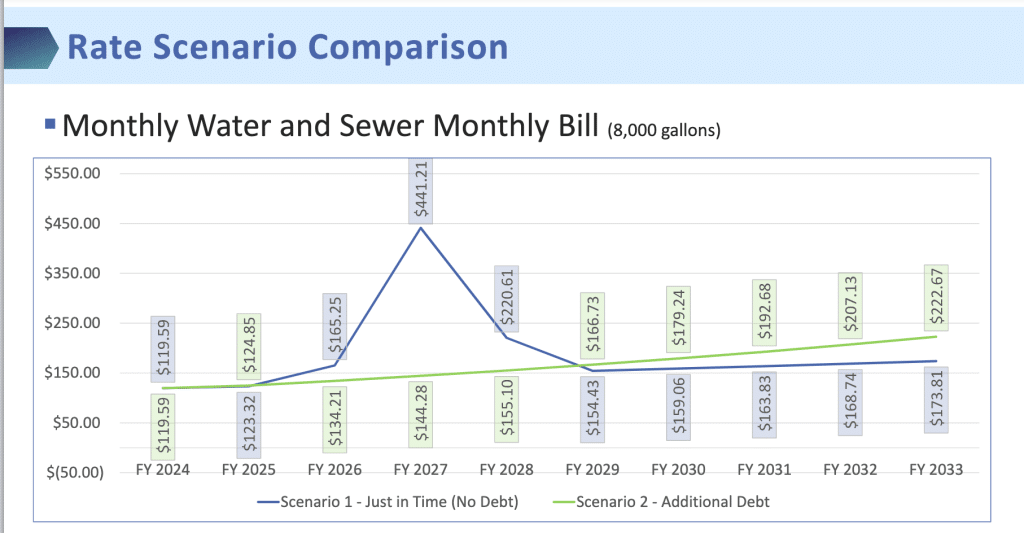
“To meet your requirements while doing pay as you go, it would require an almost 128% rate increase,” Willdan consultant Tara Hollis said.
That initial hit would happen abruptly before a more gradual rise in fees afterward. If the city didn’t take on any debt to fund capital projects, the cost per resident for stormwater service would rise from the current $11.49 per month, to $26.19 for 2025, then another jump to $30.30 the next year, then 2% increases from then on out.
“A lot of people are not as afraid of a $26 a month bill as I anticipated,” Mayor Megan Sladek said.
This isn’t the first time Oviedo has raised its stormwater rates in recent years, though previously it was a significantly lower figure.
If the city took the route of borrowing nearly $10 million to fund the project, the stormwater rate would still increase, but not as quickly, rising to $13.79 in 2025, then $16.55 in 2026, and $19.03 in 2027. But the lower initial increases would eventually give way to higher stormwater rates for the financed plan in 2033 and beyond.

Pollack, an accountant by trade, said that the financed plan made more sense than the big jump in fees early on to pay off the plant more quickly.
“The individual citizens pay all this money up front but they don’t get that value back if they leave,” Pollack said. “That’s why you use the debt to levelize these rates, so that you don’t have a 120-something percent rate impact in your first year. I think this is a much more fair approach to residents.”
That’s the plan the Council told Cobb to look into. He said he’ll have the city analyze more in-depth how the plan would work and then talk to the Council.
Public Works Director Bobby Wyatt said that the plant upgrade is in the design phase and will go into the bidding phase in September, if not sooner.
Sorry for the interruption but please take 1 minute to read this. The news depends on it.
Did you know each article on Oviedo Community News takes anywhere from 10-15 hours to produce and edit and costs between $325 and $600? Your support makes it possible.
We believe that access to local news is a right, not a privilege, which is why our journalism is free for everyone. But we rely on readers like you to keep this work going. Your contribution keeps us independent and dedicated to our community.
If you believe in the value of local journalism, please make a tax-deductible contribution today or choose a monthly gift to help us plan for the future.
Thank you for supporting Oviedo Community News!
With gratitude,
Megan Stokes, OCN editor-in-chief
Thank you for reading! Before you go...
We are interested about hearing news in our community! Let us know what's happening!
Share a story!