Seminole County was already set to give the go-ahead for its portion of funding for the Lynx transportation system for the 2025 fiscal year Tuesday when the accusations began flying about hidden problems.
“We don’t want to have to walk into a room kicking and screaming,” Seminole County Commissioner Andria Herr said, addressing failures she said Lynx had made to update the county and Lynx’s own board on the ridership issues with several of its routes, possibly for up to a decade.
“Unless we ask a very specific question it’s very difficult for us to get information from you all,” Commissioner Bob Dallari said.
“I sit here rather embarrassed, having sat on your board for a year thinking that this work [to identify under-performing routes and other issues and find solutions] was actively being done by Lynx on our behalf and finding out that it wasn’t,” Herr said.
Tuesday the Commission had just sat through a half-hour presentation by Lynx officials outlining a slew of options for how the transportation organization could move forward with plans to revamp routes and types of service when the Commission began questioning why it hadn’t already been done.
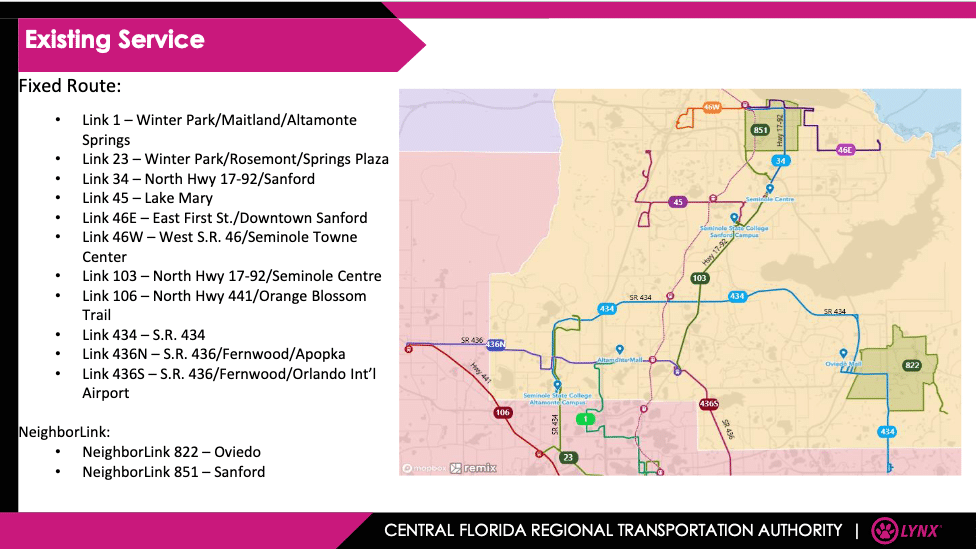
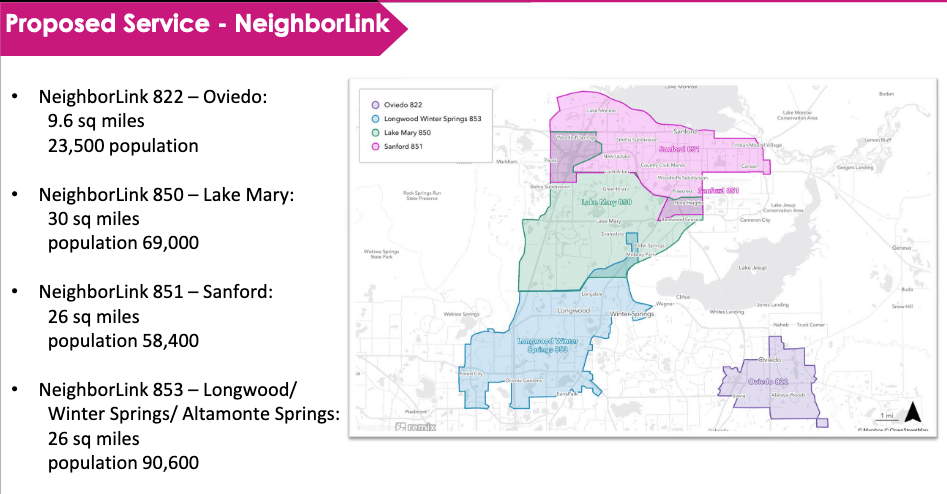
Currently the service operates 11 fixed bus routes, two Neighborlink on-demand micro-transit zones (one of which serves Oviedo) and varied Access Lynx paratransit services, according to new Lynx interim planning director James Boyle.
But that could soon change, as Boyle said Lynx is looking to save the county money, though Lynx has already suffered through funding issues for years.
That’s a problem, Boyle said, because of the role Lynx plays in funneling service industry workers from Seminole County and into the tourism and attractions areas.
“It helps keep that regional economy going,” he said.

Ominous numbers force a rethink
As of the fiscal year 2025 budget, Lynx is expecting to have a $208.1 million total budget and $77.8 million in revenues from riders. The gap between those two numbers is made up with money paid by Orange County, Orlando, Seminole County and Osceola County. Seminole County’s portion of that bill is roughly $14 million the coming year. That current approximately $130 million gap, shared by Orlando and the three counties, is expected to rise continuously to $170 million by 2030. Commissioner Amy Lockhart and others had already balked at proposed cost increases back in June.
Lynx Chief Financial Officer Leonard Antmann said that the system lacks a dedicated funding source, resulting in funding and operating cost issues, but hasn’t raised ticket fees since 2009.
That will change as Lynx officials try to revamp the system, including a potential big change that could result in a more targeted Neighborlink micro-transit system that is on-demand for riders rather than relying on scheduled bus routes. That system uses vans and vehicles much smaller than Lynx buses to pick up passengers on request.
“One of our big goals for the project was to expand transit to make it more accessible to more people in Seminole County, but also to reduce cost,” Boyle said.
That includes the potential to merge several bus routes in the county, discontinue routes in Lake Mary and Sanford, replace them with Neighborlink on-demand zones, and possibly fully outsourcing Lynx’s customer software.
A more ambitious idea
A proposal by Seminole County Budget Director Tim Jecks would attempt to adopt a style of transportation like that used in Arlington, Texas. That city, according to Jecks, was the largest in the country that did not have a mass-transit system before it adopted a Neighborlink-style on-demand system, but for an entire city. They use not just a handful of vehicles but 75 of them in a 100-square-mile area. That ambitious plan would potentially centralize a large Neighborlink zone in the densest part of Seminole County between I-4 to the west and State Road 417 on the east, stretching north to Lake Monroe and south to the border with Orange County.
“Arlington did it as a single zone for the entire city,” Jecks said. The cost per trip per passenger ranged from $3 to $5 depending on distance, and included free fares for students and some other types of passengers.
Another part of the attempt to reduce the cost burden to the county also may include finding ways to increase ridership and therefore fare revenue. Dallari questioned Lynx officials about whether more advertising could work.
Boyle said the system’s goal is an average of at least 15 riders riding per fixed bus route at any given time. Seminole County’s average for all routes is below 12.
“Three quarters of our routes are below Lynx standards,” Herr said.
That may be because of speed issues, Boyle said. If riders have to wait 60 minutes for a bus, they might not ride at all, he said.
According to the federal government’s American Community Survey data, as of 2020, of the top 30 metro areas in America, metro Orlando’s mass transit system had the second worst time difference in transporting commuters compared to cars, more than doubling commute times on average.
But some commissioners pushed back against the idea of replacing bus routes with more Neighborlink zones, particularly Chairman Jay Zembower, who said it wasn’t suitable for the more sprawling county.
“This is not efficient for Seminole County,” Zembower said. “This type of transportation belongs in a core city center, not in the entire MSA of Orlando.”
Zembower said he’d already spoken with officials from other transportation companies, including Freebee, which services Kissimmee. He said he was interested in the county staff’s recommendation that the county seek other potentially more cost-effective bidders.
A resolution and a plan
Whatever the result of that process, Commissioner Lee Constantine said he hoped that the system would continue to serve the area regionally and connect workers to where they needed to go and not leave people stranded.
“We cannot rise without all of us rising,” he said. “With any system that we get to, protect the least of us. That’s what government is about, is to protect the least of us.”
Boyle agreed.
“There might not be a million people using Lynx in Seminole County,” Boyle said. “But for those folks who do use Lynx, it is their lifeline.”
The Commission approved their funding agreement for Fiscal Year 2025, and directed staff to create a request for proposals to transportation companies, including Lynx, to potentially provide a Neighborlink-style on-demand transportation system in a broader area in Seminole County. That will be brought back at a Commission meeting expected in December for review before being advertised for bids.
Sorry for the interruption but please take 1 minute to read this. The news depends on it.
Did you know each article on Oviedo Community News takes anywhere from 10-15 hours to produce and edit and costs between $325 and $600? Your support makes it possible.
We believe that access to local news is a right, not a privilege, which is why our journalism is free for everyone. But we rely on readers like you to keep this work going. Your contribution keeps us independent and dedicated to our community.
If you believe in the value of local journalism, please make a tax-deductible contribution today or choose a monthly gift to help us plan for the future.
Thank you for supporting Oviedo Community News!
With gratitude,
Megan Stokes, OCN editor-in-chief
Thank you for reading! Before you go...
We are interested about hearing news in our community! Let us know what's happening!
Share a story!