After almost a decade of work and adversity, the Historic Oviedo Colored Schools Museum is about to take a big step forward toward opening its doors.
On Wednesday, March 5, the Seminole County Planning and Zoning Commission will hold a future land use public hearing for the property to allow it to be rezoned to a planned development and move forward in its construction. If the vote succeeds in the hearing, the Planning and Zoning Commission will make a recommendation to the Board of County Commissioners for a final vote, which is expected to be held sometime in April.
The public hearing is a long time coming for HOCSM Board of Directors President Judith Dolores Smith and the museum.
Smith began working on the project in 2018 and, despite encountering some speed bumps along the way — including the COVID-19 pandemic, which led to delays due to scheduling availability — has persevered and expects to open the museum to the public sometime in 2026.

A look at the planned interior of the Historic Oviedo Colored Schools Museum (Rendering by Richard Thomas Reep Architect)
”When we first approached Seminole County about renovating the building, we thought we could be grandfathered in and renovated as a church and get all our permits and everything,” Smith said. “But they said, because it had not been used as a church for more than six months prior to us coming in, that we couldn’t do that. We had to start all over and we had to rezone.”

Proposed layout of the exterior area of the Historic Oviedo Colored Schools Museum (Rendering provided by HOCSM)
The building, located at 2170 James Drive in Oviedo, is the former Gabriella Colored School, an elementary school that closed in 1951, and Historic Jamestown AME Church, but was last used as a church around 2014.
Once the museum passes the rezoning phase, it can move on to the design and layout, which is being done by Richard Thomas Reep Architect, a firm that has taken on similar historic preservation projects previously and began working with Smith in 2022.
”Her vision at the time was to reopen it,” he said. “It’s always been a church, so to be able to hold services. She was hoping that it could be a school, but more geared toward adult education and then become a museum and somehow be able to share the story of all the colored schools in the area that existed at that time.
”As an architect, I want to restore it as true as possible to its character [to] a certain point in time, and what we chose that point was to be at 1950, which was kind of the last year it served as a school,” he said.
While Reep and Smith had difficulty finding the original building documentation, he said “the building itself is actually constructed really, really well. I mean, it’s very, very beautiful craftsmanship for it, which is a testimony to the reason it’s withstood the test of time.”
In addition to historical items, such as photographs, documents, records and newspaper articles, the museum will have an interactive digital display that will include oral histories, maps and video presentations visitors can learn through. It is also planning potential walking tours of Jamestown, a log bridge, a garden with fruit trees, donor and memory walls, and other features.
The first walking tour of Jamestown is expected to take place on April 5.

The planned walking tour map (Map provided by HOCSM)
”You will have an experience on multiple sensations,” Reep said. “You’re seeing things, you’re hopefully feeling things — like the log bridge. You’re hearing things. So it’s hitting you in a lot of different ways.”
While the project is moving along, it has seen major hurdles, including one that led to outcry from the community.
On the weekend before the Martin Luther King, Jr. Day holiday, passersby saw racist speech and images spray painted across the outer walls of the building facing the street.
And as it shook the community, and the Seminole County Sheriff Department says they “are actively following leads and continuing to gather evidence,” Smith has not let it deter her from her goal of opening the museum.
“It took a lot of thought for somebody to do that,” she said. “That’s as far as I’ll go in terms of even thinking about it.
”I don’t want to let it get me to the point where I’m ruminating on it so much that I’m off target and I’m not moving forward with the project, so I’ll let the police … do their investigation and we’ll see.”
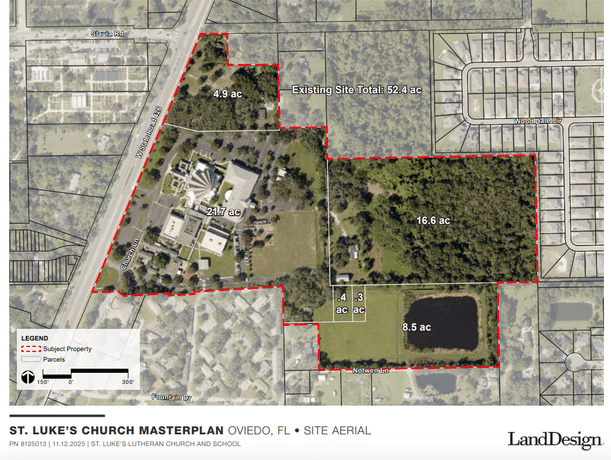
To reach the public hearing and rezoning phase, Smith had to surpass a number of benchmarks from the county, including landscaping, Americans with Disabilities Act (ADA) compliance and parking availability. While there is not currently a parking lot at the location, Smith worked with the nearby St. Luke’s Lutheran Church to allow for parking for visitors. St. Luke’s is about 1.3 miles from the building but Smith said “the law, it does not state a distance [required for parking], just that we have to have a written parking agreement”.
“If we were operating as a church, the church would be allowed to park on the street,” she said. “We aren’t allowed to do that, so we had to find someone who would give us a written parking agreement that would allow for at least six parking spaces.”
Because they will be using St. Luke’s parking, the museum will plan to be open from Monday through Saturday, since the church will have services on Sundays. Smith is speaking with locations closer to the museum to allow visitors to park as well.
To achieve opening status, Smith estimates that it will cost more than $300,000 and, while the project has received a number of grants, including a $228,000 African-American Cultural and Historical grant, money is still needed.
“This has been a long, tedious process, and I know sometimes people may not see you have a vision, and other people don’t see your vision until it comes to fruition, and then they’ll pay attention to it,” Smith said. “My desire is that people will see that … we’ve been working on this to preserve the history, and it’s hard work. I would hope that the community will see that we’re doing something that benefits everyone.
“It would be nice if people came out physically [to the public hearing], but, just being honest, in order to bring it to fruition, it takes funds,” she said. “You know what support is? Donations.”
Sorry for the interruption but please take 1 minute to read this. The news depends on it.
Did you know each article on Oviedo Community News takes anywhere from 10-15 hours to produce and edit and costs between $325 and $600? Your support makes it possible.
We believe that access to local news is a right, not a privilege, which is why our journalism is free for everyone. But we rely on readers like you to keep this work going. Your contribution keeps us independent and dedicated to our community.
If you believe in the value of local journalism, please make a tax-deductible contribution today or choose a monthly gift to help us plan for the future.
Thank you for supporting Oviedo Community News!
With gratitude,
Megan Stokes, OCN editor-in-chief
Thank you for reading! Before you go...
We are interested about hearing news in our community! Let us know what's happening!
Share a story!