Seminole County Commissioners made a surprise vote Tuesday afternoon to end fluoridation of the county’s water system, countering the pleas of pediatric dentists and doctors who had moments earlier explained the dangers of removing fluoride from the water supply.
The unusually timed vote came unexpectedly during an informational report by Seminole County Utilities Director Johnny Edwards.
Minutes before the vote, Dr. Johnny Johnson, a pediatric dentist representing the Florida Academy of Pediatric Dentistry, had explained the process by which fluoride, regularly ingested in small amounts by children through drinking water, helps create fluorapatite crystals in developing teeth, strengthening them and making them “much more resistant to cavities.”
“It gets into those developing permanent teeth and makes them form stronger,” Johnson said. “You can never get that once the teeth come in.”
Commissioner Bob Dallari, who spoke in favor of ending the county’s water fluoridation program, said it’s already being supplemented in products, such as toothpaste and mouthwash, available to the public.
“With all the additional products being put out there with fluoride, I don’t know why we’re continuing to do this,” Dallari said.
According to the Harvard School of Public Health, fluoride in water and food is “mostly absorbed in the gut,” rather than the mouth. After it is absorbed in the gut it is then transported and stored in bones and teeth.
Johnson, who said he grew up in the 1950s in a time that predated water fluoridation, but has since regularly used fluoride as an adult, said “I have a mouth full of crowns and root canals. My children have almost nothing.”
Many residents at the meeting disagreed that it was necessary to have fluoride in drinking water.
“It’s not an essential nutrient,” resident Robin Jonas of Sanford, who spoke during public comment, said. “Our kids do not have to get it through our drinking water.”
Much of the crowd appeared to be against municipal water fluoridation, an issue that saw little recent discussion locally until the rise of Robert F. Kennedy, Jr. as the potential nominee, later confirmed, for secretary of the U.S. Department of Health and Human Services in February. Kennedy had spoken about fears of fluoride’s impacts on IQ.
Edwards, in researching fluoride and its benefits and potential downsides before giving his report to the Commission, said that he had tried to refer to the Centers for Disease Control for more information but said, “I believe their oral health division has been eliminated.”
Kennedy had previously pointed to a Jan. 6, 2025 Journal of the American Medical Association analysis of 74 studies, more than 50 of which were considered “high-risk-of-bias,” that indicated that, compared to lower levels of fluoride in drinking water, higher levels of fluoride, at levels measured between three and six times higher than the U.S. national standard, were associated with a drop in IQ.
None of those studies measured the effects of fluoride at levels such as the 0.52-0.7 ml/L of fluoride found in water in Seminole County and Oviedo. Seminole County has fluoridated its water since 1988, and Oviedo since 1995. In some parts of the world, such as parts of Australia, fluoride naturally occurs in ground water at levels of 0.7-1.0 ml/L, which is also far below the level of fluoride studied in any of the 74 studies analyzed by the JAMA.
Only 7 of the 74 studies in the JAMA analysis assessed children whose water contained less than 1.5 mg/L of fluoride. Those studies found there was no relationship between fluoride exposure and IQ.
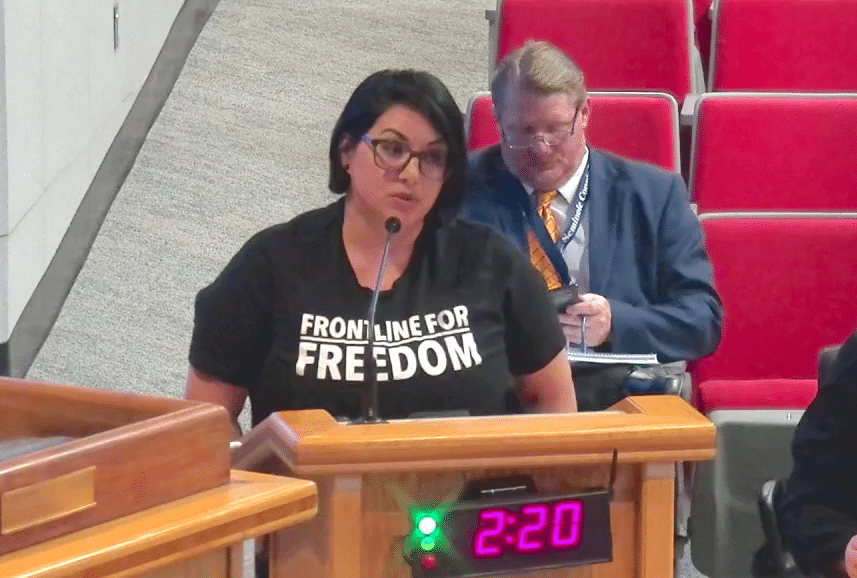
During public comment on the issue, Nicole King, a nurse from Sorrento wearing a black “Frontline for Freedom” shirt, said that water fluoridation, which had in many areas in Florida, including Oviedo, been approved by a citizen vote, was being done without residents’ consent. She referred to fluoride as “a toxin.”
What renders something toxic is a matter of dosage, though, according to public health experts. “For example, chemicals that are helpful at low doses can be used as medicines, but at higher doses can be harmful,” reads a statement on toxicology from the Virginia Department of health.
Commissioner Andria Herr, who did not refer to what information she was using to make her decision, said she was more concerned with effects on “children’s IQ and vital organs” than she was in tooth decay.
After one hour the Commission declined to hear further discussion from the community, with Commissioner Lee Constantine dissenting.
“I think it’s rude of us here not to hear from everybody,” he said.
“You could speak for 3 more hours,” Herr said. “You’re probably not going to change my mind.”
Commission Chairman Jay Zembower said that he expects the national recommendation for maximum fluoride dosing level to continue to fall over time, though he did not say what data that was based on.
“I pride myself on doing as much research as I possibly can,” Zembower said. “I put this in the category of evolving science.”
In her closing statement immediately before the vote, Commissioner Amy Lockhart said that she didn’t want to hear information from doctors from outside of Seminole County, saying she wanted to represent “the people of Seminole County” which received heavy applause from the crowd.
Herr then motioned to vote to end the county’s water fluoridation program. Lockhart seconded it.
“I can see the benefits of fluoridation in our systems that we’ve had,” Constantine said in a final plea before the vote. “I’ve heard anecdotal evidence, and I’ve heard dentists who teach at the University of Florida … who’ve come and said the benefits of it. I’ve heard the FDA strongly endorse fluoridation. I’ve seen the chapter of the American Academy of Pediatric Medicine strongly endorse fluoridation.
“I will go with science before I go with anecdotal evidence.”
The vote to end water fluoridation passed 4-1, with Constantine dissenting.
Sorry for the interruption but please take 1 minute to read this. The news depends on it.
Did you know each article on Oviedo Community News takes anywhere from 10-15 hours to produce and edit and costs between $325 and $600? Your support makes it possible.
We believe that access to local news is a right, not a privilege, which is why our journalism is free for everyone. But we rely on readers like you to keep this work going. Your contribution keeps us independent and dedicated to our community.
If you believe in the value of local journalism, please make a tax-deductible contribution today or choose a monthly gift to help us plan for the future.
Thank you for supporting Oviedo Community News!
With gratitude,
Megan Stokes, OCN editor-in-chief
Thank you for reading! Before you go...
We are interested about hearing news in our community! Let us know what's happening!
Share a story!