
Major funding source missing from 2025-26 Oviedo budget
Minus ARPA funding, Oviedo Mayor Megan Sladek fears for budgets in the future for maintenance and repairs.
As the city of Oviedo works to finalize its fiscal year 2025-26 budget, there will be a sizable line item missing: funds from the American Rescue Plan Act.
Beginning in October 2021, Oviedo received a total of $21 million in ARPA funds, following its March 2021 signing by President Joe Biden. A requirement for those funds, however, was that they needed to be obligated by Dec. 31, 2024, meaning they can no longer be used for projects they have not been allocated for, eliminating them from the upcoming budget. The funds that have been allocated but not yet spent will need to be spent by December 2026.
“Before ARPA came in, I think a lot of cities were not in a good place as far as backed-up maintenance, backed up infrastructure that they didn’t have the budget for, and ARPA really came in and saved the day,” Oviedo Council member Natalie Teuchert said. “We played catch-up with it.”
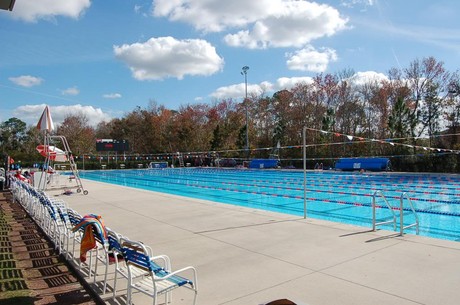
The city completed dozens of projects with the ARPA funds, including big-ticket items such as replacing the Big Kahuna pool liner at Oviedo Aquatic Center ($515,000), HVAC renewal and replacement throughout the city ($1.2 million) and the Boston Cemetery Road improvement ($498,000) and millions of dollars in stormwater and water utility projects. Smaller projects included playground shade and ground improvements, roof repairs and adding hands-free water fountains and faucets, among others. Additionally, about $2.2 million of ARPA funds will be used for the to-be-built public safety building annex and, due to how the city invested the funds before they were spent — with the State Board of Administration — nearly $1 million in additional interest was generated.
The process and plan was administered mainly by Assistant City Manager Patrick Kelly.
“He did an incredible job of identifying what the immediate needs were, and what the smartest spend was,” Oviedo Finance Director Jerry Boop said. “What ARPA enabled us to do was to get caught up on a lot of maintenance-type capital projects and things of that nature that needed to be taken care of around the city. And it created a great foundation for us to be able to move forward and hopefully stay abreast of a lot of the capital and facilities type maintenance and other things that are somewhat expensive in nature that we need to take care of going forward.”
Capital projects are large, long-term city improvements that often include infrastructure and facilities.
While the funds did help Oviedo tackle a number of large projects it otherwise would not have been able to undertake, especially without taking on debt, Mayor Megan Sladek said that they did not come without a cost.
“Basically, we got a free pass on having to figure out how to pay for the replacement of everything at the end of its first lifecycle, and what a little bit of manna from heaven that was,” she said. “Now we’re kind of getting a reset button, but also we are not attempting to save up in advance to have a plan for when the things we just put in with ARPA money [go] out all over again. Even if it has a 15-year lifespan, you have to start, at some point, thinking about ‘Do we want this thing to exist forever?’
“All of the roofs, all of the air conditioners, all of the capital things wear out, everything wears out. The sun shades, the pool liner,” Sladek said. “Had we not just been handed $22 million, we would’ve had everything just fall apart. There was no plan [before the ARPA funds became available]. We would’ve had to raise taxes [more than they have].”
Teuchert said that while the city will eventually need to pay for repairs, they most likely wouldn’t be a need at once because “even though they’re all being done within the same five-year period, it doesn’t mean they have the same life [span].”
Oviedo City Council did vote to adopt an 18% increase in property taxes for the 2024-25 budget in September.
While Sladek said she believes the only way to begin saving for eventual repairs or replacements of the large-scale fixes the city undertook with ARPA funds is to raise taxes again, she and Boop said they do not foresee one in at least the next fiscal year.
“I don’t know that there’s political will to do it because it takes sacrifice now to be prepared to pay the bill later, and nobody wants to make sacrifices now by collecting taxes and sitting on them and allow them to accrue interest so we don’t have to borrow money [in the future],” Sladek said.
Boop was even more direct about the city not planning to increase taxes in the next fiscal year.
”We’re not going to increase taxes,” he said, stating the only possible rate increase outside of the already scheduled stormwater and water utility rate increases would be for solid waste, which is currently being studied.
In recent years, the city has shifted to undertaking 15-year loans rather than 30-year loans, to keep the debt payoff timeline shorter, resulting in less interest owed, Sladek said.
The city will have about $48 million in debts in the upcoming budget.
Boop said that despite that number, the city is “in a very solid financial position,” though that does not take into account any impacts of laws passed by the state or federal governments in the future.
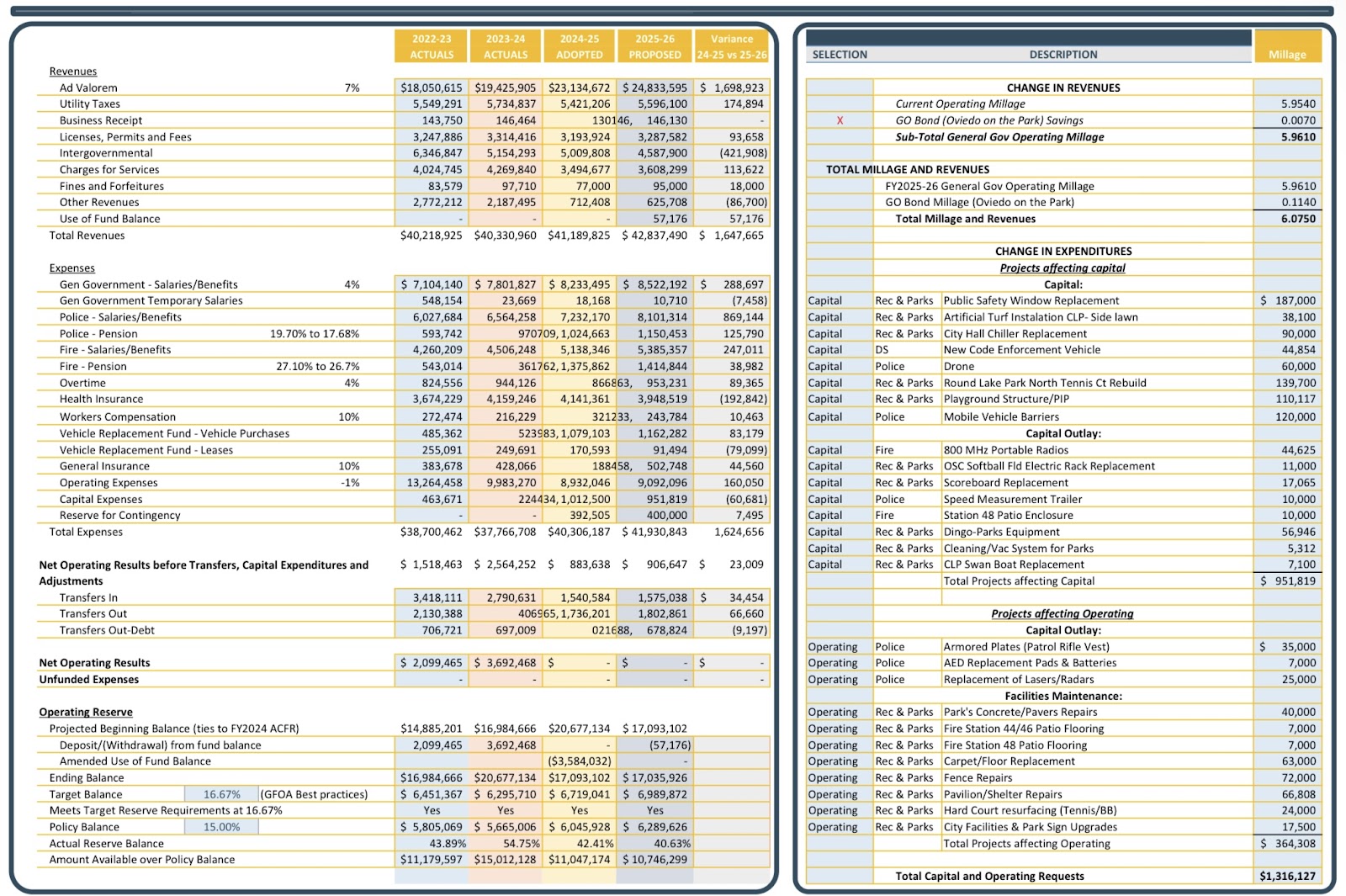
Oviedo’s proposed 2025-26 general fund budget
“There’s a concern about property taxes and things of that nature going forward,” he said. “There was a discussion, basically to get rid of property taxes or to impact them in some way, shape or form. So the state legislature seems to be constantly eroding [municipalities] and counties’ ability to acquire funds via property taxes like we have in the past.
“I would say that the immediate financial future outlook is positive, but I cannot forecast the impact of what the state legislature has the ability to do, or how the economy performs or anything climate-related,” he said. “We have adequate cash, adequate cash flows and adequate income to meet the immediate financial needs of the city.”
Oviedo’s proposed 2025-26 general fund budget includes $43 million in total revenue and $42 million in total expenses, with a projected $17 million in operating reserves, which is similar to the last three budgets.
“I think that the city is overall on a very solid financial footing,” Boop said. “I feel very confident in our ability to be able to take care of ourselves [without ARPA funding] at this point.”
Want to contact your elected leaders and weigh in on this topic? Find their contact information here. Have a news tip or opinion to share with OCN? Do that here.
Sorry for the interruption but please take 1 minute to read this. The news depends on it.
Did you know each article on Oviedo Community News takes anywhere from 10-15 hours to produce and edit and costs between $325 and $600? Your support makes it possible.
We believe that access to local news is a right, not a privilege, which is why our journalism is free for everyone. But we rely on readers like you to keep this work going. Your contribution keeps us independent and dedicated to our community.
If you believe in the value of local journalism, please make a tax-deductible contribution today or choose a monthly gift to help us plan for the future.
Thank you for supporting Oviedo Community News!
With gratitude,
Megan Stokes, OCN editor-in-chief
Thank you for reading! Before you go...
We are interested about hearing news in our community! Let us know what's happening!
Share a story!
Author

Related Articles
Oviedo accepts state grant for major road safety project
Mitchell Hammock Road in its traverse through the pastoral landscape of the Duda Sod farm will soon look significantly different.

Oviedo welcomes new art to enhance the city
Four new art projects are in the works to be placed around the city. Oviedo’s Public Arts Board uses local artists to encourage community through art.

Winter Springs election to be heavily contested as candidates line up
2026 Seminole County election season heats up: Two incumbent county commissioners draw opponents, Winter Springs seats draw new challengers.