
Max charge for Seminole County ‘micro-transit’: $15 one way – but rides to SunRail capped at $2
After Seminole County announced micro-transit rates, one rider says he may need to get a car now. ‘This is way too much’
SunRail riders would have some of the cheapest rates as the Seminole County Commission approved proposed rates for an Uber-like service that will replace much of the LYNX bus routes.
Starting Oct. 15, Scout, powered by Freebee, will launch in five different zones in Seminole County as a replacement for “non-productive” fixed-route LYNX bus routes in the county. And those catching a ride to a SunRail station would have fares capped at just $2.
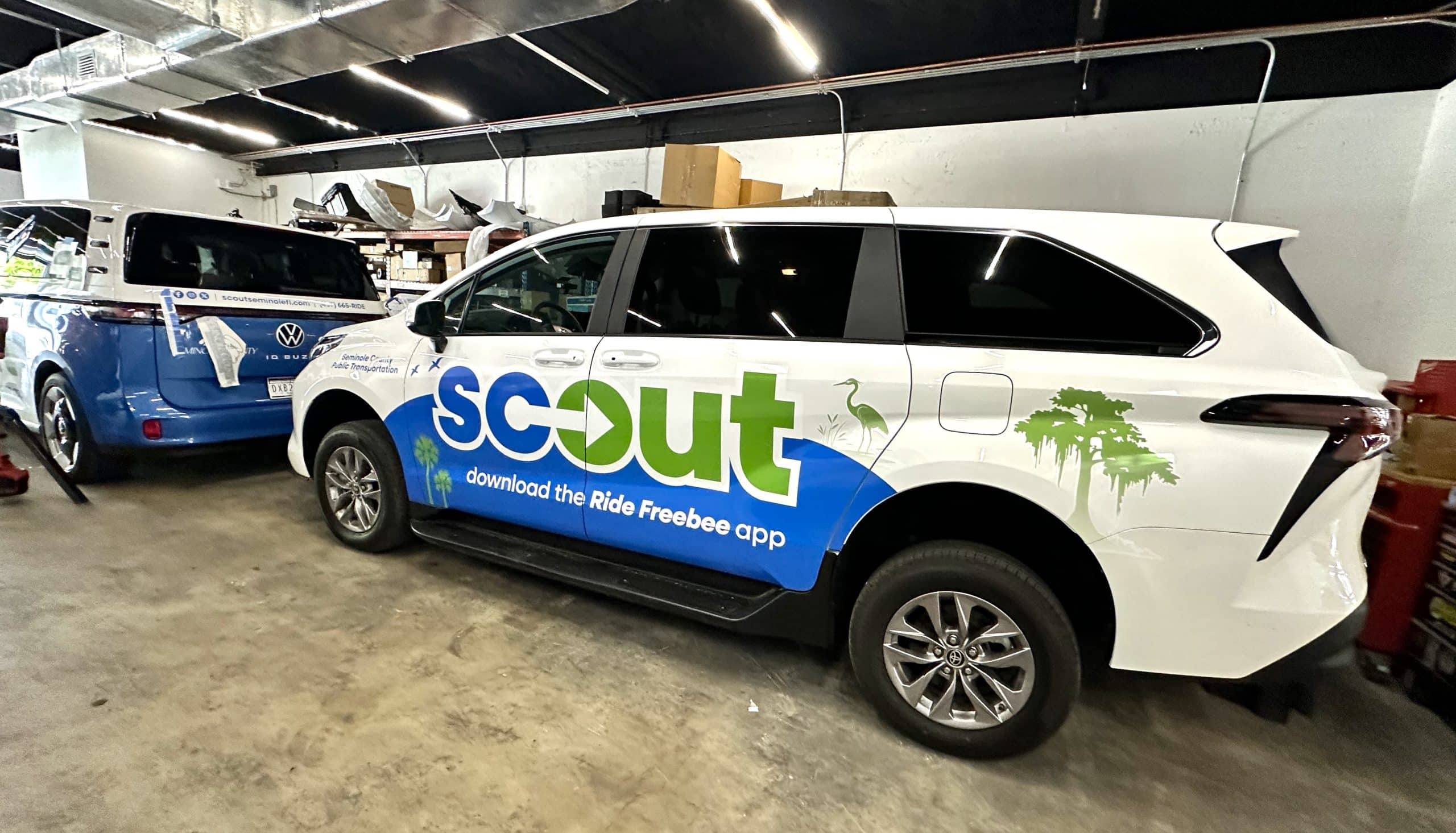
“I know we’re all excited about … opening the aspect of people getting to SunRail, the first and last mile,” said Seminole County Commissioner Bob Dallari. “And so this is going to be a huge asset for us when it comes to SunRail. And that’s another piece of this that’s exciting, where with LYNX, we couldn’t do that.”
In May, the county chose Freebee as its “micro-transit” vendor; the Seminole County service will officially be called Scout, powered by Freebee. The idea is that residents will be able to download the Ride Freebee app and, starting in October, book an Uber-like, on-demand ride that goes door-to-door, picking up other passengers along the way. (Check here to download the app for Android devices; check here to download the app for Apple)

The county will be split into five zones, and trips within a zone will have a base fare of $4. Crossing into a second zone would be an upcharge to $7, and it would cost $10 to go across a third zone. The max rate would be $14 to go anywhere in the county. There’s also a $1 surcharge if you’re taking a trip during rush hour in the morning or afternoon.
“We gave you the absolute most impossible needle to thread, and I think this does exactly what we wanted it to do,” Commissioner Amy Lochart said Tuesday. “We wanted this to serve those who need public transportation the most, to be able to navigate their daily lives and be able to afford to do it. And we also want to be able to not compete with our private sector partners.”
Lockhart said that Uber is in conversation with Freebee to become a backup service for Freebee as well.
Customers are broadly put into two categories: “Choice” riders, who are paying full price, versus “essential riders,” those who are reliant on public transportation to get around. The rates for “choice” customers, who don’t qualify for a discount, are relatively high, while the county approved multiple discounts for “essential” riders.
Students and seniors over 65 would get half off the fare. And there are two categories for low-income “essential” rider discounts; they would qualify for a 50% off rate, and the total fare would also have a maximum limit.

One discount would be for people eligible for housing assistance, which would be an income of $59,050 for an individual and $84,300 for a family of four; their total fare would be capped at $5.
And for people making twice the federal poverty rate, or $31,300 or less for an individual and $64,300 for a family of four would have their fares capped at $2.50. People with an existing Access Plus Card from LYNX and those with disabilities would have their fares capped at $1.
“We’re proposing a cashless system,” Kristian Swenson, the assistant county manager, said during Tuesday’s meeting. “We can have tickets available at places at county offices where we take money, such as parks and libraries and things like that. We can easily develop that system.”
So how will this impact riders? Brian Fields rides the LYNX bus five days a week from Metro West in Orange County to Longwood in Seminole County. With the proposed system, it would likely be cheapest for him to take a bus to the LYNX central station in downtown Orlando and hop on SunRail. Once in Seminole County, trips to and from SunRail stations during operating hours would be capped at $2.
Still, though, Fields would have to keep his existing LYNX bus pass at $50 for the Orange County part of his commute. He would also need to buy a monthly, two-county SunRail pass for $84. And then the last leg of his commute would be capped at $2 each way, or another $80 a month.
That means his monthly bill would go from $50 a month to $214.
“I would personally do it anyway,” Fields said. “If I need to spend the extra money, I will, unfortunately. It’s just not convenient.”
Fields said he works with a number of people who also live in Orange County and commute. Fields said Orange County has more seasonal, tourism-related jobs, while Seminole County seems to have better paying options.
He said the cost for the commute could ultimately push him toward buying a car.
“I don’t like monthly payments. It’s really trying to push me into a corner,” Fields said. “I feel like they’re making a wrong decision. I get they’re trying to save money. But their solution is gonna create more problems.”

Seminole County estimates that making the switch from LYNX to Freebee will save the county $2.2 million the first year, and then $2.7 million to $5.6 million in Fiscal Year 2027. The total savings depends on how popular the service is and how many cars get deployed, and could also change based on the rates set by the county. Per the contract, the county receives all of the proceeds from the fares and splits any advertising revenue.
Joanne Counelis is a Lake Mary resident who attends LYNX and SunRail meetings and asks for buses to run more frequently. One question that’s still being decided: What will happen to bus stops.
“I don’t want our bus stop ripped off,” Counelis said.
Seminole County Commission Chairman Jay Zembower said he’s worried that prices are actually too cheap, and that too many people will flood the service. The board is requesting frequent updates to make sure that people who need to use Scout are able to.
“My real fear is it’s gonna be so successful and so inexpensive that the typical people who aren’t using LYNX will want to use this instead,” Zembower said. “We’ve told staff it’s gotta be monitored very closely to make sure those needing transposition are given priority over everyone else.”
Every LYNX bus route in Seminole County will be cut, except for the following:
- State Road 436 North and South (Link 436S and Link 436N)
- U.S. 17-92 reduced, going from the Orange County line to the Fern Park Super Stop (Link 34 route)
- S.R. 434 reduced, from the Orange County line to connect to Link 436 (Link 23)
- U.S. 441 Orange Blossom Trail stop (Link 106).
Check here for a full map of LYNX routes. Want to contact your elected leaders and weigh in on this topic? Find their contact information here. Have a news tip or opinion to share with OCN? Do that here.
You can watch the meeting here. Check here for the county’s presentation on fares.
Sorry for the interruption but please take 1 minute to read this. The news depends on it.
Did you know each article on Oviedo Community News takes anywhere from 10-15 hours to produce and edit and costs between $325 and $600? Your support makes it possible.
We believe that access to local news is a right, not a privilege, which is why our journalism is free for everyone. But we rely on readers like you to keep this work going. Your contribution keeps us independent and dedicated to our community.
If you believe in the value of local journalism, please make a tax-deductible contribution today or choose a monthly gift to help us plan for the future.
Thank you for supporting Oviedo Community News!
With gratitude,
Megan Stokes, OCN editor-in-chief
Thank you for reading! Before you go...
We are interested about hearing news in our community! Let us know what's happening!
Share a story!
Author

Related Articles

After Oak Forest Lake fish kill, the question looms: Who pays for cleanup on private lakes?
Winter Springs meeting next week to hash out a new stormwater policy, expected to lead to increases in stormwater fees for residents.
Seminole County finalizes arts funding for 2026
Grant application windows open next week for arts organizations after Seminole County finalizes arts funding that was in doubt after commissioners questioned it.

Winter Springs approves $65.8M replacement to aging wastewater plant – cheaper than budgeted
After years of planning, the city moves forward to replace water facilities. Winter Springs also appoints new charter review committee members who could oversee major changes to the city.