
Oviedo City Council approves license plate reader lease
Councilman warns of ‘real Fourth-Amendment privacy issues’ while police chief says the readers have helped find missing people.
A controversial electronic device capable of reading and cataloging every license plate of cars driving past it was narrowly approved by the Oviedo City Council on Monday.
According to City Manager Bryan Cobb’s report, Automatic License Plate Readers (ALPR) are camera systems used to capture vehicle and license plate information that “can then be queried as an investigative tool in criminal investigations.”
That vehicle information can also be entered into the system and prompt an alert if an ALPR detects it, aiding law enforcement as a tool that “has proven to be effective in increasing the solvability of crimes, apprehension of criminals, and recovery of missing persons and stolen property.”
The resolution passed 3-2, with Mayor Megan Sladek and Council Member Alan Ott voting against.
“I do not believe that we have picked the locations for these readers, but they do provide us with valuable information regarding…arrest warrants,” Cobb said. “The chief was even telling me today about a missing person that we were able to locate, because it connects us into a greater network of other jurisdictions, and so it allows us to be able to tap into that.”
Cobb said the city had first intended to purchase the ALPRs but the vendor, Flock Group Inc., had changed its business model to a lease program. The total cost for the lease of the eight ALPRs for 60 months is $128,800.
Equipment implementation costs and the first two years of the lease will be covered through funds in the fiscal year 2024-25 budget.
The third year of the lease will be funded by the fiscal year 2027-28 general fund, while the lease’s final two years will be covered by federal forfeiture funds, which the city already received approval from the U.S. Department of Justice to use. According to the resolution, Flock Group was chosen in part due to its “good standing in the System for Award Management (SAM.gov) required for the use of federal forfeiture funds.”
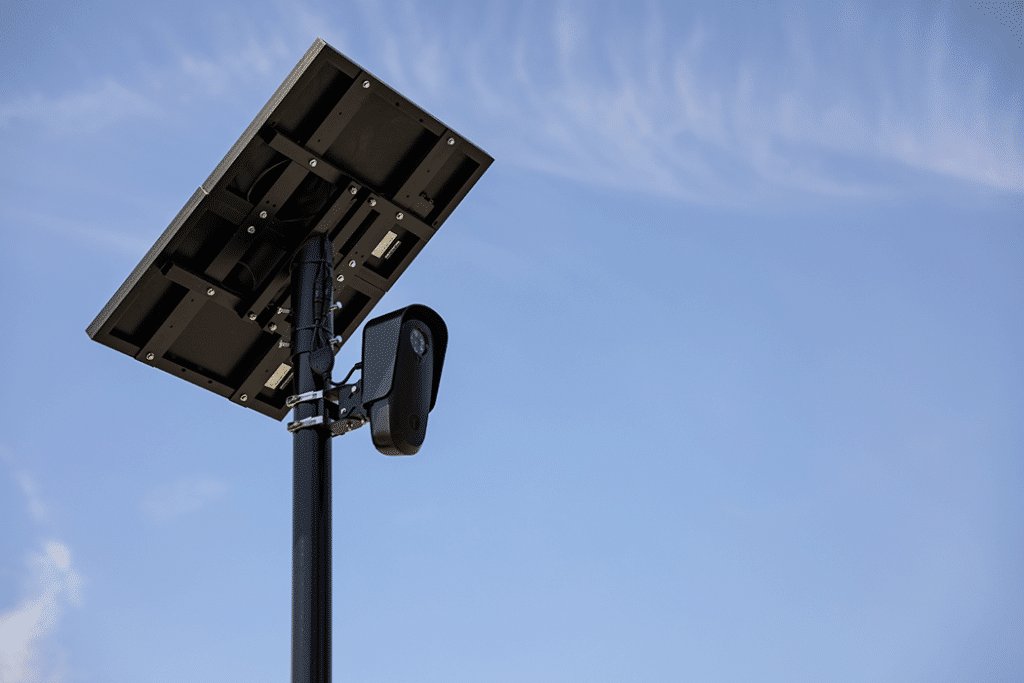
Ott began the discussion by acknowledging some of the “good” the equipment could be used for, such as making it easier for law enforcement to find missing persons or stolen vehicles.
But he also said some of the equipment’s “downsides” were in his opinion “real Fourth-Amendment privacy issues,” adding that the information collected would be put into government databases that could be searchable by other agencies besides the Oviedo Police Department.
“We’re talking about the county sheriff, we’re talking about state-level, FDLE, all the way up to the federal level, FBI, Marshal Service and ICE,” Ott said. “With the data in the database, that means there’s access to this data without having to go and get a warrant, right?”
Ott continued, saying while it wasn’t being currently proposed, it was “only a matter of time” before the equipment could potentially allow law enforcement to issue speeding tickets.
“That’s not something that’s currently done, but we’re setting up the ability to collect the data that could generate somebody’s speed over a particular route,” Ott said.
He added the city doesn’t have a standard operating procedure that could allow it to definitively say that couldn’t eventually happen, before concluding his argument came from the idea that people have rights, not the government.
“The government has responsibilities,” Ott said. “The government has powers, and those powers are delegated to the government by the consent of the governed. And up here on this dais we represent the government…in my opinion, we should not delegate these powers to the government.”
Oviedo Police Chief Dale Coleman then addressed Ott’s concerns.
“We set the parameters on what the license plate will trigger for an alert,” Coleman said. “For instance, a stolen car is a trigger. It has to be a criminal act before it’ll trigger for us to be notified. The data is stored for 90 days and it’s deleted because there’s no long-term need for this.”
The only time data would be held is during an active investigation, he said, but data would otherwise be deleted afterwards.
Council Member Keith Britton asked Coleman if his agency would have access to data-tracking apps for vehicles, such as the one his own vehicle uses.
“We do not have access,” Coleman said. “That would require a subpoena or a search warrant…It’d be weeks or maybe even months before we get the data back.”
In regards to the equipment’s installation throughout Oviedo, Council Member Jeff Boddiford said he assumed the request for specifically eight cameras would be so as to have one at each road that comes into the city.
Coleman said decisions for potential locations are still being finalized but that those installations would not take place on private property, only on public, state or county owned property.
The agency’s ALPR use policy drafted by Coleman is “straightforward,” he said, as it would have to “follow all the rules.”
“We confirm the tag before we do any action,” Coleman said. “Before we take any action on the tag … alerts that come out on the tag have to be a criminal offense. In other words, you can be arrested for it. So if your tag’s expired, it’s not going to tell us.”
That kind of information could be captured but no alerts would come from it, he added.
“We can’t sit there and put your tag in and say, ‘Let’s see how many times he comes in there,’” Coleman said. “There’s a set direction on what goes on the hot sheet, which is the tags that go in. They have to be wanted for a criminal act or missing person or something of the law enforcement nature, and doing something otherwise — well, [that officer] won’t work here anymore. I’ll just put it that way.”
He added there was also discussion of using a mobile ALPR to target areas within the city, with Oviedo on the Park as a given example, in cases where law enforcement might require aid in identifying vehicles related to criminal concerns.
“We have a lot of options on the table,” Coleman said. “This is just the presentation on the use of them. Where they go and all that, we haven’t finalized yet. But like I said, they are a force-multiplier by a large shot.”
“Just to be explicit, there are seven cities in Seminole County and six of them already have these deployed — we are the only ones who do not,” Ott asked, which Coleman confirmed.
Budget and millage rate passed
The night also saw the final public hearing and council approval of two resolutions adopting the city’s fiscal year 2025-26 annual budget and millage rate, beginning Oct. 1, 2025 and ending on Sept. 30, 2026.
Calling it a “culmination” of the Council’s work-sessions over the last three months, which “promoted open discussion of the issues facing the city,” Cobb said the new budget would maintain the service levels of the previous fiscal year’s budget.
“It funds the four-percent increase for general government employees, and also funds the increases for police and fire bargaining units per their collective bargaining agreements,” Cobb said. “…We’re also increasing a fire marshal position that is being reclassified to a firefighter position, so that we can account for a firefighter who is going on extended military leave.”
The newly adopted budget will also fund an internship within the city’s development services, the promotion of a police record specialty position from part-time to full-time, and new maintenance technician positions for the recreation and parks facilities.
Meanwhile, the city’s operating millage rate, which is used to calculate property taxes, was set at 5.8610 mills, around 4.32% higher than the rolled-back millage rate of 5.6184, but not as high as a previous proposal. The millage rate translates to $586.10 for every $100,000 in a home’s taxable value.
According to the Florida Department of Revenue, rolled-back rates are “generally the amount of property taxes the property owner would owe if there were no change to the taxing authority’s budget.”
In July, City Council members had voted to adopt a tentative maximum millage rate of 5.9610 that would’ve resulted in a 6.1% citywide tax increase.
“I love that we are taking this opportunity to lower the tax rate just a touch,” Sladek said. “Unlike the county raising theirs, I think it is a really, really nice thing for us to do for our residents and still maintain the same level of service.”
A City Council work session scheduled for Sept. 22 is cancelled as the Council chambers will be undergoing structural improvements to upgrade its broadcast and other audio-visual equipment. The City Council plans to host its next regular meeting Oct. 6.
Want to contact your elected leaders and weigh in on this topic? Find their contact information here. Have a news tip or opinion to share with OCN? Do that here.
CLARIFICATION: a previous version of this sentence: “’Just to be explicit, there are seven cities in Seminole County and six of them already have these deployed — we are the only ones who do not,’ Ott said, which Coleman confirmed.” did not clearly identify Ott’s question as a question to Coleman.
Sorry for the interruption but please take 1 minute to read this. The news depends on it.
Did you know each article on Oviedo Community News takes anywhere from 10-15 hours to produce and edit and costs between $325 and $600? Your support makes it possible.
We believe that access to local news is a right, not a privilege, which is why our journalism is free for everyone. But we rely on readers like you to keep this work going. Your contribution keeps us independent and dedicated to our community.
If you believe in the value of local journalism, please make a tax-deductible contribution today or choose a monthly gift to help us plan for the future.
Thank you for supporting Oviedo Community News!
With gratitude,
Megan Stokes, OCN editor-in-chief
Thank you for reading! Before you go...
We are interested about hearing news in our community! Let us know what's happening!
Share a story!
Author

Related Articles
Questions raised about Winter Springs commissioners’ spending at hotel
A Winter Springs advocacy group wants to see receipts after purchases by commissioners on city-issued cards at an Orlando hotel.
Seminole County’s rural boundary survives the 2026 Legislative Session
A bill that would have granted near-automatic development rights in parts of rural areas failed in the Florida Senate’s final day.

Oviedo celebrates St. Patrick’s Day with a 5K and a street party
St. Patrick’s Day weekend in Oviedo started off with a bang at the HOPE Helps Sham Rock N Run 5K Saturday morning, then a big celebration in the evening.