
‘Micro-Transit’ operator Scout wait times average 44 minutes as many Lynx bus routes end in Seminole County
‘My option is to walk. A lot of people don’t have that option,’ one rider says after Seminole County Lynx bus routes end with the new Scout system still finding its way.
Payton Tarr is new in town.
The 32-year-old moved to Seminole County from Naples, Florida about two weeks ago. She’s in school for cyber security, and had a job lined up when she moved here.
But the job fell through, and she needs a little financial help. So on Monday, Peyton walked to the Fern Park SuperStop to catch a Lynx bus to the St. Lawrence AME Church in Eatonville.
“Right now, I’m going to a food drive because I just don’t have any money right now,” Tarr said. “I’m trying to get through school. I need a laptop charger. It’s like a feedback loop.”
But when she walked up to the bus stop, workers with both Lynx and Scout delivered some bad news: The Link 103 bus she was going to take had been eliminated. So now she’s got to walk a few blocks down the road to try and catch a different bus to the church.
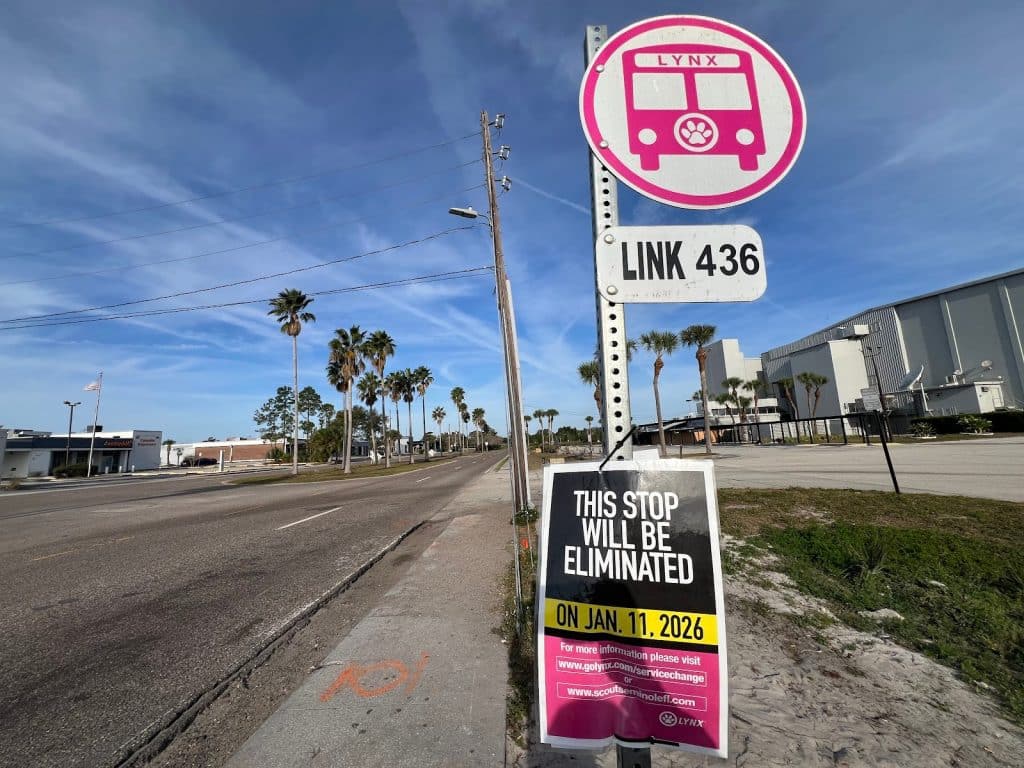
This is the first week without most of the bus routes that used to serve Seminole County. Those routes were eliminated as the county looked to save money.
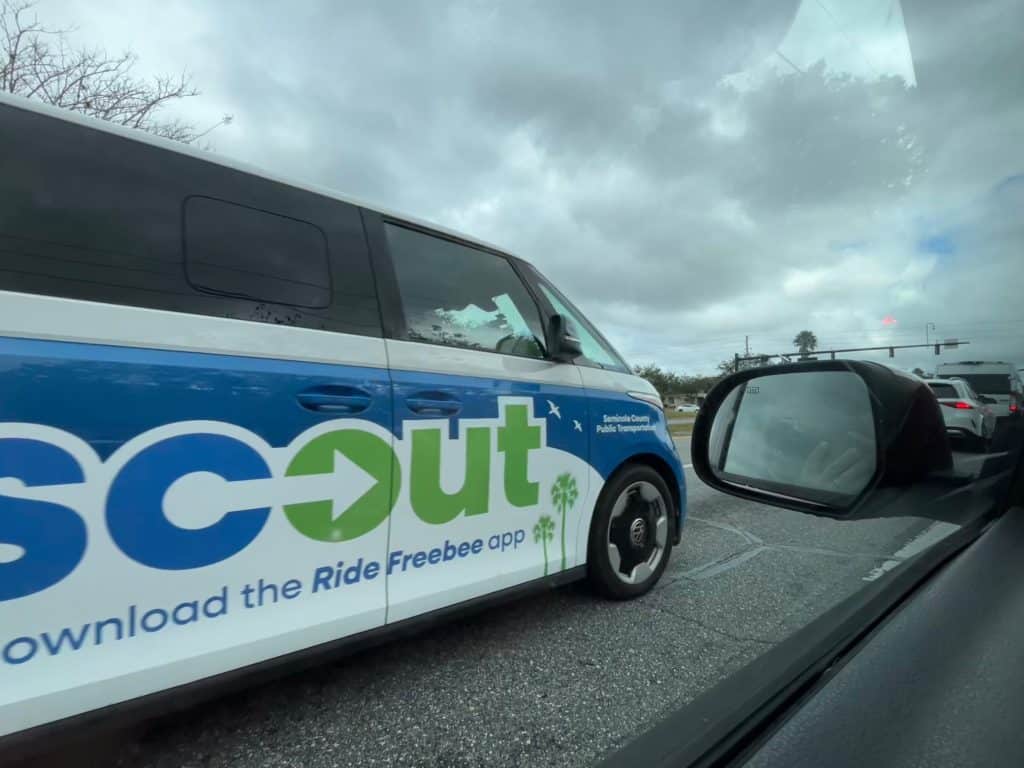
Public transportation in the county has mostly switched to an on-demand “micro-transit” system called Scout, which is run through the Freebee app. It’s a service similar to Uber or Lyft, where users book a ride through an app, with one notable difference: Odds are you’ll be riding in that Scout vehicle with strangers who were either picked up before or after you, as a way to economize on transportation costs.
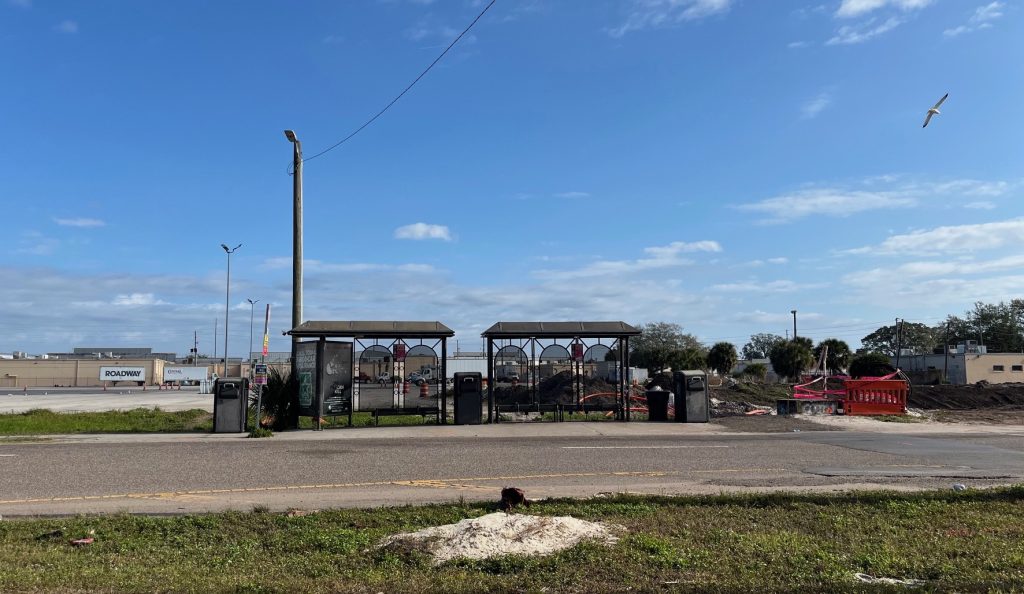
On Monday, the usually busy Lynx bus stop at the intersection of State Road 436 and State Road 17-92 was nearly empty. Some stragglers didn’t know about the change; for some, it was a language barrier. Representatives from Lynx and Scout were there to help direct people.
“I would say nobody minds the changes as long as there’s a proper substitution for the change so they’re not missing out on where they need to go,” Tarr said. “I don’t think anybody cares as long as they can still get around.”
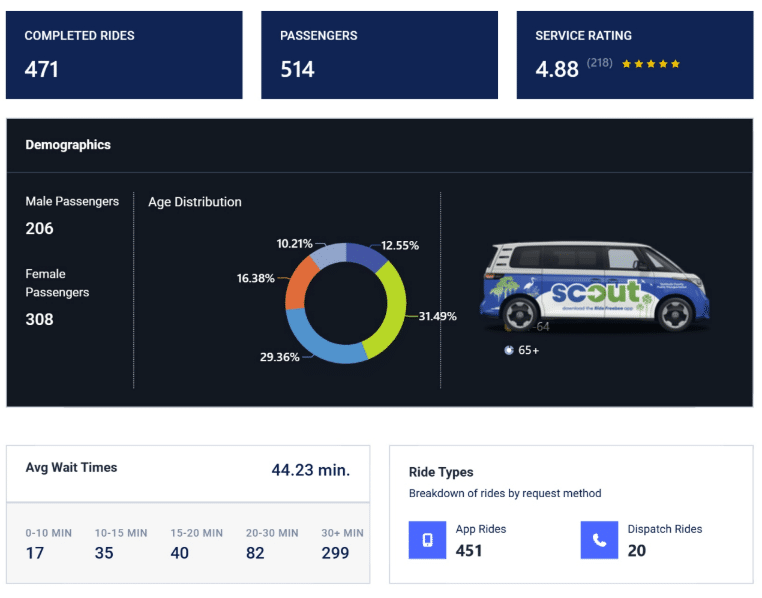
On Monday, the average wait time between when a rider requested a Scout pickup and when they actually got picked up was 44 minutes. The county’s contract with the service mandates that the average wait time be 30 minutes or less. The highest wait time Monday morning was 126 minutes – more than two hours.
“We knew we couldn’t rely on the Lynx data,” Assistant Seminole County Manager Kristian Swenson told county commissioners Tuesday. “Our goal was to put people in the vehicles that were previously on Lynx. What we [have] since realized was due to the transit deserts out there, there was a big need and those folks flocked to the system relatively quickly.”
The discontinued Lynx bus routes are:
- Link 34 – North U.S. 17-92/Sanford
- Link 45 – Lake Mary
- Link 46E – East First St./Downtown Sanford
- Link 46W – West State Road 46/Seminole Towne Center
- Link 103 – North U.S. 17-92/Seminole Center
- Link 434 – State Road 434
- NeighborLink 822 – Oviedo
- NeighborLink 851 – Sanford
In addition to the discontinued routes, there are also changes that were made to other existing routes:
- Link 1 – Service north of Maitland Center will be discontinued.
- Link 23 – Route will end at State Road 436/State Road 434. Daily schedule adjustments.
- Link 102 – Discontinuing service on Fernwood Boulevard. Extending route to Altamonte Springs SunRail via Oxford Road, State Road 436 and Ronald Reagan Boulevard.
- Link 436N – Changing route to operate between Apopka SuperStop and Altamonte Springs SunRail. Daily schedule adjustments.
- Link 436S – Discontinuing service on Fernwood Boulevard. Extending route to Altamonte Springs SunRail.
- With the changes, all Lynx bus service in the greater Oviedo and Winter Springs area has ended.
According to a survey done Monday of Scout passengers, 16% previously relied on Lynx, and 37% were Uber and Lyft riders. Swenson said 32% would not have been able to make the trip without Scout.
For just the morning rush, 541 passengers took 471 rides by Monday afternoon. Of those, 299 waited 30 minutes or longer for their rides. On Monday, 204 people created a new profile and 124 of them completed trips that day.
“We just went through all that outreach we did, which was a crazy amount of outreach in a short amount of time, and yet people still chose to wait to the last minute (to sign up),” Swenson said.
Another issue that sprung up Monday was a relatively small number of users who were frequently canceling rides. There were 18 users who were responsible for 150 cancellations. The top one made 16 requests in 45 minutes.
Swenson said the app developer is working on being able to lock out users who cancel an excessive number of rides. They would still be able to book, but they would have to call the call center at 407-665-7433 (RIDE) to book a trip.
“I believe this individual thinks it’s’ some kind of transit tetris, where I’m waiting for the right piece to fall and I’ll move it to me and I’ll get a five minute ride,” Swenson said. “It doesn’t work like that. He’s really going to the back of the queue every time he does this. It’s also screwing up other riders.”
The Seminole County Commission approved the contract with Freebee on June 12, 2025. The program soft-launched in September, and officially launched Oct. 15, 2024. The last day for many of the Lynx routes in Seminole County was Jan. 10, 2026.
Overall, county commissioners seemed pleased with the rollout of Scout.
“I think these numbers clearly prove out (that) we didn’t have much Lynx ridership to begin with,” said County Commissioner Jay Zembower. But, he added, the county may have to add more vehicles down the road.
Seminole County Commissioner Bob Dallari, who represents the Oviedo area, said people who are worried about the wait times should be comparing those times to how long it would take to walk to a Lynx station, ride the bus and then walk to the destination.
“Doing something of this size within 12 months is no easy task,” Dallari said. “I look forward to seeing where this evolves to. Breaking the 20,000 people per month (metric) is just the beginning.”
Commissioner Amy Lockhart said educational institutions, like Seminole State College, could work with the county to subsidize rides for students. Private businesses are also able to make similar deals.
Seminole County Manager Darren Gray said the budget for Lynx in 2026 originally was $17 million – and now it’s been cut by $10 million with the dropped routes. When you factor in what Seminole County is paying for Scout, it’s a net savings for the county.
“With the fare box, we are saving approximately $5.5 million, taxpayer dollars, providing a better service for our residents here,” Gray said.
Back at the SuperStop on Monday, Tarr walks to catch a different bus. She keeps her phone in the same waterproof bag she used to strap to her bike back in Naples.
When Tarr lived in Naples, she mostly got around with a bike. She likes the phone case because she is still outside in the elements.
“I need a new bike, but that’ll be down the list,” Tarr said.
She said she likes the Lynx buses she’s been on so far – they’re clean. But she understands that the county is trying to save money.
So what would Tarr do without a bus? She says she’d walk an hour and a half to the church.
“My option is to walk,” Tarr said. “A lot of people don’t have that option. I see a lot of people in wheelchairs.”
Want to contact your elected leaders and weigh in on this topic? Find their contact information here. Have a news tip or opinion to share with OCN? Do that here.
Abe Aboraya is a Report for America corps member
Sorry for the interruption but please take 1 minute to read this. The news depends on it.
Did you know each article on Oviedo Community News takes anywhere from 10-15 hours to produce and edit and costs between $325 and $600? Your support makes it possible.
We believe that access to local news is a right, not a privilege, which is why our journalism is free for everyone. But we rely on readers like you to keep this work going. Your contribution keeps us independent and dedicated to our community.
If you believe in the value of local journalism, please make a tax-deductible contribution today or choose a monthly gift to help us plan for the future.
Thank you for supporting Oviedo Community News!
With gratitude,
Megan Stokes, OCN editor-in-chief
Thank you for reading! Before you go...
We are interested about hearing news in our community! Let us know what's happening!
Share a story!
Author

Related Articles
Seminole County finalizes arts funding for 2026
Grant application windows open next week for arts organizations after Seminole County finalizes arts funding that was in doubt after commissioners questioned it.
Seminole County’s rural boundary survives the 2026 Legislative Session
A bill that would have granted near-automatic development rights in parts of rural areas failed in the Florida Senate’s final day.

A one-shot deal: Jerry Vaughan honors veterans’ last wishes nationwide
Chuluota veteran Jerry Vaughan crafts reconstructed military uniforms to give deceased veterans a dignified final salute. His hope is, with a new federal bill, he could put himself out of a job.