An update to Oviedo’s Land Development Code could bring noticeable changes to the city as it continues to grow.
At the Oviedo City Council’s Oct. 23 work session, representatives from Kimley-Horn, one of the city’s public works consultants, presented a number of proposed updates, including potential changes to zoning districts and regulations, landscaping, parking and environmental preservations.
“[The Land Development Code changes are] in response to the comprehensive plan update, really moving in a direction toward more infill and redevelopment, and accommodating different densities than were permitted prior to the comprehensive plan update,” Eliza Harris Juliano, from Kimley-Horn, said.
The updates will also reorganize the code to make it easier to navigate.
“The other thing that this does, from a practical standpoint, is it allows us to look at how we’re treating these issues across zoning districts and overlays to make sure we’re either treating them consistently, or if we’re not treating them in the same way, that there’s a reason for that,” Juliano said.
The last LDC overhaul rewrite occurred in 2006, however amendments have been made to portions of it over the years.
Zoning districts and regulations
The target areas for these updates include the West Mitchell Hammock Corridor, the Gateway West Core Marketplace, the Downtown neighborhood, the mixed-use corridor of Central Avenue and the Downtown mixed-use district core. These areas were “designated for urbanization and redevelopment opportunities with the potential for growth and revitalization,” according to the presentation, with a goal of promoting sustainable development, encouraging investment and redevelopment, and promoting a “pedestrian-friendly environment.”
For the Downtown core, the draft Land Development Code will allow for buildings up to 5 stories with additional height possible through a new bonus structure, while the mixed-use corridor of Central Avenue will allow for up to four stories, and the Downtown neighborhood up to three stories, both also eligible for the bonus structure. This will allow for a broader mix of usage for buildings in the areas.
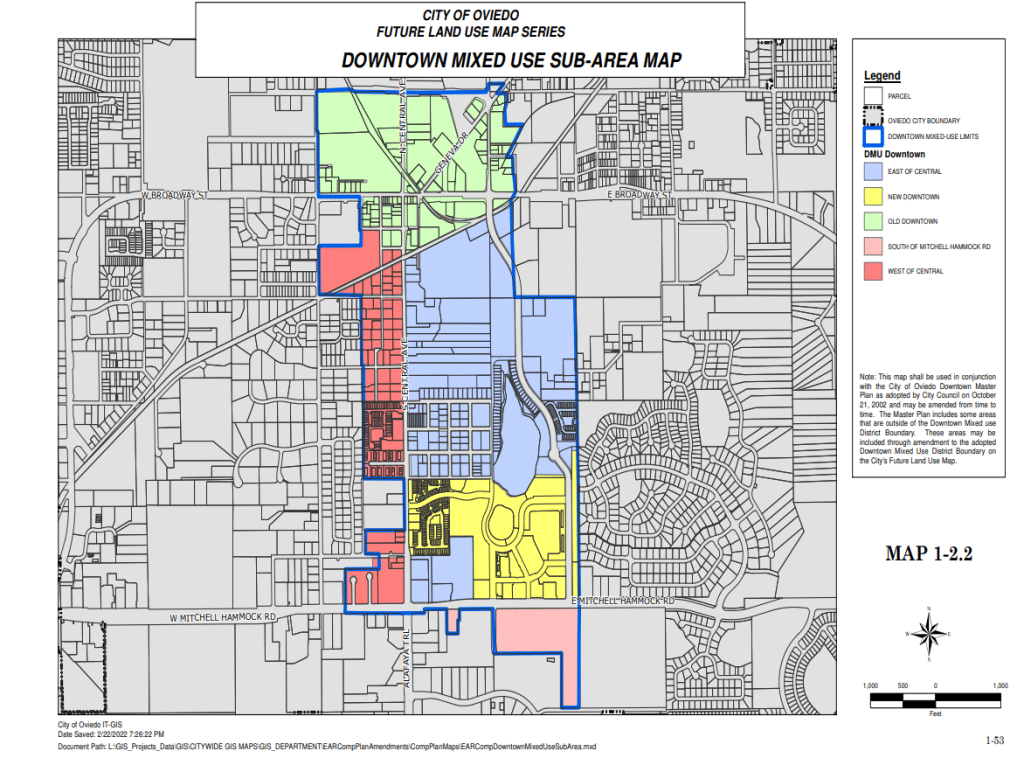
The Downtown neighborhood zone will be more focused on residential properties, including missing middle housing.
The updated Land Development Code will ensure there are efficient connectivity standards, such as not allowing too many driveways that go into major roads, but rather, creating a street network where vehicles can enter and exit off of side or rear streets.
In addition to building density and connectivity, the Land Development Code is looking into increased setbacks for major roads to allow for buildings to not be as close to the roads.
Trees and landscape
As part of the updates, Florida-Friendly Landscaping standards will be incorporated in the code, while they will remove references to xeriscape, which is a style of landscaping that reduces or requires no irrigation.
“[Xeriscape] is really an outdated term,” Juliano said. “I think the [current] code actually references a xeriscape council, that doesn’t even exist anymore.”
Additionally, the code will reduce high-water use from a maximum of 30% to 20%, which will reduce the amount of landscaping that requires a high-amount of water.
“Our landscape architect, who does resorts as well as residential and more-typical zones, says you can accomplish really nice landscaping within that constraint, while having the improved sustainability of reducing water consumption,” Juliano said.
To encourage retaining large trees around the city, the new code is increasing the replacement requirement on a graduated scale, determined by size, and a requirement to mitigate all removed oak, pine and cypress trees 8 inches in diameter or greater.
Parking
The updated Land Development Code is also looking into reducing the parking requirements for development in terms of the number of required spaces, which can promote growth by lowering construction costs, thus making units more affordable. Additionally, reducing parking requirements can promote more-walkable neighborhoods, make more efficient use of land and have positive environmental impacts by reducing excess pavement and reducing the heat-island effect. Heat islands are urban areas that have higher temperatures than other areas caused by structures and infrastructure that re-emit heat from the sun, according to the United States Environmental Protection Agency.
The proposed parking changes are:

These proposals are not intended to be a cap on parking, so if developers were to want to build more spots, they would be permitted to do so.
“I’m still a fan of eliminating parking minimums, since people really are allowed to build as much as they want,” Oviedo Mayor Megan Sladek said. “I think the ultimate test is Jinya [on Mitchell Hammock Boulevard]. Every time I’ve swung by there, everyone’s like, ‘Oh, we don’t know if it’s going to work on the parking front.’ And so far, it’s working, people. I don’t know where they’re parking, but they’re lined up around the block.
“I think letting the free market do that would be a very forward-thinking opportunity for us,” she said.
Eliminating the parking requirements is not in the code update, and other Council members are hesitant to broach the idea.
“I’m in favor of lowering our requirements, like we’re doing, but I don’t think we’re at the point where it’s no parking requirements,” Councilmember Natalie Teuchert said. “I don’t think we have the walkability around that’s built out in the infrastructure yet.”
Environmental preservation
Wetland protection is included in the code updates, specifically by strengthening the requirements for environmentally sensitive areas to be in line with the city’s comprehensive plan. Wetland setbacks of a minimum of 25 feet, with a 50-foot average buffer for all protected boundaries will also be established.
It also clarifies and strengthens the Econlockhatchee River protection and preservation requirements, including a maximum residential density of one dwelling unit per 10 acres, and permitting passive recreation facilities within 550 feet of a stream’s edge.
An even more in-depth plan, which will include updates for streets and sidewalks, recreational facilities and open space, architectural design and more will be sent to City Council by Oct. 31.
Sorry for the interruption but please take 1 minute to read this. The news depends on it.
Did you know each article on Oviedo Community News takes anywhere from 10-15 hours to produce and edit and costs between $325 and $600? Your support makes it possible.
We believe that access to local news is a right, not a privilege, which is why our journalism is free for everyone. But we rely on readers like you to keep this work going. Your contribution keeps us independent and dedicated to our community.
If you believe in the value of local journalism, please make a tax-deductible contribution today or choose a monthly gift to help us plan for the future.
Thank you for supporting Oviedo Community News!
With gratitude,
Megan Stokes, OCN editor-in-chief
Thank you for reading! Before you go...
We are interested about hearing news in our community! Let us know what's happening!
Share a story!