Abandoning current wastewater plants completely and connecting to an option outside the city was floated during a workshop in Winter Springs recently. And one Winter Springs commissioner expressed support for sending the city’s wastewater 15 miles southeast.
The Iron Bridge Water Pollution Control Facility, located just northwest of the University of Central Florida, is primarily owned and operated by the City of Orlando and designed to service 400,000 residents in areas including Maitland, Winter Park and Casselberry as well as portions of unincorporated Orange and Seminole Counties.
Winter Springs Commissioner Mark Caruso expressed interest in switching the city’s wastewater system to the Iron Bridge facility.
The city’s storm and wastewater systems have come under scrutiny following a recent FDEP warning letter to the city for potential wastewater violations, as well as a history of resident concerns over flooding and infrastructure issues during high rainfall events.
The east and west wastewater facilities are also considered to be “well beyond their useful life,” as the plants were pre-owned before being installed in the ‘70s and ‘80s.
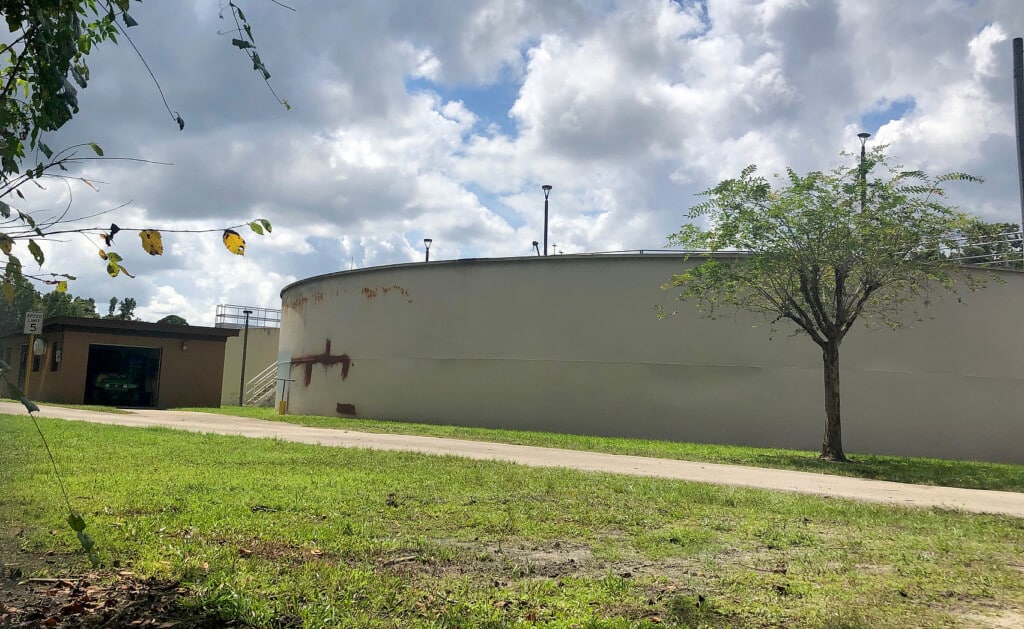
Scott Richards, project director and infrastructure design manager with Carollo Engineers, said the main considerations for Iron Bridge would be getting the wastewater to the facility, establishing an agreement for the wastewater to be treated and then how the city would get the reclaimed wastewater back.
An expensive option
Additionally, the Iron Bridge alternative is estimated to cost twice as much versus replacing the plants, with Richards throwing out a number of about $200 million as a “high level look” at cost for pump stations, pipeline to the plant and the reclaim water back.
In terms of getting wastewater to Iron Bridge, Richards said there are two options.
The first would require building pump stations and associated pipelines from each plant to tie into the South Seminole and North Orange County Wastewater Transmission Authority, or SSNOCWTA.
“As we understand it, there’s approximately 34 lift stations that already tie into that force main network from the SSNOCWTA system,” Richards said. “The challenge is there is already limited hydraulic capacity in that system.”
But with limited hydraulic capacity, Richards said adding to it could potentially put the city at risk for potential spills or overflows at the pump stations.
The second option: the city would install piping all the way to Iron Bridge, which would have to route through multiple communities outside of Winter Springs.
“That would be basically developing your own force main system,” Richards said. “That would require building master pump stations where each plant is … you would be pumping as much as 15 miles from the west plant to Iron Bridge.”
Following pushback from Caruso arguing for investment into Iron Bridge over the plants, Mayor Kevin McCann said the discussion, while appreciated, needs to be tabled in favor of moving forward.
He added that the city has heard from multiple professionals over the years as to why Iron Bridge is not as feasible an option.
“I think we can’t spend another half a million dollars doing the deeper dive on the connection and the cost to Iron Bridge and what is going to cost more,” McCann said. “At this point, five years into it, that ship has sailed, and although I appreciate that we want to make absolutely sure that we’re doing the right thing, at some point, we have to trust the engineers.”
Deputy Mayor Cade Resnick later told Caruso that he originally had been in support of Iron Bridge at the start of his term but had since come around to the idea of maintaining “local control” with the plants.
“When I first came up here, I was in the same place you were,” Resnick said. “I spoke to quite a few people who said, ‘Let’s go to Iron Bridge.’”
City manager Kevin Sweet said that he would be “fully on board” with Iron Bridge if it were closer to the city, but that after discussion building the new plants is the path the city must take for its residents.
“Last thing I want to do is build new plants,” Sweet said. “You know, it’s not an area that we want to be in the business of, if ideal, but we’re at a point where our location and where we stand today and the biggest factor being time, next being cost. That’s the direction that I feel that we need to be going in.”
Additional challenges
Caruso, who expressed significant support for investing further into the idea of pumping to Iron Bridge, questioned how the piping construction process would actually occur.
Richards said though it’d be too early to determine the exact process or route needed, the construction to pipe to Iron Bridge would have “significant impact” and could feasibly incur challenges such as drilling and piping under major roadways.
In addition to getting the wastewater to the plant, the city would need to enter some form of agreement for treatment capacity in order to get the water itself treated.
“The City of Orlando is the primary and controlling member of Iron Bridge, and by their charter, they have to remain at least a 51% or greater owner of that flow for that plant,” Richards said. “Winter Springs does not currently own any capacity and most of the members, as we see it, don’t have really available capacity.”
He added that Iron Bridge has indicated it has no sale for capacity and that while the city could work to look at purchasing from an existing member, it’s been “made clear” it couldn’t share capacity between members.
Richards said the biggest issue with switching to the Iron Bridge connection now would be scheduling, as current plans for the two wastewater plants are about five years into the process.
“If we were to look at an option for the Iron Bridge, this would really require effectively starting over from a planning level,” Richards said.
He said it could be another 8 to 10 years, including planning, before the city could see any sort of piping connection to Iron Bridge if the switch were to be made.
But with the current state of the plants already beyond the need for repairs, according to city officials, that may be time the city’s wastewater infrastructure doesn’t have.
“It would certainly add a lot of time to the process because you would effectively be starting over from a planning perspective,” Richards said.
He said while rerouting would reduce treatment effort from the city perspective, the offset would be that the city would have increased maintenance needs by owning a transmission system that goes through multiple communities and jurisdictions.
“Some of the challenges that come with that would be additional pipelines,” Richards said. “You often have a lot of air release valves, potentially additional pump stations that are not within your control or city limits you have to then manage and maintain.”
He said one example of this issue was when a reclaimed water main break in the Seminole Oviedo area left customers without reclaimed water for months.
“Yes, you’re offsetting the wastewater plant internally, but you’re really picking up other risks outside of your city limits that could impact the city,” Richards said.
“So as we’re piped into Iron Bridge, what environmental impacts would we have if Iron Bridge was to have a spill?” Caruso asked Richards. “What would the DEP put a consent water on us for?”
Richards said the issue would not be with the Iron Bridge plant spilling, but if there was a spill anywhere along the city’s pipeline that it would have to create in order to connect to the facility.
“The challenge comes in, if you had a spill anywhere along your pipeline into Iron Bridge, that’s on the city,” Richards said. “Even if a fiber driller in another city drilled through that pipe, that’s a risk.”
He said while he understands the concerns expressed by Caruso, the new plant designs are intended for long term use unlike the current ones, known as package plants, which are designed as a “quick” solution.
“These [package plants] are not designed to last more than 50 years, and you see a lot of these around Florida,” Richards said. “A lot of cities around Florida are paying the price for having inherited these packaged plants, and they’re slowly disappearing because the reliability of the plants and the longevity of the plants are not the goal of those plants.”
He said the plants being proposed are “nowhere close” to a package plant design.
“This is a modern treatment plant built with proper concrete, proper coatings, stainless steel and piping materials,” Richards said. “All the right components to give you that life span, and certainly you have to maintain that plant … you’re not going to be looking at CIP maintenance and priority repairs anytime soon, right? You’re talking decades down the road.”
Construction for the east plant is estimated to take place over a two-year period, with the project expected to be completed by about mid-2028.
Funding schedules for the west plant could potentially begin late in 2027 or early in 2028, with the target construction completion date estimated at some point in 2030.
Want to contact your elected leaders and weigh in on this topic? Find their contact information here. Have a news tip or opinion to share with OCN? Do that here.
Sorry for the interruption but please take 1 minute to read this. The news depends on it.
Did you know each article on Oviedo Community News takes anywhere from 10-15 hours to produce and edit and costs between $325 and $600? Your support makes it possible.
We believe that access to local news is a right, not a privilege, which is why our journalism is free for everyone. But we rely on readers like you to keep this work going. Your contribution keeps us independent and dedicated to our community.
If you believe in the value of local journalism, please make a tax-deductible contribution today or choose a monthly gift to help us plan for the future.
Thank you for supporting Oviedo Community News!
With gratitude,
Megan Stokes, OCN editor-in-chief
Thank you for reading! Before you go...
We are interested about hearing news in our community! Let us know what's happening!
Share a story!