
Dorworth’s challenge to rural boundary rules denied
A judge rejected developer Chris Dorworth’s legal challenge to Seminole County’s rules regarding the removal of land from its East Rural Area on Monday.
The ERA, designated in 1991, is rural land located on the east side of Seminole County, and the “rural boundary” separates it from the urban areas of the county. In 2018, Dorworth submitted an application to the Seminole County Board of County Commissioners to remove the 669 acres of land he owns from the ERA in order to build a mixed-use development called River Cross. That application was denied.
In Dorworth’s legal complaint, he argued that the language used in the Commission’s (BCC) rules for removing land from the ERA (which were approved by Seminole County voters in 2004) are “unconstitutionally vague”. That County language reads: “The BCC may remove property from the [ERA] and amend the Rural Boundary accordingly, by ordinance whenever, in the opinion of the board, such a change is necessary”.
According to court documents, Dorworth said this “provides no guidance on what criteria the BCC must consider when evaluating an application to amend the rural boundary.” He further argued that the use of the word “may” provides the BCC with “unbridled discretion”.
In the document, Florida Circuit Court Judge Randell Rowe wrote that Seminole County residents voted to enact these rules, which essentially mean that the ERA should remain in place no matter if the land was annexed out of the county. Further, Rowe wrote that in prior cases, the Florida Supreme Court determined that using the term “necessary” without a further definition did not render a statute vague and that in cases such as these, the actual definition of such a commonly used word will suffice.
“In deferring to the BCC’s opinion and discretion to determine when a change is necessary, the voters presumably, purposefully passed the amendment without defining the term “necessary” in order to defer to the BCC’s expertise,” Rowe wrote.
Dorworth said he plans to appeal the decision and feels confident about a win. He argued that the voters voted to allow the Commission to take land out of the ERA when necessary. “They didn’t say there will never be movement of this line,” he said, referring to the rural boundary. “So I challenge that whole concept.”
This is not the first lawsuit Dorworth has filed against Seminole County. In October 2018, after the Commission’s denial of his River Cross application, Dorworth filed a lawsuit in federal court against the county, claiming that the denial violated the federal Fair Housing Act. That suit was rejected in June 2021. Dorworth requested to remove the land from the ERA two more times in November 2019 and May 2020. Both times the requests were denied with the county citing the pending litigation.
The original proposal for the River Cross development in 2018 planned for 600 single-family homes, 270 townhouses, 500 apartments and 1.5 million square feet of commercial space. Development densities within the ERA are limited to one dwelling unit per three acres, one dwelling unit per five acres, and one dwelling unit on 10 acres.
Dorworth said that if River Cross comes back to the county, it would be strictly a single-family home subdivision.
Proposal for Pappy’s Patch property to be heard soon
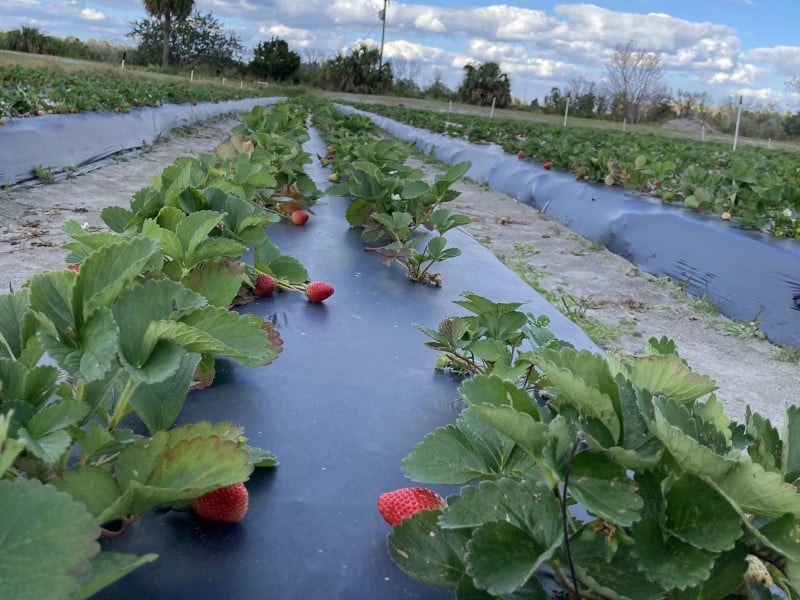
Dorworth also has a pending request with the county to remove the 67 acres within the ERA that Pappy’s Patch, a you-pick strawberry farm, currently operates on. That is expected to be heard by the Commission on Feb. 22.
Dorworth said that if he’s successful in getting a higher density zoning there, Pappy’s Patch would stay as it is today. He said he’d like to build a single-family home subdivision surrounding the strawberry patch.
“I’ve taken my kids to Pappy’s Patch. That’s a community treasure. I think my own kids would hurt me if I tried to change that,” he said.
Sorry for the interruption but please take 1 minute to read this. The news depends on it.
Did you know each article on Oviedo Community News takes anywhere from 10-15 hours to produce and edit and costs between $325 and $600? Your support makes it possible.
We believe that access to local news is a right, not a privilege, which is why our journalism is free for everyone. But we rely on readers like you to keep this work going. Your contribution keeps us independent and dedicated to our community.
If you believe in the value of local journalism, please make a tax-deductible contribution today or choose a monthly gift to help us plan for the future.
Thank you for supporting Oviedo Community News!
With gratitude,
Megan Stokes, OCN editor-in-chief
Thank you for reading! Before you go...
We are interested about hearing news in our community! Let us know what's happening!
Share a story!
Author

Related Articles
A one-shot deal: Jerry Vaughan honors veterans’ last wishes nationwide
Chuluota veteran Jerry Vaughan crafts reconstructed military uniforms to give deceased veterans a dignified final salute. His hope is, with a new federal bill, he could put himself out of a job.
Winter Springs approves $600,000 in emergency repairs to wastewater system
Officials say they’re 90 days away from breaking ground on a treatment plant – but equipment failures have the city keeping the environmental regulators appraised