Seminole County banned books list reached 110 in 2023
One author is worried the banned books are affecting her ability to get published
During her senior year at Oviedo High School in 2022, Kayla Michalkovich’s English class had a little free time at the end of the year.
So the class read an extra book: “Long Way Down” by Jason Reynolds. The novel follows a character who is ready to get vengeance after his brother is killed. The book takes place in the elevator on the way down, and on each floor, a ghost gets on the elevator and tells a story about how violence affected them.
“It’s important,” Michalkovich said. “It was great. We had great discussions about it in class, great discussions about gun violence.”
Those discussions will be harder to have in some Florida classrooms. “Long Way Down” was banned by Clay County in Florida, according to the most recent report by Pen America, an advocacy group tracking book challenges. Florida continues to top the list as the state with the most banned books in the U.S., according to the report, with Florida tallying 40% of all banned books in the U.S.
So how does Seminole County rank in the latest iteration of book bans? “Long Way Down” was not one of the 11 books banned in Seminole County, according to Pen America. But that data can lag. According to a public records request by Oviedo Community News, the latest book ban totals are much higher in Seminole County than some of the reported totals.
In total, 110 unique book titles have been banned in Seminole County. That includes 88 books that have been banned at every high school, middle school and elementary school in Seminole County. In addition, another 22 books have been banned at elementary and middle schools. Nine more books have been placed on a parental consent list, which are books that are available for checkout with a parent’s permission.
The group spearheading the book bans, Moms for Liberty, is a conservative political action committee that became active when schools were closed for COVID-19. Jessica Tillmann with the Seminole County Moms for Liberty group said they are not banning books.
“We don’t feel it is appropriate for minors to have access to pornography. These books are not like classics,” Tillmann said. “We are not banning books. We are advocating for age-appropriate books for unaccompanied minor children in an education setting. You can get any of these books on Amazon; Barnes and Noble is littered with them. The public library has them. Go to the public library and check them out for free.”
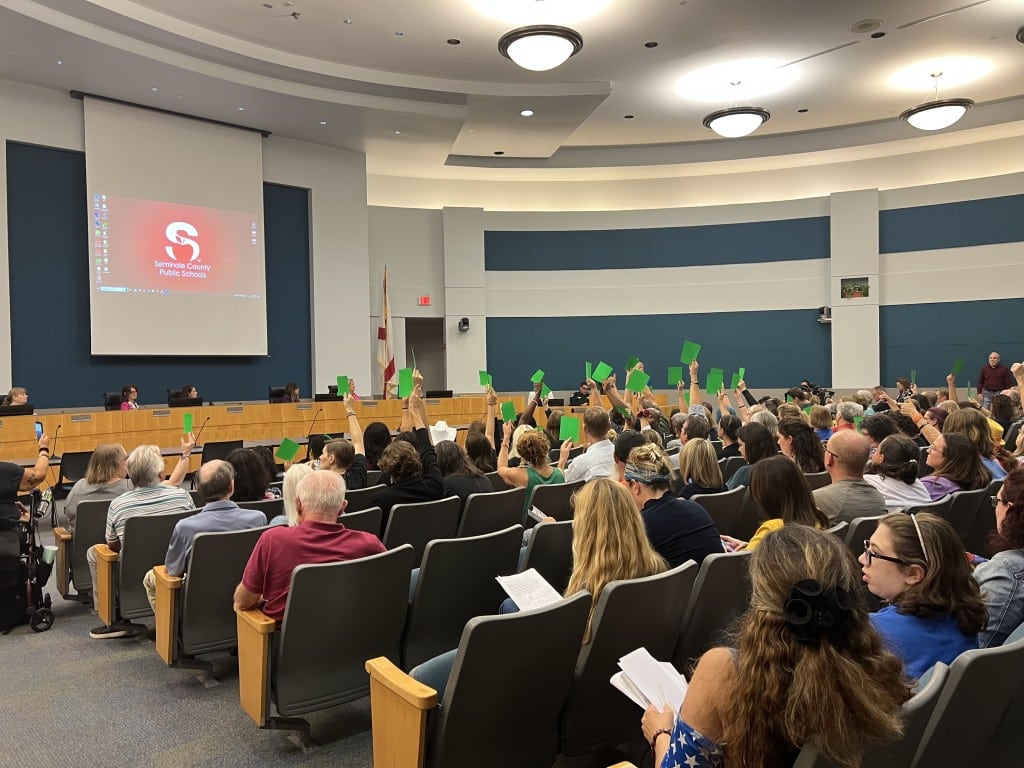
Moms for Liberty turned out dozens of supporters to the Sept. 19 Seminole County Public Schools school board meeting. Supporters read excerpts of books they wanted to see banned, taking advantage of a new Florida law that requires a book to be automatically banned from a school library if a speaker is stopped from reading it at a school board meeting.
Moms for Liberty members read excerpts of passages with graphic content, profanity and racial slurs. But a large part of the meeting also featured people speaking against removing books.
Take Lynn Moira Dictor, a Seminole County mother who had two kids graduate from Seminole County schools. She said the commonalities are obvious when you look at the list of books.
“They are anti-Black, anti-gay, anti-Jewish, anti-American history and world history,” Dictor said of those trying to ban books at the meeting. “The list, assembled by amateurs and I dare say racists, does not have Seminole County students in mind. That is your job.”
Dictor was a candidate to replace Joel Greenberg as Seminole County’s tax collector. She said voters had sent a clear message last election that Seminole County “is not extreme.”
Tillmann said her group does plan to run candidates for Seminole County’s school board next year, although no one has yet filed to run for the two seats up for election. Overall, Moms for Liberty’s success rate of turning outrage into ballot box victories is mixed.

Seminole has second most bans in the state compared to last year
Most of Seminole County’s book bans actually didn’t come from objections from citizens. Of the 110 books that were banned, only six were discontinued after getting a complaint from a citizen or group; another nine were put on the list requiring parental consent because of a citizen complaint. The rest were discontinued after a review was done based on a guidance issued by the Florida Department of Education (FDOE).
“We won’t be doing any interviews with our board or Superintendent on this topic,” said Katherine Crnkovich, spokeswoman for Seminole County Public Schools. “We’re following the guidance provided by [FDOE] and ensuring SCPS remains in compliance with the law.”
But if you compare the most recent Seminole County data to the FDOE’s publicly released 2022 list, Seminole County has the second most book bans in the state, comparing current numbers to last year. Only Clay County had more book bans, with 177 total bans (although Clay County will likely continue to have the most). Most counties actually had no books removed in the last year, and nearly every county had at least a few challenges as the FDOE’s list continues to grow.
Though many of the books may be unfamiliar to parents, several books on the list have been adapted into film and television, including “Fight Club” and “Choke” by Chuck Palahniuk, “Push: A Novel” (“Precious” is the movie title) by Sapphire and “13 Reasons Why” by Jay Asher. Alice Sebold’s memoir “Lucky” about surviving a sexual assault was also banned; Sebold also wrote the bestselling “The Lovely Bones” that became a movie.
One author who appears on the Seminole County list more than any other: Ellen Hopkins. Hopkins has written 14 young adult books, and four novels for adults. In total, 17 of her books have been pulled from SCPS schools – nearly all of her published books. She is frequently on lists of authors with the most banned books in America.
Hopkins says that two of the books on the list to get pulled are books aimed at adults: “Triangles” and “Collateral”. One of her books, “Crank”, is a fiction book, but is based on her own daughter’s experiences with drug addiction (it too was made into a movie). Another book of hers that needs parental consent is “Flirtin’ with the Monster”, which is a collection of essays about drug addiction.
“There are essays by me, my daughter, her kid, there was an essay by a drug court judge – there is zero content in that,” Hopkins said in an interview with Oviedo Community News. “So why it would need any parental consent is beyond me. … They’re just removing authors.”
Hopkins has another young adult book, “Sync”, due out next summer. She said she found herself wanting to self-censor at times while writing it, but ultimately didn’t because teenagers can tell when something isn’t real.
When asked if the book bans could have the opposite effect and increase sales, Hopkins said that can be true for books in print.
“If they can afford to buy books, yes,” Hopkins said. “The teens that really need these books can’t afford to buy them or may not want their parents to know they’re reading them, especially books about LGBTQ topics.”
And Hopkins is worried that the bans are affecting her career. Normally, her book proposals are out for maybe six weeks and get picked up; “Sync”, for example, had several publishers auction for the rights.
But she’s had one book proposal out for nine months that hasn’t been picked up.
“For me, I’m wondering if it’s because I’m writing it,” Hopkins said. “And I can’t say that it is for sure, and I can’t say it isn’t. But I do think there is a hesitation.”
Here’s the list of books that have been banned in Seminole County
Have an opinion you’d like to share with the Seminole County School Board? Find board members’ contact information here.
Sorry for the interruption but please take 1 minute to read this. The news depends on it.
Did you know each article on Oviedo Community News takes anywhere from 10-15 hours to produce and edit and costs between $325 and $600? Your support makes it possible.
We believe that access to local news is a right, not a privilege, which is why our journalism is free for everyone. But we rely on readers like you to keep this work going. Your contribution keeps us independent and dedicated to our community.
If you believe in the value of local journalism, please make a tax-deductible contribution today or choose a monthly gift to help us plan for the future.
Thank you for supporting Oviedo Community News!
With gratitude,
Megan Stokes, OCN editor-in-chief
Thank you for reading! Before you go...
We are interested about hearing news in our community! Let us know what's happening!
Share a story!
Author

Related Articles
A one-shot deal: Jerry Vaughan honors veterans’ last wishes nationwide
Chuluota veteran Jerry Vaughan crafts reconstructed military uniforms to give deceased veterans a dignified final salute. His hope is, with a new federal bill, he could put himself out of a job.
Winter Springs approves $600,000 in emergency repairs to wastewater system
Officials say they’re 90 days away from breaking ground on a treatment plant – but equipment failures have the city keeping the environmental regulators appraised