
Making a mark: Black Oviedo pioneer Henry Jackson to be memorialized at Jackson Heights Middle School
Henry Jackson helped transform an agriculture industry that shaped the future of Oviedo, and now he’ll be honored for it.

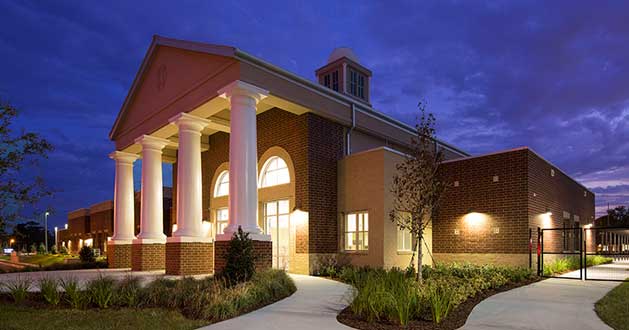
Henry Jackson is the namesake of the Jackson Heights neighborhood and middle school in Oviedo. (Photo provided by Annie Gavin)
If it weren’t for a young man’s search for his missing siblings, Oviedo may be a very different place.
Around the turn of the last century — sometime between 1900 and 1906 — a Black man, born in 1883 and no older than 23 at the time, the child of formerly enslaved people, left Mitchell County, Georgia to look for at least some of his 13 siblings, who had already dispersed, with a number heading south.
He had already been away from home — a small farm — having taken a role living with a white family in Georgia as a teenager to be a caretaker for one of their children, who may have had a disability, according to discussions with surviving family members.
While the teenager did not receive any formal schooling, the white family, despite some laws throughout the South forbidding it, taught him how to read and write. He later told his grandchildren that they treated him like a member of their family.
Eventually, the young man headed down to Central Florida, where he reunited with at least four of his siblings.
This is how Henry Jackson, the namesake of the Jackson Heights neighborhood and middle school — which will be cementing his legacy with a historical marker on Feb. 28 — came to set down roots in Oviedo.
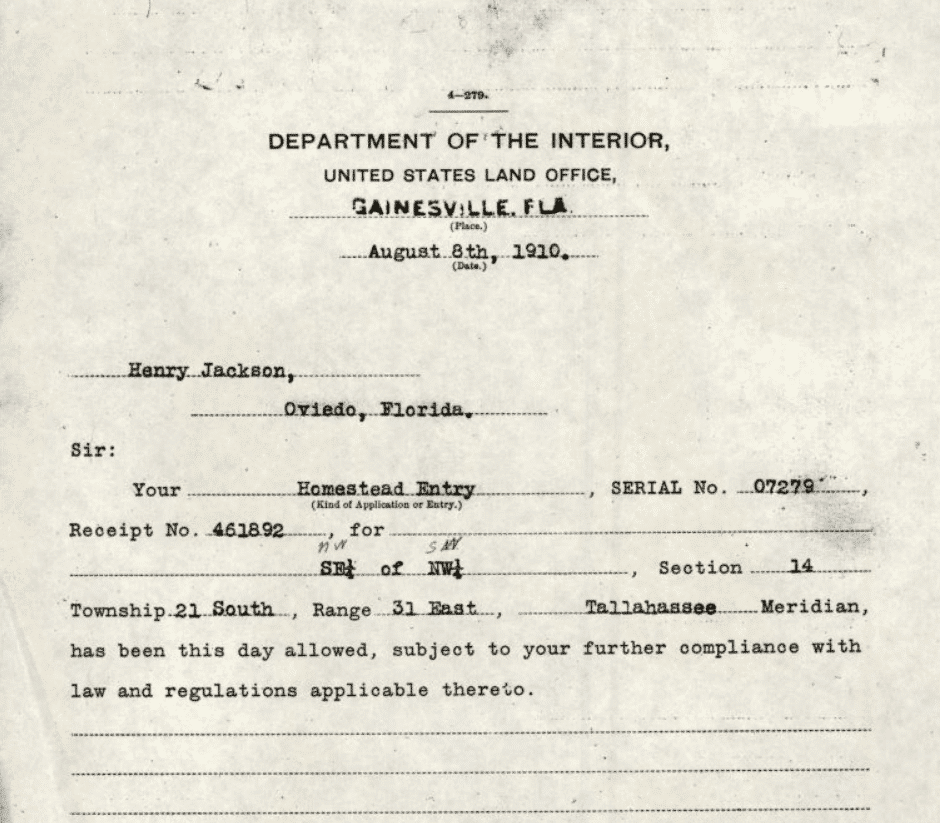
Jackson wanted to settle down, and began applying for homesteading in Oviedo, with his first documented application coming in 1906. He eventually was granted 40 acres along both sides of Long Lake in 1910, where he built a home overlooking the lake and began farming crops, from muscadine grapes, to apples, pears, mulberries, guava, peas and potatoes.
The Homestead Act of 1862, signed by President Abraham Lincoln, allowed for the transfer of up to “160 acres (65 hectares) of unoccupied public land to each homesteader on a payment of a nominal fee after five years of residence.”
According to the National Park Service, there were 28,096 homesteaders in Florida, accounting for a total of 3.3 million acres, about 8% of the current size of the state.
“Homesteading wasn’t easy, that was something you had to work for it. It wasn’t just given,” said William Jackson Jr., who is a member of the City of Oviedo’s Improving Oviedo Neighborhoods (ION) program. “You had to work to maintain it and keep it.”
Lasting Legacy
Henry Jackson, who died in 1985 at the age of 102, and his wife Arthier Cummings, had one child, Moses Elijah Jackson. Henry Jackson led a crew of men using mules to remove trees, stumps and debris from Black Hammock to clear the area for farmers to grow celery — a key crop for the development of Oviedo. This allowed local farmers to expand beyond their reliance on only growing citrus.
“He was one who set foot in this swampy area [previously] called Mosquito County, and started producing and making it a community,” said Judith Dolores Smith, a childhood neighbor of the Jacksons and currently the president of the Board of Directors of the Historic Oviedo Colored Schools Museum. “The buildings and all that kind of stuff doesn’t make a community. What does make a community is that when you have family, and you are an example for the community and what you do and how you raise your family.
“Somebody had to start that, somebody had to lay a foundation,” she said. “And the foundation in this area was laid by men like Mr. Henry Jackson.”
The success of the citrus and celery industries helped Oviedo grow and thrive.
“[Without them], I genuinely do not think that this town would’ve grown into what it is because the train tracks would not have been built here,” said Megan Sladek, Oviedo Mayor and founder of The Oviedo Preservation Project. “Had the train tracks not been built, people here wouldn’t have been able to jump on the train and go to Rollins College and start to further their education.
“It’s little things like that, and you just kind of follow this domino effect.”
In addition to his work in Black Hammock, Jackson also grew his extensive array of crops to ensure he received the homestead and to provide for his family.
“African-Americans were not paid as much as others were paid during the time,” his granddaughter Annie Gavin, who currently lives on the homesteaded land, said. “So he used his own farming on his acreage to supplement their income.”
[Editor’s note: Gavin is considered a major donor to OCN. OCN donors have no influence over editorial content. Read OCN’s Editorial Independence Policy.]
When he had excess, he would also share his crops with others in the community.
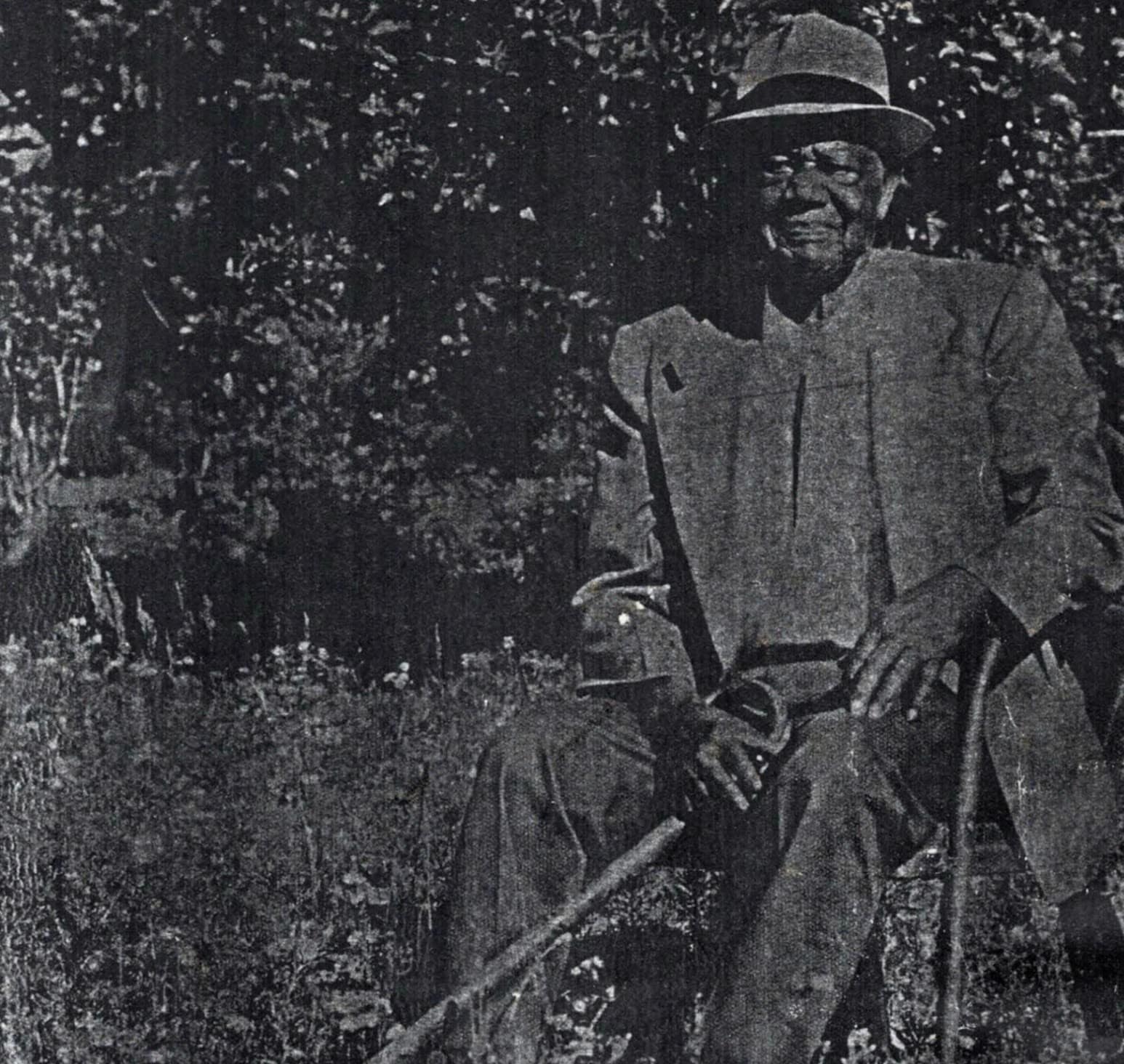
Over time, as he was raising his family — Moses and his wife Lucille Williams Jackson had 10 children — Henry Jackson was a pillar of the Black community in Oviedo.
“[His importance to Oviedo] is profound,” William Jackson said. “There were some pioneers in the community who saw fit to try to make sure that we had an equal standing in education and in other places.
“Their work ethic was so strong because they knew what they had to do to survive, and they didn’t mind doing it,” he said. “And then not only did they survive, they thrived and made it better for others after them.”
Because of the respect he garnered and his large family living on the land, the surrounding area became known in the Black community as Jackson Heights.
“He’s a bulwark, a bulwark in that he was a cornerstone,” Smith said. “Men like Mr. Jackson, that’s what communities are built on.”
While his hard work on the land helped Oviedo grow, it was his affect with others that made him so beloved.
Memories
Known for a “friendly and very easygoing” demeanor, according to Gavin, Jackson could often be seen with a cigar in his mouth, smoking it to the point where he could only hold it with a toothpick.
He was also an involved member of the Antioch Missionary Baptist Church.
“I could see him on the pew that he sat on faithful[ly],” Smith said. “They gave him the respect because it was Mr. Jackson.
“We had interaction with Mr. Jackson, whose kindness [was well-known],” she said. “Sometimes you don’t need people to say a lot. Just be there. And his strength of his character sitting on that pew in the church is what I [remember].”
He would allow local children like Smith to roam around and pick treats to enjoy, especially his famous — and delicious — muscadine grapes.
“My dad would always say, ‘do you want to go out and get some grapes?’” Smith said. “Every summer, we would go and pick muscadine grapes from his muscadine orchard. My dad would always say, ‘Now, ask Mr. Jackson how much it’s going to cost.’ And he would say, ‘Nothing.’
“I loved to go out there on Long Lake just to look at the lake and be on the homestead and pick those muscadine grapes.”
In addition to the fruit, his granddaughters remember other sweets that Jackson would bring.
At the end of the week, every week, he would go to Mr. Spencer’s general store, which was located across from what is now CrossLife Church, and bring home cookies.
But not just any cookies. Giant cookies.
“We called [them] big wheel cookies,” Gavin said. “These round cookies, they were bigger than all of the other cookies. And they were expensive, because they were a penny a piece. All of the other cookies you could get two for a penny.
“My grandfather used to buy [the cookies] and come to our house … and we would line up like we were in school, and he would pass out the big wheel cookies.”
The cookies were made by Jack’s Cookie Company, Annie’s sister Theresa Robinson remembers.
“They were big cookies, sugar cookies,” Robinson said. “He was good to us.”
Memories, as with everyone, were not all positive, however. Tragedy fell on Henry Jackson’s son in 1965.
While she didn’t experience hate in Oviedo growing up — partly because “our parents shielded us from a lot of the ugliness,” hate did cause one of the biggest tragedies of her family’s lives.
In 1965, just as Gavin was getting ready to finish her senior year of high school and go to Livingston College in North Carolina, her father was on his way home from work in Cape Canaveral. He and a friend were walking, waiting to meet their ride home, when suddenly, three white men drove up and offered to take them to their ride, which was three-quarters of a mile away. When they got to the meeting point, however, the car didn’t stop. Instead they drove the two unsuspecting men into the woods and ordered them out of the car by gunpoint.
“My dad said to [his friend], ‘well, I’m going to get one of them,’” Gavin said, based on recollections from her father’s friend. “My dad ran toward the one holding the gun. They shot him and shot [his friend], and left them in the woods to die.”
His friend survived to tell the story. Her father died on the way to the hospital.
Importance of Education
As time went on, Jackson sold and donated parts of his 40 acres. One of the parcels he donated was where the current Jackson Heights Middle School sits, Sladek said.
However, it did not start out as a middle school.
Originally, it was an Black elementary school, first known as the Oviedo School for Negro Children, and then Oviedo Elementary, Gavin said.
In 1960 the community wanted a change.
“Because he was so prominent, and because he lived so long back here, the PTA and the community voted to name the school Jackson Heights Elementary,” Gavin said.
The Seminole County School Board approved the name change on Dec. 8, 1961.
Set up by the descendants of former enslaved people, Oviedo had at least six “colored schools” between 1890 and 1967. They focused on high-quality education to help the Black community get ahead amid segregation.
“My parents never did tolerate anything other than us getting our schoolwork [done], doing our homework, reading,” Smith, who attended Jackson Heights while it was still segregated, said. “You were never given the luxury of having the excuse that we were in a segregated society.
“Our mindset was directed in that if you are going to rise above it, you must get your education.”
The school was integrated along with all Seminole County schools for the 1967-68 school year, and became a middle school in 1971.
And for a time, students knew exactly why it was named Jackson Heights.
“That was instilled in us,” William Jackson, who went to the school while it was still segregated, said.
Over the years, however, the background of who Jackson Heights was named after became lost to history, even to those who attended the school.
“This is a really big deal because so many kids go to this school. It is [one of] the best school[s] statistically in Seminole County for middle school, and nobody [knew] it’s named after a Black man,” Sladek said. “And I went there and I did not know. I kind of observed that it was in a neighborhood that seemed to be historically more African-American, but I didn’t know that a guy donated the land and it was Mr. Jackson.”
And because of that lost history in the community, Gavin said she experienced immense hate in that exact location three decades after the school was named for her family.
In the 1990s, Gavin, who had moved away from Oviedo for college and work before moving back with her husband in 2019, was visiting her mother and went to an open house at Jackson Heights Middle School. She saw a red pickup truck parked between the school and the Jacksons’ property, throwing trash into her mother’s yard.
Displaying similar bravery to her father, Gavin did not avoid confrontation.
“I went out to the truck and asked him to stop,” she said. “He called me everything under the sun. He told me how his parents owned [n-words] and told me to get away from his truck and pretended that he was pulling something out of his glove compartment. I asked him, ‘have you always been this hateful, or is that something that you are just saying to me now because you are offended?’ He rolled his window up and kept calling me all kinds of things, and I just walked away.
“I never had anyone call me a [n-word] until I came back to visit my mother.”
Now, 30 years after that incident, her grandfather and her family name will forever be memorialized at the school.
Making a Mark
The work on the historical marker has been more than a year in the making, with meticulous document gathering being done by multiple people.
Gavin, TOPPS board member Deb Jepson, and Sladek worked diligently to gather the information, which then needed to be vetted to be included with the marker before sending it to the Florida Bureau of Historic Preservation, to be approved as a Florida Heritage Site by the Department of State.
In 2019 Sladek and The Oviedo Preservation Project began working on having new historical markers added throughout the city to better tell the history of Oviedo, though there were already a number of markers existing. Since 2019, this will be the fourth marker the Preservation Project got approved by the state, with one at Solary Park up next. The city currently has 10 total, but hopes to add more. [Editor’s note: The Historical Marker Database is missing at least two of Oviedo’s markers on its website]
“I’m hoping that we can make sure that everybody’s story is told, whose story we can,” Sladek said. “It means we have not forgotten where we came from. Even though we’ve grown a lot, we’re still making an effort to celebrate the stuff that made us become what we are.”
Sladek hopes to be able to tell the stories of areas like neighboring Washington Heights and Johnson Hill before time runs out.
“We’re trying to get those things before we lose the people who can write them down and it counts as a primary source,” she said.
Now, the marker ensures that Henry Jackson and his contributions to the City of Oviedo will not be forgotten.
“I think it’ll make a great statement to let people know and acknowledge the contributions that African-Americans, Blacks, negroes, made to Oviedo and surrounding areas,” William Jackson said.
Editor’s note: The original publication of this article should have included TOPPS board member Deb Jepson as a part of the research and writing team for the marker memorializing Henry Jackson.
Sorry for the interruption but please take 1 minute to read this. The news depends on it.
Did you know each article on Oviedo Community News takes anywhere from 10-15 hours to produce and edit and costs between $325 and $600? Your support makes it possible.
We believe that access to local news is a right, not a privilege, which is why our journalism is free for everyone. But we rely on readers like you to keep this work going. Your contribution keeps us independent and dedicated to our community.
If you believe in the value of local journalism, please make a tax-deductible contribution today or choose a monthly gift to help us plan for the future.
Thank you for supporting Oviedo Community News!
With gratitude,
Megan Stokes, OCN editor-in-chief
Thank you for reading! Before you go...
We are interested about hearing news in our community! Let us know what's happening!
Share a story!
Author
Related Articles
Bill to gut Seminole County rural boundary could apply outside of Central Florida
Florida Senate poised to take up the bill this Friday, as developer Chris Dorworth pushes county commissioners to support it.

Life as a Hagerty transgender student, explained
“I’ve been trying to figure myself out for a long time.” Hagerty transgender students find solace among ‘the same kind of different.’
Twin Rivers Golf Club to receive protections; Stormwater project updates
Bounded on both sides by the Econ and Little Econ rivers, Oviedo’s Twin Rivers Golf Club now could see new laws to keep it safe.