
Community reminisces about shuttered Canterbury Retreat
The sudden closing of the Canterbury Retreat took many in the community by surprise. Now former guests hope it can be saved.
Former Oviedo City Council member and longtime resident Judith Dolores Smith has always held a special appreciation for what she’s long considered to be a jewel in the city’s urban landscape: the Canterbury Retreat and Conference Center.
Canterbury provided more than conference rooms and boarding accommodations, serving as a place for residents and visitors to meet, pray, unplug, meditate or relax in what was described as a “tranquil escape from the ordinary,” all while surrounded by an idyllic, wooded landscape reminiscent of Florida’s natural past and overlooking Lake Gem.
But that changed on July 19 when the owner of the 48-acre Oviedo based retreat and conference center, The Episcopal Diocese of Central Florida, announced it would have to suspend its operations for the foreseeable future following an unstable financial position.
“There’s nothing like it,” Smith said. “Nothing like it. I pray that they somehow are able to keep running it.”

In the wake of its closure, those familiar with the center mourn the loss of an Oviedo staple described emphatically by its visitors as a sacred, “unique” space.
Winter Springs resident Jacqueline Lynn said she first visited Canterbury about 12 years ago when a former pastor from her church wanted to host meetings in a space free from distractions, something she said the center amply provided for its guests.
She remembers the small details that stood out to her from various visits to the center over the years, like the jar of homemade strawberry preserves made and sold by a member of the kitchen staff.
“I bought a jar and was thinking I should have bought more,” Lynn said, laughing. “When I think about it, there’s all these little fun moments.”
Lynn, who is active with the Central Florida Christian Chamber of Commerce, is currently in the midst of organizing a week-long entrepreneurial youth boot camp with the group for next summer and said she was excited by the idea of potentially hosting the camp at Canterbury before she learned about the center’s closure.
“It really is a loss to the community to see that shut down,” Lynn said. “It’s one of those places where, until you’ve been there, you don’t really know what it is and appreciate it. And maybe you’ve been there once, and you may not go back for years, but it’s knowing that the resource is there.”
While other spaces may be able to offer similar amenities to Canterbury, Krystal Parker, president of the U.S. Christian Chamber of Commerce, said there is nothing else that truly embodies the Canterbury experience and its ability to transport its visitors away from the city while still in it.
“You just walk on the ground and you just know there’s something different there,” said Parker, who previously helped to host fellowship on the property when she served as the president of Central Florida Christian Chamber of Commerce years prior. “It is in the middle of the city, but yet you can drive down that drive and you feel like you’ve left the city.”
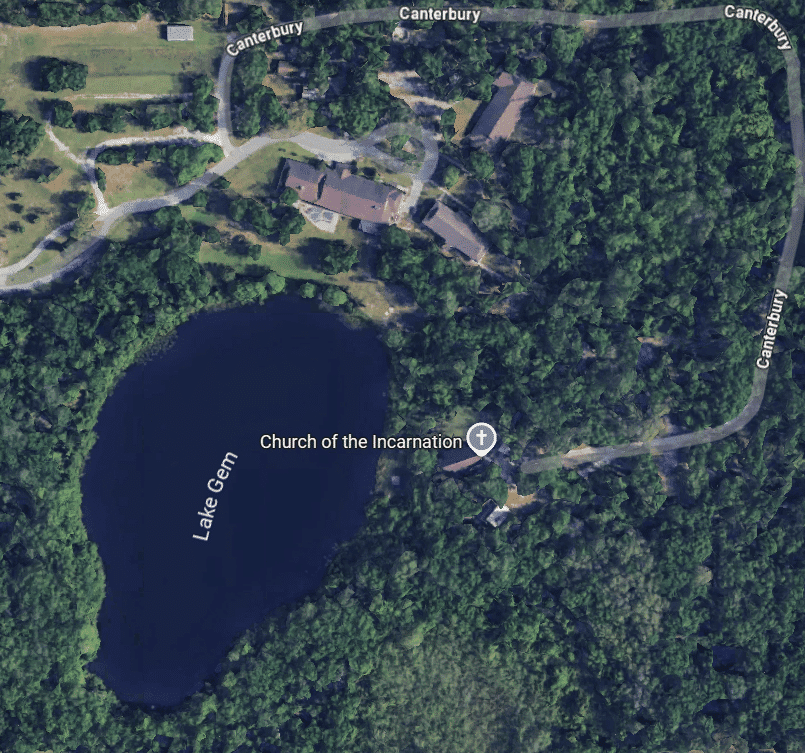
All of Canterbury’s regular operations currently remain suspended. Events are unable to be booked on its website and even the Church of the Incarnation, which previously held services at the St. Augustine chapel located at the back of the property, now meets at the Reformed Theological Seminary in Oviedo instead.
But for the center’s old visitors, it seems like the memory of Canterbury is still holding on as a community mourns the loss of what they and many others considered to be a hidden Oviedo gem.
“If you let it, it really does feed your soul,” Lynn said. “It really does.”
What happened to Canterbury?
Ultimately, Canterbury’s current status came down to a history of struggling finances. An article published to the Episcopal Diocese of Central Florida website in September detailed a financial crisis, which first came to light in 2023, unable to be solved by the center itself or the diocese.
By 2023, the center was running a monthly deficit of $30,000 to $40,000 and had a $1 million mortgage payment due by June 30 with no ability to pay it, according to the article. The situation led the Canterbury Board to resign on June 27, 2023, acknowledging it recovering from the fiscal crisis would be impossible under the current business model. A new board of diocese-elected members was then formed to address the crisis.
Despite efforts to reduce costs and increase revenue, including appointing a temporary managing director and restructuring debt, the financial situation remained dire for the center. Operational costs were high due to deferred maintenance, rising staffing and food service costs as well as limited income compounded by underuse.
By early 2024, the diocese acknowledged that continuing operations was financially unfeasible without significant additional support, which led to the recommendation to cease retreat and guest services at the center.

The Real Estate Commission then began exploring potential future uses for the property, and by June 2024, the Diocesan Board voted to discontinue operations at Canterbury and explore its sale or redevelopment as it became clear the center’s operational model was no longer sustainable to maintain.
The Episcopal Diocese of Central Florida article said that the board is still currently seeking to “find the solution that maximizes the property’s value in a way that best advances the mission of the diocese” without a sale.
Director of communications for the Episcopal Diocese of Central Florida Erik Guzman said in an email to OCN that there is no additional information to share at this time regarding the center beyond the details included in the diocese’s September article.
“I anticipate that we will have additional information on the Canterbury property to report to the diocese in January,” Guzman told OCN.
A piece of Oviedo’s past
The property itself has a longstanding connection to the history of Oviedo through Prince Butler Boston, who moved to Central Florida at 12 years old in 1885 with his father Dr. Alexander Atkinson, a Georgia slave owner. Following the 1890s citrus freeze, Atkinson left his Oviedo land to Boston, who changed his name.
It’s a history Smith’s familiar with herself.
“When I was growing up, at the entrance of the present Canterbury, there was a wooden house and it belonged to the Bostons’,” Smith said. “One of the Boston sons stayed in that wooden house. That’s where I know of Canterbury, before it was Canterbury.”
According to the center’s history page, the “Boston family home site is where Canterbury Retreat and Conference Center is located — its centerpiece, Lake Gem, named by the Boston family for a dear family member.”
The Episcopal Diocese of Central Florida would eventually purchase the Canterbury property years later in 1978 with the intention for it to serve as a retreat center for the diocese, before officially opening its doors in 1982.
While the history of the property itself is rich, the institution of Canterbury itself seems to represent for some residents like Smith a connection to a version of Oviedo recalled now only through memory.
“It’s wonderful because it’s that last little portion of Oviedo before we started becoming a bedroom community for Orlando,” Smith said. “It’s that last little piece that’s left out there.”
Smith said she’s not against progress but fondly remembers Oviedo’s less developed past, back when the city’s main industry was based in orange groves and provided residents what she calls a shared common ground.
“It was a village when I was growing up, about 2,000 people,” Smith said. “And then now we are a city of about 40,000 and we don’t have a common thread anymore. Like the citrus industry, we had a common thread … but now the common thing that we have in Oviedo seems to be subdivisions, and that’s kind of sad.”
It was Canterbury that Smith felt continued that feeling of a common thread amongst the community in the wake of new development and residential subdivisions and took its visitors “back in time.”
It’s a sentiment Oviedo resident Anna Woods, who first discovered Canterbury through a lakeside yoga class, shares. Woods, a trauma-informed life and grief coach, previously hosted retreats and community talks about grief at the center.
“Even if Canterbury becomes a part of the history of Oviedo, which it will, we must preserve something about Canterbury in a very unique way for our community,” Wood said.
A place of its own
Perhaps the most uniting opinion of those who’ve stayed at or visited Canterbury in the past is the uniqueness of their experiences and the almost spiritual feeling many said they felt once immersed in the secluded, natural site.
Kathleen Joy said she can recall her visits to Canterbury from as far back as the 1980’s, when she could visit the grounds to meditate or pray by simply walking up to the center’s front desk to let them know she was on the property.
“They were okay with that, even if I wasn’t staying there,” Joy said. “I just think that there’s not a whole lot of places like that.”
For woods, she remembers sinking into the seats there.
“It’s funny how certain things kind of stand out in your mind,” Woods said. “Because it was comfortable, it felt like home to me. Felt like coming home.”
Looking toward the future
“Once you let it go, there’s no there’s no way to bring something like that back,” Smith said, when asked her thoughts on the future of the Canterbury property. “It’s an impossibility.”
And even though a community mourns the loss of this unique piece of Oviedo history, some are happy to have just had the chance to experience it for themselves.
“I would want to thank the people who put in their blood, sweat and tears and kept that going and maintained it over the years,” Joy said. “Because it was a source of comfort and spiritual direction for people to be able to go out there … I would like to just thank them, and I appreciate that I was able to partake in it.”
While the financial and operational future of the center may still be uncertain, the sense of community and connection Canterbury fostered by many of its past guests still remains.
“I think it stands on its own as this unique place in Oviedo that did feel like a community,” Woods said. “Even if you weren’t particularly in the community that met there on a regular basis, you still felt at home. I think that’s what community does for us. It makes us feel at home.”
Sorry for the interruption but please take 1 minute to read this. The news depends on it.
Did you know each article on Oviedo Community News takes anywhere from 10-15 hours to produce and edit and costs between $325 and $600? Your support makes it possible.
We believe that access to local news is a right, not a privilege, which is why our journalism is free for everyone. But we rely on readers like you to keep this work going. Your contribution keeps us independent and dedicated to our community.
If you believe in the value of local journalism, please make a tax-deductible contribution today or choose a monthly gift to help us plan for the future.
Thank you for supporting Oviedo Community News!
With gratitude,
Megan Stokes, OCN editor-in-chief
Thank you for reading! Before you go...
We are interested about hearing news in our community! Let us know what's happening!
Share a story!
Author

Related Articles
Bill to gut Seminole County rural boundary could apply outside of Central Florida
Florida Senate poised to take up the bill this Friday, as developer Chris Dorworth pushes county commissioners to support it.

Life as a Hagerty transgender student, explained
“I’ve been trying to figure myself out for a long time.” Hagerty transgender students find solace among ‘the same kind of different.’
Twin Rivers Golf Club to receive protections; Stormwater project updates
Bounded on both sides by the Econ and Little Econ rivers, Oviedo’s Twin Rivers Golf Club now could see new laws to keep it safe.