
Fluoride fighters sink teeth into Oviedo
Decades after being hailed as one of the greatest medical advances of the century, fluoride in water is questioned in Oviedo.
A national, hot-button health issue has made its way to Oviedo’s doorstep. On Nov. 2, Robert F. Kennedy, Jr., President Donald Trump’s nominee to lead the United States Health and Human Services Department, wrote on X “the Trump White House will advise all U.S. water systems to remove fluoride from public water.”
Three weeks later, Florida Surgeon General Dr. Joseph A. Ladapo issued similar guidance for the state – becoming the only state surgeon general to do so – due to what he called, “the neuropsychiatric risk associated with fluoride exposure.”
And at the Oviedo City Council’s Jan. 6 meeting, a number of Seminole County residents made their pleas in favor of removing fluoridation from the city’s drinking water, about which Mayor Megan Sladek said, “that has been quite the topic lately; I think it’s something we should probably discuss.”
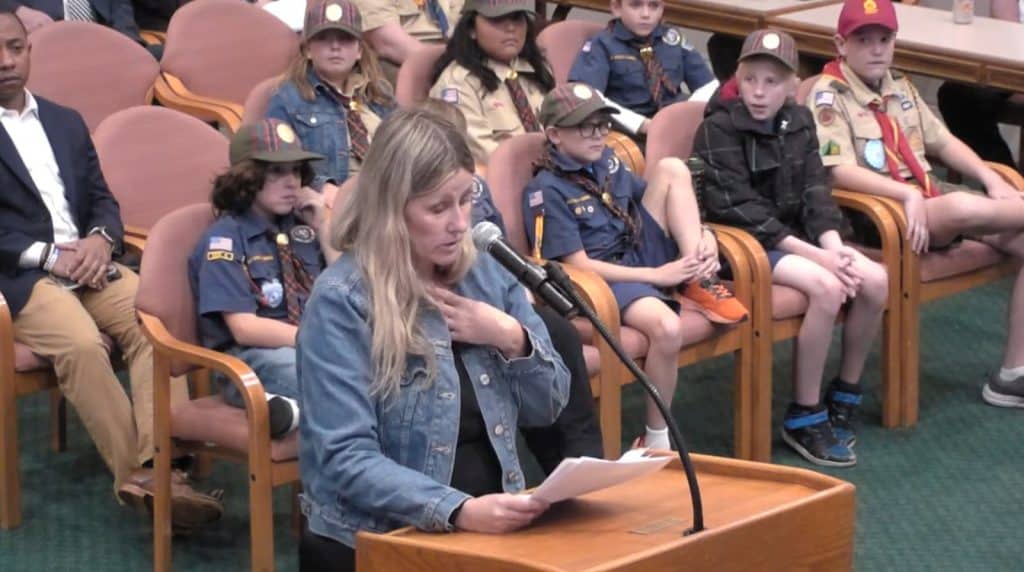
Oviedo resident Agnieszka Francis spoke at the Jan. 6 Oviedo City Council meeting about her concerns regarding water fluoridation.
Fluoride, a mineral both naturally found in water and added to nearly three-quarters of all community water systems in the United States — including Oviedo’s — has been shown to help prevent cavities and tooth decay. Oviedo residents first voted in favor of fluoridating the city’s water in 1974, and in 1995 the Oviedo City Council officially began implementing the system.
Fluoride was first added to the Grand Rapids, Mich. water system in 1945, and by 2020 73% of the U.S. population was on a community water system receiving fluoridated water, with 78.5% of Florida cities fluoridating.
“…the majority of people today do not have memory of the prevalence and severity of tooth decay that was in our country before water fluoridation,” Dr. Chelsea Fosse, director of the American Association of Pediatric Dentistry Research & Policy Center, said.
“Since we have experienced over six decades of water fluoridation, the majority of people today do not have memory of the prevalence and severity of tooth decay that was in our country before water fluoridation,” Dr. Chelsea Fosse, director of the American Association of Pediatric Dentistry Research & Policy Center, said. “That means people can’t see firsthand its dramatic impact, especially at the population level, making it easy to discount or forget.
“Fluoride has been silently, invisibly, valiantly working behind the scenes to benefit the U.S. population for years,” she said.
Water fluoridation facts
Due to its dental health benefits, drinking water fluoridation was named one of the 10 great public health achievements of the 20th century by the Centers For Disease Control (CDC). While concerns for pregnant women and children receiving more fluoride than needed when consumed at extremely high levels have been raised in opposition to the practice, the U.S. Public Health Service’s recommend 0.7 milligrams for every liter of water (mg/L), or 0.7 parts per million (ppm) concentration, “maximizes fluoride’s oral health benefits while minimizing potential harms,” according to the PHS.
To put 0.7ppm into perspective, Fosse said it is equal to one penny in more than $14,000, or, as Dr. Johnny Johnson, a pediatric dentist and president of the American Fluoridation Society cites, one inch in 12 miles.
In its 2023 Annual Drinking Water Quality Report, Oviedo detected fluoride levels of 0.69 ppm. In both 2021 and 2022 it detected 0.52 ppm levels.
Studies show that fluoridation of drinking water reduces cavities and tooth decay in both children and adults by about 25%.
Growing up on well water in Oviedo, Sladek said that she would take fluoride mouth rinses through a free program available at schools.
Because of additional ways to add fluoride outside of fluoridated water, such as certain mouthwashes and toothpastes, Sladek said fluoridation removal is worth looking at for the city, though experts disagree with her premise.
“Fluoride in drinking water helps protect teeth — primary, or ‘baby,’ teeth and permanent teeth — making it helpful for people of all ages,” Fosse said in an email to OCN. “Acids from bacteria break down or demineralize enamel — the outer surface of teeth — while fluoride strengthens and remineralizes the enamel, helping to repair and protect teeth from decay.”
Used as a complement to fluoridated toothpaste or washes — like ones Sladek used in school — fluoridated water maximizes dental health, according to Johnson, as it helps reduce cavities by an additional 25%, while fluoride tablet supplements do not “have any benefit” for adults in communities without fluoridated water, he said.
“One does not replace the other, just like seatbelts and airbags,” Johnson said. “It takes both of them [fluoridated water and topically applied fluoride] to give you maximum cavity reductions.
“When we brush with toothpaste, we get [coverage] of fluoride that lasts only about an hour or two, then it falls back to baseline levels,” Johnson said. “What happens is when you drink fluoridated water, you’re coating the teeth … but you’re also coating [the] tissues in your mouth and your tongue, and they end up releasing fluoride out of their tissues during the day and during the night.”
Fosse said that it is important for families to understand how all potential fluoride touchpoints work, such as in the drinking water both at home and at school, varnish treatments at check-ups and other supplements, and what is most effective for each individual by consulting their medical doctors and dentists.
From ‘crazy hippie types’ to mainstream
As a Council member, Sladek said in about 2017 she brought up removing fluoride from the Oviedo water system for what she believed was “substantial evidence” of potential negative health effects vs. health benefits, but it did not gain any traction and, “everybody just kind of looked at me like I lost my mind.”
“I think it’s just nobody was talking about it at the time except for people who are considered kind of ‘crazy hippie types,’” she said. “Now, the crazy hippie types are in charge, I guess, of our medical places up in [Washington] D.C. and in Florida.
“These are very highly — well one’s highly credentialed and one is, you know, Mr. Kennedy,” Sladek said. “The Ladapo guy, like, he’s not a total quack.”

Florida State Surgeon General Dr. Joseph A. Ladapo (Photo via FloridaHealth.gov)
What the studies show
Ladapo’s Nov. 22 guidance — which Johnson said was “absolutely” unprecedented as he is the first known state surgeon general to issue a message broadly opposing public health expert guidance regarding fluoride — included bullet points referencing “safety concerns related to systemic fluoride exposure” on children.
A link to the National Toxicology Program in the guidance’s first bullet point, about a study on the potential effects of fluoride on children’s IQ, states that the review “was not designed to evaluate the health effects of fluoridated drinking water alone,” and has the following finding written in bold: “It is important to note that there were insufficient data to determine if the low fluoride level of 0.7 mg/L currently recommended for U.S. community water supplies has a negative effect on children’s IQ.” This seemingly refutes the claim Ladapo’s guidance is trying to make by including it.

Findings from a National Toxicology Program review state that the data correlating fluoridated drinking water at Oviedo’s levels and effects on children’s IQ were insufficient. The words were bolded by the NTP.
Having the right amount of fluoride added to the water systems is the key to the effect, Johnson said. “The dose makes the poison,” he said, referencing the famous adage and concept of toxicology, credited to 16th-century physician Paracelsus.
For example, even oxygen and water, essential for life, can be toxic or damaging at certain high levels or doses, but at correct doses they are beneficial.
The 2024 National Toxicology Program report looked at whether increased levels of fluoride exposure negatively impacted IQ scores in children.
Most of the studies measured fluoride levels much higher than the 0.7 mg/L national standard, and only seven looked at levels of less than 1.5 mg/L — more than double Oviedo’s — and found no correlation between that level and IQ when considered independently.
Fifty-two of the 74 included studies that were performed in 10 countries — none of which were the United States — were rated as “low quality” and judged to have a “high risk of bias,” while finding “there was not enough data to determine if 0.7 mg/L of fluoride exposure in drinking water affected children’s IQ”.
The report “does not address” whether fluoride in drinking water itself is associated with an effect on IQ.
“The IQ tests that were given were not standardized,” Johnson said.
He said that in some regions of China that were tested, the population receives additional fluoride from breathing in the coal burned in their homes for heating and cooking, and not only from fluoridated water.
Johnson will be on a panel with Ladapo being put on by the Bartow City Commission on Feb. 18 to discuss the pros and cons of water fluoridation.
Groups pushing for removal
Prior to the Jan. 6 Oviedo meeting, Council members and city staff received multiple emails from groups, including We Are Change Orlando and Stand for Health Freedom, which said they are “actively working to end water fluoridation,” and echo Ladapo’s claims in the messages.
“They’re trying to ‘educate’ us with false narratives,” Deputy Mayor Natalie Teuchert said.
While the vast majority of Florida residents were on systems with fluoridated water, according to the surgeon general’s press release and self-reported 2023 data, a number of cities and counties in the state have recently decided to at least temporarily remove fluoride from tap water, including Stuart, Port St. Lucie, Collier County, Naples, Winter Haven and Tavares.
“Fluoride cessation poses a significant risk to the dental health of children,” Fosse said. “Our colleagues and neighbors in Canada have experienced this first-hand, notably in Calgary, where fluoride was removed from the water systems in 2011. In the years that followed, tooth decay rates went up and inequities were exacerbated — where those without insurance fared worse.”
Following more than a decade without fluoridated water and seeing the effects on children’s teeth, Calgary residents voted to have fluoride reintroduced to its water system in 2021, and the completion of the system is expected sometime this year.
Fluoridation in Oviedo
Sladek said residents could use the savings from having it cut from the budget to fund at-home fluoridating supplements. Oviedo pays $11,000 annually for fluoride — which comes out to about $0.25 per person per year.
Sladek said she is “very much leaning in that direction” of wanting to see fluoride removed from Oviedo’s water system. Doing so, however, would take a majority vote from Council, and at least one member has come out and voiced support for keeping the status quo.
“I believe in science,” Teuchert said. “There’s a reason my whole generation doesn’t have [many] cavities.
“[I] will follow what scientists and professionals in the field say,” she said.
A discussion about the issue is expected to be held at a future meeting, and Councilmember Alan Ott said data will determine which way he ends up deciding.
“I think the first thing you want to look at is, is this something that’s a public good, for the public good currently,” he said. “Is it something that was for the public good in the past but maybe is not necessarily the same anymore?
“I can’t say for certain whether I am for or against, but I definitely want to have that discussion,” he said.
Sorry for the interruption but please take 1 minute to read this. The news depends on it.
Did you know each article on Oviedo Community News takes anywhere from 10-15 hours to produce and edit and costs between $325 and $600? Your support makes it possible.
We believe that access to local news is a right, not a privilege, which is why our journalism is free for everyone. But we rely on readers like you to keep this work going. Your contribution keeps us independent and dedicated to our community.
If you believe in the value of local journalism, please make a tax-deductible contribution today or choose a monthly gift to help us plan for the future.
Thank you for supporting Oviedo Community News!
With gratitude,
Megan Stokes, OCN editor-in-chief
Thank you for reading! Before you go...
We are interested about hearing news in our community! Let us know what's happening!
Share a story!
Author

Related Articles

A one-shot deal: Jerry Vaughan honors veterans’ last wishes nationwide
Chuluota veteran Jerry Vaughan crafts reconstructed military uniforms to give deceased veterans a dignified final salute. His hope is, with a new federal bill, he could put himself out of a job.

Seminole County Public Schools approves county’s first community school
Seminole County Public Schools finalized an agreement Tuesday to bring the county’s first community school to Sanford.