
Heated Oviedo City Council meeting focuses on solutions around fluoridation “breakdown”
Water fluoridation system problem in Oviedo opens flood of criticisms from City Council and mayor over communication of problems.
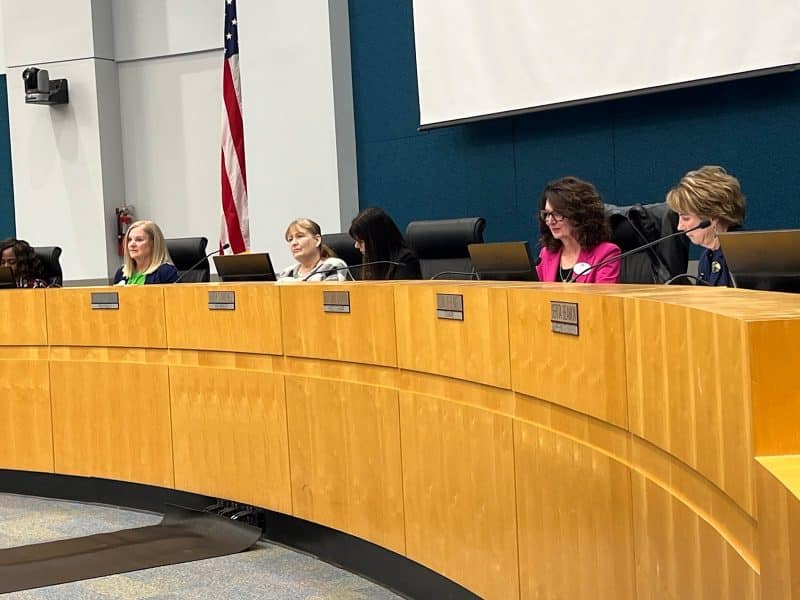
The evening began with an apology, but it ended with a flurry of criticism and potential policy changes. A yearlong “communication breakdown” about the shutdown of Oviedo’s ailing water fluoridation system triggered a barrage of questions at the City Council’s March 3 meeting. The meeting grew tense with Council members digging into how city staff shares information with elected officials and residents, especially since fluoridation was voted for by residents decades ago and has been in place in Oviedo for 30 years.
The city’s system began experiencing issues with the dosing mechanism, which ensures a safe and consistent measurement of fluoride in the water, as far back as December 2023 or January 2024. That mechanism experienced intermittent pausings so as not to overdose the water. Despite officials saying in an email to Oviedo Community News and a post on the city’s official Facebook page last week that dosing was first “halted and restarted at the end of July, ran through August and the beginning of September” before being “primarily off-line since,” it was revealed at Monday’s meeting that the system has only worked for three months since at least the beginning of 2024.

Oviedo’s Public Works Department was recognized during the March 3 City Council meeting for its work, with a Flood Awareness Week proclamation. Director Bobby Wyatt is in the middle (Photo via City of Oviedo’s Facebook)
The Public Works Department did not notify Oviedo residents or elected officials about any issues until February, as it was not in their current protocol to do so, Assistant Public Works Director Alexis Stewart and Utilities Manager Steve Santiago said during the meeting.
“The protocol for that doesn’t call for us to make it a public issue,” Santiago said. “It’s just we are working on it, we’re working on repairs and it’s in-process. It’s not like our compliance issues, where we have to report to the public, to the director immediately that there’s an issue because it’s affecting compliance. It’s not affecting compliance, so it doesn’t get the same treatment.”

A diagram explaining the Oviedo’s water fluoridation system (Schematic provided by the City of Oviedo)
Officials left in the dark
City Manager Bryan Cobb said that he first learned of issues in either late January or early February 2025 and instructed the Public Works team to notify Council. Public Works Director Bobby Wyatt said at the meeting that while he first learned about the issue at a similar time as Cobb, he was recently made aware of an email he was copied on in November by an operator on his team about fluoridation.
A Nov. 27 email to the Orlando Sentinel provided to OCN did not give any specifics about the system being down, though it did say that the amount of fluoride added has “changed.”
“I don’t remember it, to be honest with you but obviously I missed it, so that’s on me and I take responsibility,” Wyatt said. “From an operational standpoint, the staff doesn’t have a political sensitivity like I do.
“[Fluoride’s] been out there on social media and news, but from our standpoint from the operation [side], it’s not a priority,” he said.
A bigger issue?
Despite it not reaching the department’s priority level for notification to the Council or the public, Oviedo Mayor Megan Sladek stressed that that needs to change, and it could be part of a potentially more systemic issue.
“I feel like I owe the City of Oviedo, the residents, I owe you guys an apology,” Sladek said. “This is the latest in a series of oversights where things fell through the cracks for a much longer time than they should have, and the city manager did not say anything, and we sat idly by and allowed a culture of ambivalence, lack of oversight to turn to what it is right now.”
“It’s an all-out apology for not paying enough attention and asking enough questions and allowing a situation to arise that had us have fluoride in the water only three months of the last year,” she said. “You elect us, we hire the city manager. So at the end of the day, [voters] can’t fire the city manager. … All we can do is talk to the city manager and express disappointment that we are in this position.”
The city manager is tasked with overseeing all city operations and serves at the pleasure of the Council. And, while criticism is acceptable, Deputy Mayor Natalie Teuchert said Sladek’s comments went a bit too far.
“Do we have issues where things take too long? Yes, we have brought that up in public meetings multiple times,” Teuchert said. “But to lay it all on the city manager in the way that it was done, I don’t think it was professional at all.
“I do think there is definite room for improvement on a lot of these things, and there’s nothing wrong with sitting down and having a work session and going through how do we fix some of these inefficiencies on how we get things done,” she said.
A messaging mishap?
On Feb. 6, Wyatt sent City Council members an email explaining that the system was experiencing issues, but the wording of the email led council members to believe it was a short-term issue.
“I really thought it was maybe we’re a week or something [that it’s been] off that they sat on this and then told us,” Sladek said.
Officials said that no prior communication efforts had been made because it wasn’t determined to be a “health, life, safety issue,” such as “too much fluoride put in the water,” Oviedo Public Information Officer Lisa McDonald said.
“That’s when we would be called to action to put a message out to people because too much fluoride could be dangerous, of course,” she said. “But when there’s not a health, life, safety issue, they’re not forced to let me know about something like that.”
Stewart said at the meeting, “this is a non-emergency issue, so we were just doing our due diligence fixing it and addressing it as it needed to be addressed. There was no regulatory violation, there’s not a compliance issue … I don’t think there was any oversight.”
Sladek and Teuchert said the problem is not with whether it was an emergency issue, but that a system that residents have an expectation is working was down for the better part of a year without the public works director, city manager, elected officials or the public being notified.
“It was not a health issue,” Assistant City Manager Patrick Kelly said. “I mean, yes, I mean, you can say dental health, but nobody was in danger from the fluoride additive, the hydrofluosilicic acid, not being in the water. Fluoride is always in the water.”
Fluoride, a mineral both naturally found in water and added to community water systems, has been shown to help prevent cavities and tooth decay. Oviedo’s natural levels are around 0.2 parts per million, and it is supplemented to reach close to the national standard of 0.7 ppm. In 2020 73% of the U.S. population was on a community water system receiving fluoridated water, with 78.5% of Florida cities fluoridating.
Due to its dental health benefits, drinking water fluoridation was named one of the 10 great public health achievements of the 20th century by the Centers For Disease Control (CDC). But the mineral has seen recent controversy after statements by recently appointed Secretary of Health and Human Services Robert F. Kennedy, Jr. questioning its use. Florida Senate Bill 700, aka the 2025 Florida Farm Bill, would outlaw the adding of “the use of any additives included primarily for health-related purposes,” including fluoride.
“It’s the only chemical [added to Oviedo’s water] that doesn’t contribute to water quality,” Teuchert said. “It’s a public health initiative, but it is not a water quality issue. And they’re required, for water quality issues, to notify.”
A communication “miss”
Kelly said the concerns in the Feb. 6 email began being worked on following the Council’s Jan. 6 meeting when a number of people spoke about water fluoridation during the public comment section of the meeting. Council members had received multiple emails prior to that meeting from groups such as We Are Change Orlando and Stand Up for Health Freedom, which said they are “actively working to end water fluoridation” in Florida.
“That’s when staff started putting together the information because Council requested a work session item on it,” Kelly said. “That’s sort of what got the ball rolling.”
While Teuchert said she does not believe that the staff purposefully withheld information, and it was just a “miss,” Sladek worried that there may be a philosophical concern on communication.
“There’s a complacency and there is a desire to do whatever staff wants, regardless of what Council direction is, and if staff can get its way by stalling, I don’t know if it’s being used purposefully,” Sladek said. “It’s a public trust issue.
“Just tell us the truth at this point,” she said. “I don’t even know when I’m being told the truth.”
What comes next?
Following the lack of communication on such a hot-button issue, will the city change any of its policies?
“That’s certainly something that we will work with Public Works to get to the bottom of,” McDonald said. “And maybe not just Public Works, but other departments as well for issues like that, because this is really the first time personally I’ve ever come across an issue like this.
“Not just for the city, but across the board for as many years as I’ve been doing communications,” she said. “So it’s certainly something we can look into.”
At the meeting, the Council asked for Public Works to notify them of any issues with the system going forward, to which the department agreed. Additionally, despite previously stating the system would need a $300,000 repair to be able to work again, Stewart said they just had the system serviced and can turn fluoridation back on and monitor to ensure there is no overdosing, and alert the Council if any issues arise. No exact timeline for restarting it was given.
Regardless of when the system is restarted, the city’s communication policy is set to be addressed in the near future. The Council asked for it to be discussed in more depth at an upcoming work session or meeting.
“We’ll sit down … as a staff,” Cobb, the city manager, said. “I’m going to get with the mayor to find out exactly what she says and we’ll start working on it and we’ll bring forward something to the Council that will address their concerns. That’s what we’re going to do.
“Being in a heated situation like that, that happens, and we just have to work through, concentrate more on finding a solution,” he said. “I’ve been city manager for 11 years. This isn’t the first time that Council wasn’t happy with something we were working on. So we focus on the solution.”
Teuchert was more direct in her solution-seeking.
“Let us know what you’re going to do to fix this, and not have this happen in the future,” she said.
Sorry for the interruption but please take 1 minute to read this. The news depends on it.
Did you know each article on Oviedo Community News takes anywhere from 10-15 hours to produce and edit and costs between $325 and $600? Your support makes it possible.
We believe that access to local news is a right, not a privilege, which is why our journalism is free for everyone. But we rely on readers like you to keep this work going. Your contribution keeps us independent and dedicated to our community.
If you believe in the value of local journalism, please make a tax-deductible contribution today or choose a monthly gift to help us plan for the future.
Thank you for supporting Oviedo Community News!
With gratitude,
Megan Stokes, OCN editor-in-chief
Thank you for reading! Before you go...
We are interested about hearing news in our community! Let us know what's happening!
Share a story!
Author

Related Articles

A one-shot deal: Jerry Vaughan honors veterans’ last wishes nationwide
Chuluota veteran Jerry Vaughan crafts reconstructed military uniforms to give deceased veterans a dignified final salute. His hope is, with a new federal bill, he could put himself out of a job.
Seminole County Public Schools approves county’s first community school
Seminole County Public Schools finalized an agreement Tuesday to bring the county’s first community school to Sanford.