
95-year-old Oviedo educator, activist Ophelia Moore has first birthday party
Coinciding with Oviedo’s centennial, Ophelia Moore, one of the city’s longest-lived residents, who lived nearly 40 years under segregation, celebrated in grand style.
At 95 years old, adorned in a gleaming tiara, Ophelia Moore had her very first birthday party.
The party, attended by 138 people on April 19, happened to be in the very spot where Moore started her life-long love for learning, education and sports.
The Antioch Missionary Baptist Church event center, which sits off of Franklin Street in Oviedo, is on the same land which once held the segregated schoolhouse that a young Moore had attended.
“That’s where I started school,” Moore said, known today for her decades-long education career. “It was not in that building but in that area right there on that ground, years and years ago. I started first grade there.”
Her birthday happened to fall within weeks of the City of Oviedo’s 100th anniversary celebration.
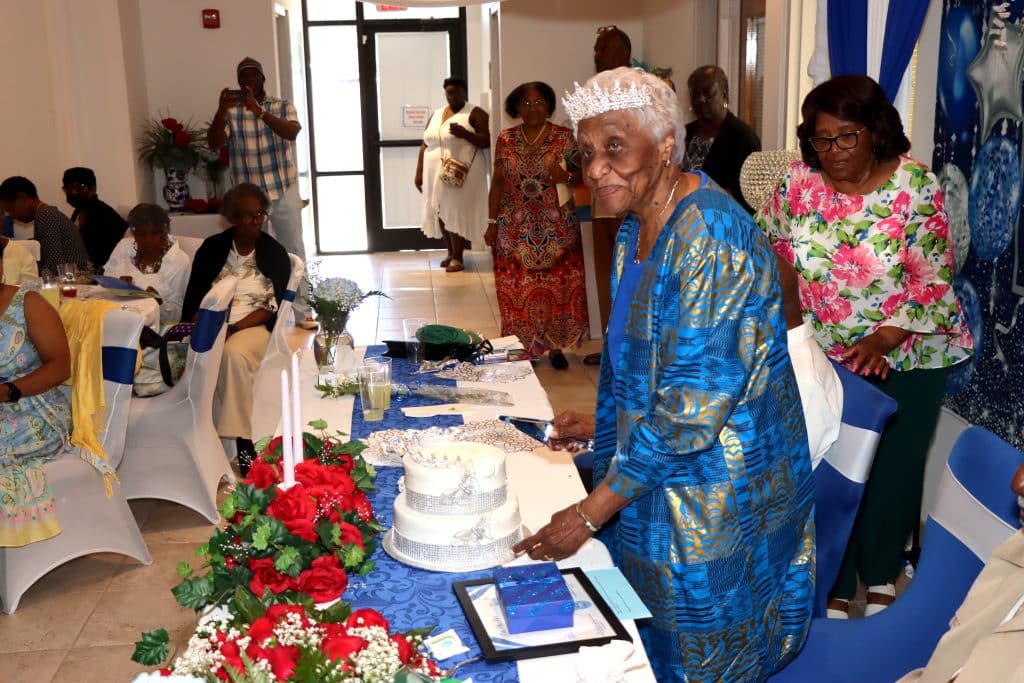
“Just think, 100 years — but Ophelia Moore has been here for 95 of them,” family member Cheryl Moore said in a speech about Moore during the party.
Bettie Miller, deaconess at Antioch, began planning the party in September after learning that she never had a birthday party in her life.
“So many people when we contacted them about the party, said she has been their role model all their life. We had to do something to celebrate her,” Miller said, adding that Moore told her that she’s still opening birthday cards from the party because she had so many. “You saw the feeling in the room. Everyone adores her.”
A focus on education
Born April 15, 1930, Moore is the youngest of three siblings – all raised by parents, George and Rena Bell Jones, in Oviedo where she attended Oviedo Colored Elementary School from first to tenth grade.
Education was of great importance to Moore’s parents, she said. It was the “one thing” they wanted for all of their children to achieve in order to help establish themselves in the future.
“They sacrificed and provided whatever they needed to provide for us to complete our education,” Moore said. “That was a big thing for them back in those days.”
But Moore and other Black students couldn’t attend Oviedo High School to complete their education as it was segregated. She said they all had to find a way to attend another school in order to do so. In her case, it was Robert Hungerford Preparatory High School located in Eatonville, which opened in the late 1800s as a private school for Black children.
Moore’s parents worked to make arrangements for a local, black-owned transportation service to take her to school. As a young girl, Moore said, she didn’t think too much about the experience of having to leave Oviedo to finish her education at the time.
“They provided the way, and I wanted to go to school,” Moore said. “I just did what I had to do to finish my education.”
Those who know of her long standing career in education might think it was an early desire to become a teacher that drove Moore to complete her education, but they’d be wrong. A skilled basketball player in her youth, Moore said it was the sport that kept her initial interest in school.
“I just enjoyed playing ball,” Moore said. “I think that’s one of the things that really got me so interested in my education was basketball, it just got me going. I played here in Oviedo and then when I went to Hungerford I played there.”
Students at the high school were often encouraged by their teachers to pursue higher education, she said, and it wasn’t until that point that Moore realized she was interested in a teaching career. It was Moore’s own teacher, Mrs. Anderson, who pushed her to attend college.
Moore headed north to Tallahasseeto attend Florida Agricultural and Mechanical State College, known today as Florida A&M University, in pursuit of a bachelor’s degree in early elementary education.
One table at Ophelia’s party was half-full of Zeta Phi Beta sorority members who traveled to celebrate their sister. She pledged the sorority at FAMU in 1954.
“I liked their motto, which said ‘A Finer Woman’,” Moore said. “I guess that was encouraging to me. There were several [sororities] on campus, but that was the one that caught my attention.”
Fellow sorority member Myrna Small said Moore “exemplified the true spirit of” that motto as she was presented with a sorority pin at her birthday celebration nearly 71 years after becoming a member.
In 1955, Moore graduated from FAMU and later accepted an offer to work as a fifth grade teacher in nearby Blountstown, Florida while filling in for another teacher’s leave of absence. But it wasn’t long before Moore was given the opportunity to take a position teaching at Oviedo Colored Elementary School, known today as Jackson Heights Middle School, and eagerly returned home.
Looking back on her decision all those years ago, Moore said she couldn’t imagine having gone anywhere else. No matter where she’s gone over the years, she’s always found her way back to the community she’s a part of today.
“Always wanted to stay here,” Moore said. “I guess because my family was here, I never wanted to go anyplace else, except maybe just to visit. I just always wanted to come back to Oviedo.”
Lifelong educator
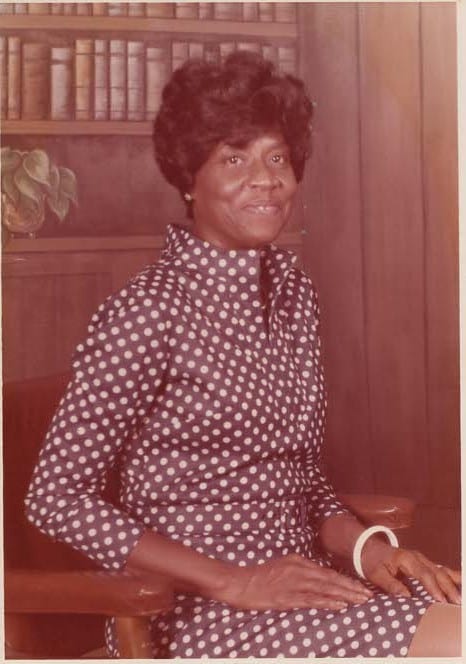
Oviedo Colored Elementary School was renamed in 1961 to Jackson Heights Elementary in honor of Black Oviedo pioneer Henry Jackson. Just a few years later, the school would be integrated along with others in Seminole County by the 1967-68 school year. It then officially became a middle school in 1971, where Moore taught seventh grade language arts. She was one of the first Black educators at Jackson Heights and taught there for 37 years.
Since then, she’s been lauded by members of the community for her contributions to the school’s success. Mayor Megan Sladek, a former student of Jackson Heights Middle School, thanked Moore for how she “transformed that school into something we are all proud of today,” she said during Moore’s birthday celebration.
“She has absolutely helped shape our community,” Sladek said
Thinking back on some of her earliest years of teaching, Moore recalled that many of her first students were so fond of her that at times it seemed they didn’t really view her as an adult, but rather, as one of them.
“I think my children thought that I was just a little girl and just took me as being part of them,” Moore said, chuckling at the memory. “It was just no big deal for them. I was just a part of them and we had a lot of fun together.”
One of those children was Janice Boston, who she said along with other students happily thought of Moore as their “plaything.”
“Then along came [her husband] Bobby,” Boston said. “He took our toy away from us, and we could not play anymore.”
Years later, Moore is still amused by her student’s ire at the loss of their favorite “toy.”
“Oh yes, they were not happy about that because they thought I belonged to them,” Moore said, laughing. “But he accepted them all. We just got to be a big family.”
It was Moore who inspired Boston to pursue teaching. The two would eventually work alongside each other for 10 years as educators at Jackson Heights Middle School. There, Boston said, her teacher finally became her friend.
Though she’s since retired from teaching, Moore’s legacy as an educator appears to stand the test of time. A historical marker was erected at Jackson Heights Middle School in February of 2024 by the Oviedo Preservation Project, which details the school’s history.
It includes information on Moore, reading: “Ophelia Jones Moore was one of the first Black teachers in the newly integrated school, and she lived next to it for more than 50 years,” the marker’s inscription reads. “She was a native of Oviedo, daughter of George and Rena Belle Jones, and a product of the segregated Oviedo schools.”
She said it’s an honor to be included in the marker and be so highly regarded by her community, but it wasn’t a need for recognition that kept Moore’s commitment to education all those years.
It was her desire to help somebody in their journey.
“I guess it was a part of me that wanted to see the children grow up to be better persons,” Moore said. “To see them have a better life and become an adult. It was one of the things that I just hoped that I could help come to pass.”
A pillar in the community
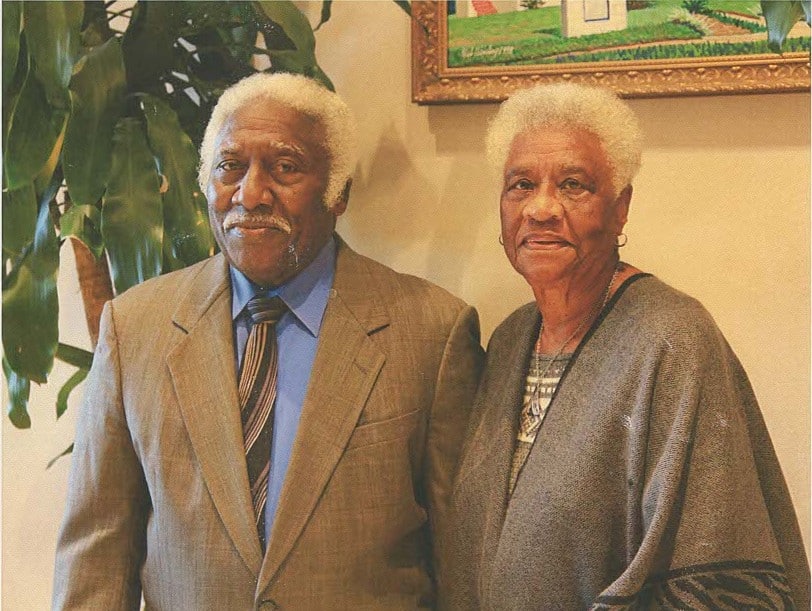
In 1959, Moore and her husband John “Bobby” Moore became engaged after years of having grown up in the small, tight-knit Oviedo community of their youth. They’ve been married now for 66 years, something she said requires always working together and a lot of understanding.
“I always think togetherness will hold any family together,” Moore said. “Whether it’s through marriage or biological family, togetherness and understanding will hold a family together, whatever it is.”
The pair are known for their work in the community, church and their dedication toward service. But it was a calling that extended beyond their careers and faith as many of the city’s residents today recall how Moore and her husband personally helped to raise them as children.
It didn’t matter if they were their biological children or not and it still doesn’t, she said. They took in everybody, from the children of their own siblings to even the students who loved to follow Moore home.
“They make up all of our family, so we have a lot of children,” Moore said.
Charles Jerry Garner, Moore’s great nephew, was one of those children who said she helped to raise and tutor him at her house when he was just six years old.
“I used to sit at a long table and she always cooked a poached egg,” Garner said. “She would make that for me for lunch. She’d make some fantastic homemade macaroni too, the best. I need to get that recipe.”
Garner isn’t the only one with fond memories of Moore’s macaroni recipe from growing up in her home. It’s a favorite amongst much of her family and children, she said, but it doesn’t look like they’ll be getting the recipe anytime soon.
“That’s my secret, my macaroni,” Moore said, laughing. “Maybe I’ll give it up one of these days, but I won’t let them get into that secret. If I do, they might not let me have it for long.”
Garner’s daughter and Moore’s great-great niece NakKeia Robinson said she also was raised by Moore as a child, who she considers to be the “beacon” of their family.
“She would always come by and give me help and raise me and everything when I was younger and I thank her for everything she’s done for us and the family and even the community,” Robinson said.
Moore may be known for her giving nature and role as being a cornerstone of togetherness for her community, but the 95-year-old still has a bit of the competitive streak that helped fuel her success.
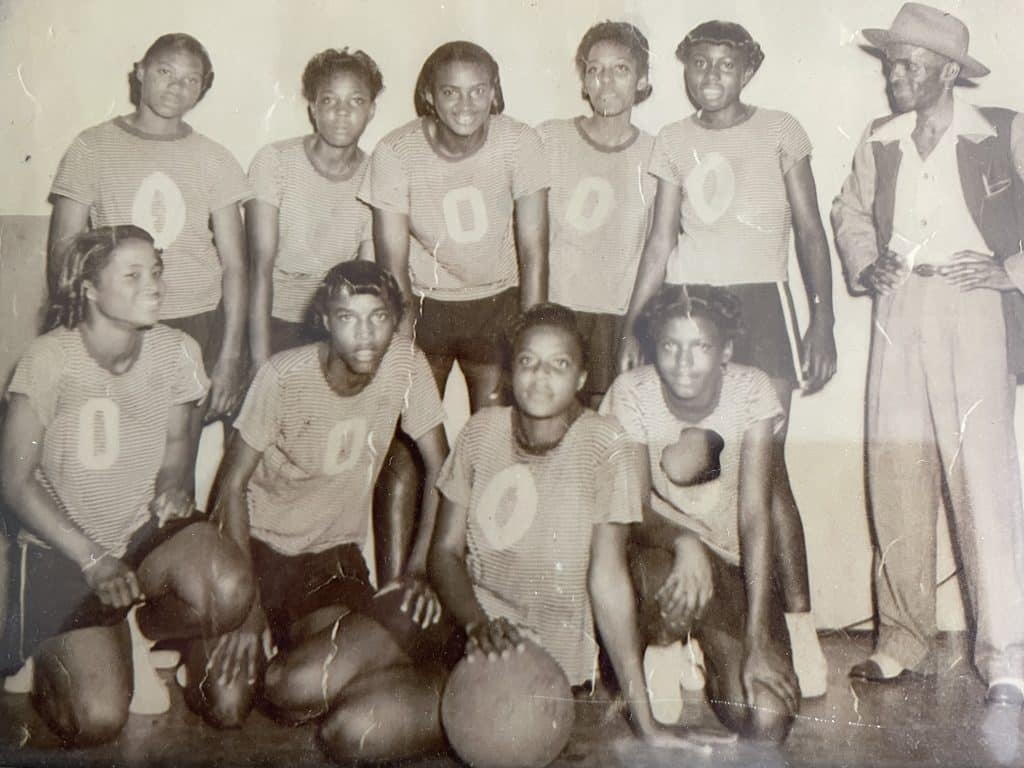
Just ask her about the time the husband of her friend Pat Bythwood challenged her to a one on one basketball game. Make no mistake, the skilled former player will still gleefully tell you the story of her victory even years later.
“He thought he could beat me, and I got up there and I beat him up,” Moore said. “We laugh about that a lot now. He still wants to get even with me, but I won’t allow it.”
She said she’s still a point ahead, after all.
Moore is often humble when describing herself and her accomplishments, but has no such reservations when it comes to appreciating the many friends and family who she said fulfill her life in a way she still almost can’t believe all these years later. On the day of her birthday celebration it was heart-warming, she said, to see all of her children in one room simply there to be with her.
She said she’s still not sure how she’ll ever thank them.
“It has been a rewarding day,” Moore said that day in April, smiling as she had cast a look around the room. “I’ve been here for life, and to see all my people — I call them all my people. It’s just added more to my life than I could ever imagine. I just appreciate everybody.”
“Advantage to society”
Beyond her extensive efforts as a teacher over the years paving the way for local Black students, Moore also dedicated herself to activism work that would help to advance her local community. She was instrumental in helping to form Oviedo Citizens in Action in the 1950s, a group which aims to “to aid, encourage, and foster community improvements and participation of low income families in Central Florida.”
“The thing that was a concern [for the founders] was to help others to advance in the community,” Moore said. “I think that that’s what the OCIA was developed for, and we worked hard to make it come to pass.”
The local community needed a group that could help those in need take advantage of opportunities to better their lives, so Moore said she and other concerned residents worked tirelessly to bring their vision to life.
“We worked really hard to see some of the advantages that were available that people could take advantage of and become better persons,” Moore said. “It’s still trying to do that same thing now.”
She said those who run it now have the same passion and interest in keeping its mission going that Moore and the original founders did.
It’s what she hopes will continue to keep OCIA advancing into the future.
“I hope that kind of concern [for the community] will last for years in the future,” Moore said. “That’s the thing I’m hoping for … because I’m telling you, sometimes the times get so hard. You just look back and just hope that it continues to advance.”
Beyond OCIA, Moore has also contributed to the community through her work with the Antioch Missionary Baptist Church, of which she is an active member serving as clerk and deaconess.
But she’s also served as a mentor for many at Antioch, church member Cora Dixon said, working with members in their times of need.
“I’m a deaconess, I still work with helping the families to make arrangements for the funeral services of their loved ones,” Moore said. “I work a lot with the families still, in their time of bereavement I meet with them.”
When asked what kept her working actively with the church all these years, Moore’s answer was simple.
“My love for people,” Moore said. “I just always wanted to be there for them. Just always wanted to help somebody, I think. I guess I’m just like that song, as I pass along I’m going to help somebody.”
Living history
In an interview with OCN, Sladek said she and many others in the city consider Moore and her husband to be Oviedo’s resident “fact checkers,” a designation Moore herself appears to agree with though she uses the phrase “old originals.”
“[Bobby] was born here too, both of us were born right here in Oviedo,” Moore said. “He spent seven years in the service, but other than that he was right here, too. Both of us, right here in Oviedo.”
Moore said she was always a member of Antioch and grew up in the church. It was much smaller back then, she said, a wooden A-frame building that at the time could seat a maximum of about two hundred guests.
“Now, it’s over five hundred,” Moore said. “It’s a great deal, a great change, but it was always right there. Always on that same parcel of land.”
Downtown Oviedo as it stands now is “amazing” for Moore to see, she said. It’s advanced so much, but she still remembers when heading down there only took traveling on one main road.
“Many years ago the front of the church would face the downtown Oviedo area,” Moore said. “And then boy, it just grew and grew and grew.”
It also amazes Moore at times to think about how far advancements in transportation have come, as traffic has continued to grow over the years in a way she’d never expected it to.
“There was very little traffic when we would be coming home walking back then,” Moore said. “We didn’t have transportation like we do now. I lived down in this area, we would walk home from church at night and almost be walking in the middle of the road.”
But in her mind, Moore can still envision a more rural, smaller version of Oviedo than the one that exists currently. There were chickens everywhere back then, she said, far more than she sees today.
What there wasn’t much of, however, was people.
“At that time, there were not a whole lot of people living in Oviedo so at church we were just like one family, all the same family,” Moore said.
It was easier back then to form close bonds in such a small community, Moore said. It was how she and her husband met long before they ever got engaged, growing up as children of rural Florida in an area where agriculture like citrus and celery once reigned supreme.
“And all of that was just farmland, right there near where the Citizens Bank was,” Moore said. “But now you see how much it has changed from when I was a little girl. Celery farms were in that area when I was growing up. It’s changed, paved now and everything.”
That change didn’t happen all at once, though. It was slow coming, she said, recalling the shift away from the little farms, one room schoolhouses and dirt roads she knew as a child.
“It was that way for many, many years as I was growing up,” Moore said. “But then once it started, it just took off and it kept advancing. I’ve seen a lot. … and even when I look at [Orlando] on the TV, it’s growing even greater and much faster.”
With Oviedo’s first 100-year celebration comes a question for today’s residents of the city’s distant future. It’s Moore who knows, perhaps better than anyone, just how much the city can change in just a few years — let alone in 95 of them.
Perhaps that’s why Moore’s belief in Oviedo’s future isn’t in the city itself, but the people who make it up. Just as long as the community can stay together, she said. If people can do that, learn to agree and disagree as one and show each other love, Moore believes they will always advance in all endeavors.
“That’s my hope for Oviedo,” Moore said, pausing a moment before her final comment. “My continued hope that we will continue to advance — together.”
Support local news!
Choose a monthly amount
Hometown Hero
Community Champion
Rooster Society
Custom Amount
Thank you for your support!
Author

Related Articles

Vote next week could help pull former Pappy’s Patch from rural boundary
Developer Chris Dorworth is ultimately looking to build 136 single-family homes in a move conservationists call a fight over the future of Seminole County’s rural boundary.
Winter Springs City Commission candidate Kyle Stewart: ‘I’m not a Christian nationalist’
Five-year-old podcast resurfaces where Stewart says ‘Amen’ after the host says non-Christians should be barred from office.
Winter Springs Commissioner Paul Diaz wants to see comparisons for county to provide police
In the wake of Amendment 3, Diaz says the big-ticket items – parks and police – should be on the table.