Winter Springs reaches plan approvals for retail developments
New retail developments in Winter Springs may mean more food options, but at the cost of more than 150 trees and not without a fight.
The Winter Springs City Commission has its eye on development, approving two long-standing major retail projects, Chick-fil-A and Ace Hardware, at the latest Commission meeting on May 22.
Development has proven a divisive topic in the city as of late, with recent Commission meetings seeing some residents call for increased efforts to attract businesses while others express concerns about future overdevelopment.
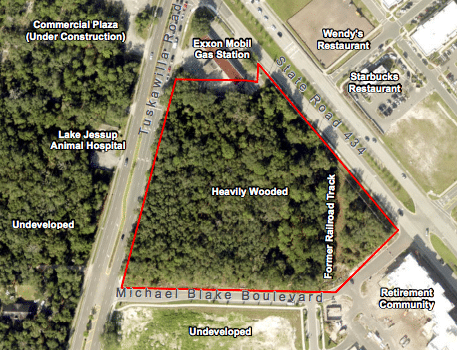
Regardless, both projects are slated to move forward as phase one of the 6.4 acre development known as Sutton Crossings, a shopping center consisting of five lots at the intersection of State Road 434 and Tuskawilla Road.
South of that intersection is the new Chick-fil-A, a 5,576-square-foot restaurant with a drive-thru located on the southeast corner of the intersection of East State Road 434 and Michael Blake Boulevard.
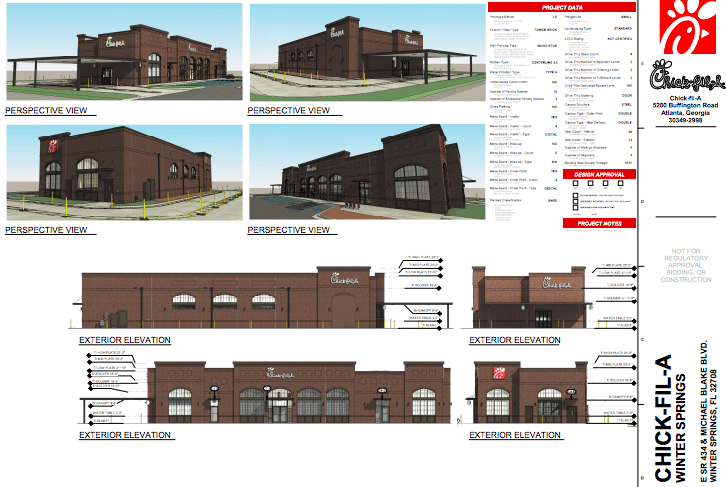
Approval of the final engineering and development plans still comes with additional stipulations that must be met before construction can begin, Director of Community Development Terrilyn Rolle said during the meeting.
Among other conditions for the development of the Ace Hardware, Rolle outlined a disagreement with the applicant about how many trees they would need to pay the city for permission to remove, a number known as “mitigation credits.” The city had previously listed all trees with a trunk diameter of 10 inches or larger and informed the builder they’d need to pay for 89 mitigation credits, but has recently revised that number higher.
The city’s arbor ordinance outlines fees required for the removal of trees with a diameter at breast height, or DBH, of four inches or greater, with exceptions for trees that are dead, diseased or pose a safety hazard. It also stipulates an alternative approach of replacing trees to offset mitigation credits for ones that are cut down.
“They have 89 credits from the arbor review that was done on the trees greater than 10 inches, but the code says trees have to be replaced starting at four inches,” Rolle said. “So there are…176 trees that are being removed that need to be replaced or paid into the tree fund.”
In this case, Rolle said the applicant was being asked to pay $52,800 for the removal of the 176 trees not considered in the original report.
But applicant representative Wes McMillan said they’d been “hit with new information” when presented with the additional mitigation fee while finalizing the development agreement a month prior, asking the commission to reconsider the fee.
“Now we’ve got an additional $52,800 that we have to pay that hasn’t been part of the agreement and understanding with the city for the past two and a half years,” McMillan said. “So it was kind of a surprise to us. And trying to understand the basis for that, we didn’t really follow the basis.”
McMillan said they’d hired an approved arborist to work with the current city landscape manager at the time on the proper assessment and requirements for the trees on site, arguing the 89 mitigation credits had already been agreed upon by then.
But according to City Attorney Anthony Garganese, neither that reasoning nor the previous understanding could stand up against the city’s code requirements.
“I think what you’re hearing tonight is he had a so-called agreement with a city staff person who didn’t have authority to actually enter into an agreement,” Garganese said. “The city staff person has an obligation to comply with chapter five of the code.”
He added the amount being asked for was on the lower side of mitigation fees in comparison to other past projects in the city.
Rolle said while McMillan was correct regarding the previous arbor review requiring 89 credits, the project could only “push forward” by following city code.
“Not city staff, not the director, not the arborist, but the code dictates the mitigation,” Rolle said. “…That arbor review did not include the four-to-nine-inch trees, and the code says four-to-nine-inch trees need to be accounted for. That’s why today, two years later, there’s additional information brought to the applicant that was not previously discussed per the code requirements, not staff agreements.”
With Deputy Mayor Cade Resnick absent from the meeting, a motion to approve the project plans including staff’s recommendation for the mitigation fee requirement passed 3-1 with only Commissioner Paul Diaz dissenting.
“Taking down trees in Winter Springs, we’re not fans of it,” Mayor Kevin McCann said. “But we have to offer relief, allow you [the applicant] some way to resolve it and move your project forward. Every project pays those fees.”
Conditions for Chick-fil-A’s approval are limited in comparison, with requirements like the inclusion of bicycle and pedestrian access infrastructure and attaining an environmental resource permit from the Saint Johns River Water Management District prior to a building permit.
The development has already faced bigger challenges in the past with the criticism of residents from the senior-living center, The Savoy, who voiced concerns early on over the safety of seniors, due to their close proximity to the restaurant.
But the biggest challenge for the site itself has been the building’s attached drive-thru window, as applicants had requested it be installed on the northern side despite Town Center District Code requiring they be located on the rear of a site.
Lowndes law firm attorney and applicant representative Joseph Kovecses said placing the window on the side yard would allow for the maximum amount of queuing around the building while keeping cars in line away from The Savoy.
“If anyone’s ever been to a Chick-fil-A, cars are running through there pretty quickly,” Kovecses said. “We just wanted to make sure we had enough space the way that building was oriented to accommodate those vehicles.”
Increased traffic from the site has also been a concern for some nearby residents. With consideration for the popularity of the restaurant’s drive-thru and a need for optimal traffic circulation and pedestrian safety, Rolle said staff had recommended the window requirement be waived.
“They submitted a waiver application because this drive-thru goes pretty much around the entire site,” Rolle said. “…That’s just the nature of [Chick-fil-A’s] business. They’re going to have some landscaping that was recommended by staff to buffer some of the drive-thru lanes.”
The motion to approve the project plans with staff recommendations passed unanimously.
An exact start date hasn’t yet been confirmed for either project, but the conditional approval of the Chick-fil-A and Ace Hardware sites means Winter Springs residents may see development of those retail spaces sooner rather than later.
And while public consensus on the future of the city’s development may vary, some residents, including recent District 3 Commissioner candidate Karen Meyer, are looking forward to having more business come to the city.
“I’m pleased to see the city in a development frame of mind,” Meyer said, addressing the dais. “We need to keep moving forward.”
Want to contact your elected leaders and weigh in on this topic? Find their contact information here. Have a news tip or opinion to share with OCN? Do that here.
Sorry for the interruption but please take 1 minute to read this. The news depends on it.
Did you know each article on Oviedo Community News takes anywhere from 10-15 hours to produce and edit and costs between $325 and $600? Your support makes it possible.
We believe that access to local news is a right, not a privilege, which is why our journalism is free for everyone. But we rely on readers like you to keep this work going. Your contribution keeps us independent and dedicated to our community.
If you believe in the value of local journalism, please make a tax-deductible contribution today or choose a monthly gift to help us plan for the future.
Thank you for supporting Oviedo Community News!
With gratitude,
Megan Stokes, OCN editor-in-chief
Thank you for reading! Before you go...
We are interested about hearing news in our community! Let us know what's happening!
Share a story!
Author

Related Articles

A one-shot deal: Jerry Vaughan honors veterans’ last wishes nationwide
Chuluota veteran Jerry Vaughan crafts reconstructed military uniforms to give deceased veterans a dignified final salute. His hope is, with a new federal bill, he could put himself out of a job.
Winter Springs approves $600,000 in emergency repairs to wastewater system
Officials say they’re 90 days away from breaking ground on a treatment plant – but equipment failures have the city keeping the environmental regulators appraised