Winter Springs development avoids fees while cutting trees
City attorney warns the 3-2 vote could set a precedent allowing more trees to be cut in the city with fewer financial repercussions to developers.
A longstanding retail project will avoid paying over $200,000 in tree mitigation fees to the city due in part to “confusing” legal documents. The decision came on a narrow vote by the Winter Springs City Commission during its June 23 meeting, after the city’s attorney warned that the decision may set a precedent that sees many more trees cut down without the city receiving compensation in the future.
The project, known as the Sea Hawk Cove Extension, is an 8.11-acre property located at the northeast corner of State Road 434 and Michael Blake Boulevard within the city’s Town Center District.
The project’s applicant is listed as James Herbert, project engineer for the consultant group NV5, alongside the property owner referred to as Tuskawilla Retail Partners II LLC.
Senior Planner John Rabon said the extension project would service five lots with a mix of residential and commercial use, of which pending final engineering and site plans had been recommended for Commission approval by the Planning and Zoning Board subject to certain conditions.
One of those, Rabon said, included an arbor fee payment of $227,400 for the project’s tree removal mitigation.
The city’s arbor ordinance outlines fees required for the removal of trees of a certain diameter with exceptions for trees that are dead, diseased or pose a safety hazard.
City attorney Anthony Garganese said the extension is another phase of the existing Winter Springs Town Center Phase Two project and would use portions of the site’s remaining commercial parcels, but that the issue at hand dealt with the current project’s arbor fee.
That’s because applicant representatives argued the fee had already been paid years prior pursuant to the original development agreement, citing legal documents that project attorney Allison Turnbull Jones said contained “confusing” wording.
“We’re just asking that the city honor this arbor fee issue from the original agreements,” Jones said. “It’s not really a waiver because we’re just abiding by the agreements that already exist.”
But Garganese disagreed, claiming there “was more to the story.”
City attorney says fee still owed
That story began back in March of 2015, he said, when the original property owner known as Winter Springs Holdings LLC received approval of the original development agreement described as a “concept plan for the future Winter Springs Town Center.”
The group later worked with the developer Pollack Shores to build a multi-family project on the property, now known as The Blake Apartments.
In December of 2015, Garganese said the city’s community development director emailed him with the project’s arbor fee calculations during the first modifications to the development agreement.
Those were based on the over 6-acre property for The Blake Apartments and totalled $275,750, an amount included in the first modification agreement and approved by the Commission with the apartment site’s final engineering plans.
But the representative for Winter Springs Holdings never signed the first version of the modification agreement, Garganese said, and another developer known as Catalyst Development Partners later took over the apartment construction.
“I found old records that indicate to me when the tree mitigation fee was calculated for The Blake Apartments, the former community development director calculated that fee for just The Blake Apartments,” Garganese said, adding that number was later reduced to about $149,000 due to arbor ordinance updates.
He said the Commission would hear the applicant argue that when the first modification to the development agreement for The Blake Apartments had been approved, the arbor fees paid at the time of construction were for the entire phase two property.
If that was true, he explained, it would mean the $227,400 fee being asked for by the city to continue developing the remaining land west of Michael Blake Boulevard would no longer apply.
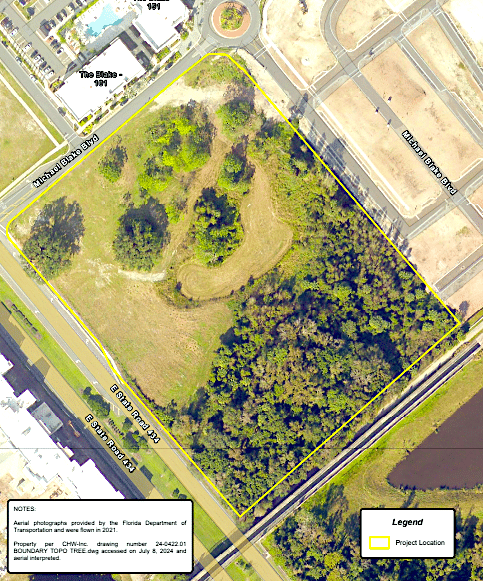
Cautioning against excusing the fee for the property’s commercial component, Garganese warned doing so could cause issues down the road with the nearby remaining undeveloped land located north.
“There’s a lot of trees on that property,” Garganese said. “You waive it here, they’re going to come back to the next portion and say that they’re entitled to the same waiver based on their argument.”
Arbor fee already paid, attorney argues
The entire disagreement appeared to hinge on one letter. Speaking on behalf of the applicant, Jones said the “confusion” over the matter stemmed from discrepancies in the original development agreement in which she outlined language defining the total property and the project.
She argued that from a legal perspective the word “Project” being capitalized in the original agreement document had made it a term of art, a word which acquires a distinct legal meaning, that’s defined as encompassing the entire property site and not specific project phases.

“The property is defined as the entirety of the whole thing,” Jones said. “All phases, everything. If you go to the first modification, it references the property more particularly described in that certain development agreement. The legal description in the original development agreement is the entirety of the property.”
Jones argued the first modification agreement isolated the $149,000 arbor fee and stipulated the payment would be for the “the Project.”
She said because the original agreement had defined the capitalized version of the word to include the land “east and west of Michael Blake Boulevard,” essentially the entire property, the usage of the capitalized term in the modified agreement would retain the same definition.
That meant the arbor fee paid at that time had actually been for the whole property including the land being developed currently, Jones said.

She added that the developer had already spent nearly $2 million prior on infrastructure work that the agreement made clear was intended to cover all current and future phases of the project, including the final arbor fee of $149,660 set in the first modification to the development agreement which had already been paid in 2017.
“They handled pretty much all of the capital expenditures for the entire city center project up front when they did the original development agreement and this first modification,” Jones said. “It’s not surprising that the arbor fee refers to the arbor fee for the entire project, because that’s how the infrastructure was handled.”
Commissioner Victoria Bruce said the city had proof of check payments made in 2017 for a portion of the $149,660 arbor fee with a total of $16,160 paid for specimen tree removal and permit costs, but no record of payment for the remaining $133,500 owed beyond an invoice.
“I don’t have that info in front of me, but that payment has been made,” Jones said. “So we are happy to confirm that, however you need.”
Director of Community Development Terrilyn Rolle confirmed no proof of that payment had been found by staff, though she acknowledged the city’s records ran on an “older system” that may have been why the payment record was missing.
Jones said market conditions and restrictions in the original agreement regarding multi-family uses had hindered the project, but that now was the time for it to proceed.
“They relied upon this arbor fee being for the entire project,” she said. “They calculated all of their budgets, they’ve entered into contracts with…people that they are selling property to based upon this having been already paid.”
Commission split in face of resident backlash
While some dais members took issue with the argument’s reliance on legal technicalities, Commissioner Paul Diaz said the applicant had based their understanding on the wording of the documents and he didn’t constitute excusing the arbor fee as a waiver.
“I find the arbor situation to be absolutely laughable at best, and probably unconstitutional to begin with,” Diaz said. “…You have private landowners that are being told how to deal with the trees on their property. This has already been paid for.”
Former Winter Springs Mayor Paul Partyka, speaking on behalf of the applicant as the property’s agent of record, said the nearly $50 million project would bring tax benefits to the city as well as needed development.
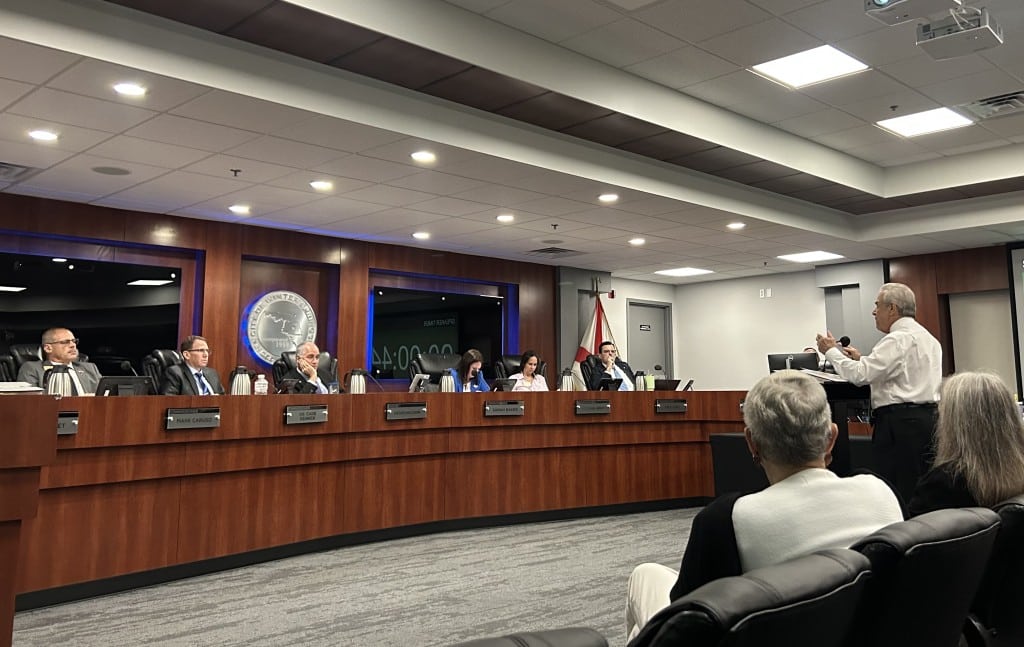
“You’re right, we don’t want to give any money,” Partyka said. “We’ve already prepaid this stuff way back when … Part of the adjusted arbor fee, which is in that document, says we effectively pay for everything for the future.”
As required for the public record, all five city commissioners disclosed that Partyka had met with them individually prior to that night’s meeting to discuss the project’s discrepancies — a detail resident Sheila Benton said she found “unnerving.”
“How do you represent me?” Benton said, addressing the Commission. “How do you represent the citizens of Winter Springs when you’ve already met with the property [representatives] and already formed an opinion?”
Resident Art Gallo said the argument had come down to a “very poorly written legal document,” but he couldn’t understand why a developer would pay arbor fees for land they didn’t yet have plans to develop.
“I think the developer knows full well what the project was at the time, and so I think legally, they got us over a barrel,” Gallo said. “I’m upset with this developer that this is the way they want to come into the neighborhood again … You’re pulling a fast one. I’m a resident here in the city and you’re not getting on my good side.”
Jones said the developer would still be willing to pay $7,200 for the mitigation fees to remove three specimen trees 2 feet or more in diameter on the property and would also abide by staff’s condition to preserve a 52-inch live oak near the corner of Michael Blake Boulevard and State Road 434.
She later clarified that while the applicant believed in the reasoning as to why the current arbor fee would not apply, they were also “not insensitive” to the importance of the city’s trees.
“I don’t want you to think that at all,” Jones said, addressing the Commission. “The problem is we are going by the governing documents, we are going by the contract.”
Commissioners initially struggled to come to an agreement on a motion, ultimately voting on one to clarify the paid 2017 arbor fee had encompassed the entire property in question while also approving the project’s current final engineering and site plans.
Approval would be contingent on payment of the $7,200 tree fee and submission of proof for the unaccounted $133,500, but the project would no longer require payment of the current arbor fee for $227,400.
The motion passed 3-2, with Commissioner Sarah Baker and Deputy Mayor Cade Resnick opposed.
As the meeting concluded, Mayor Kevin McCann said though he had wished to see the project move forward, he couldn’t help but feel “deeply disappointed” in the resulting vote.
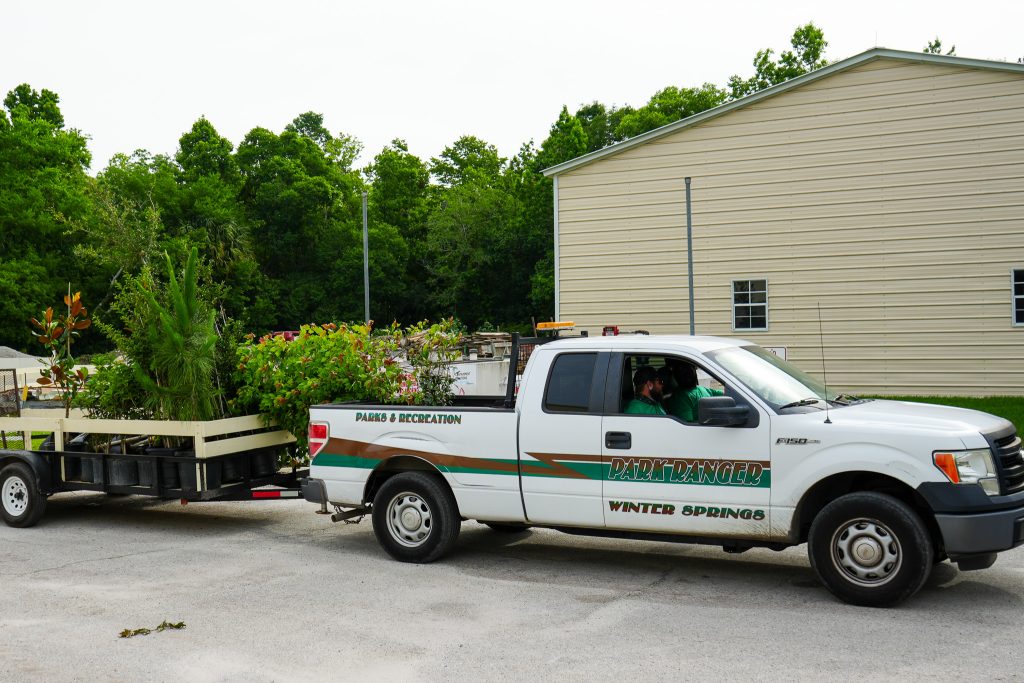
“That [almost] quarter of a million dollars just put a bullet in our tree giveaway program,” McCann said. “The unintended consequences are when you come in and you cut down a tree, you replace a tree somewhere else — we just lost the funding for that.”
Want to contact your elected leaders and weigh in on this topic? Find their contact information here. Have a news tip or opinion to share with OCN? Do that here.
Sorry for the interruption but please take 1 minute to read this. The news depends on it.
Did you know each article on Oviedo Community News takes anywhere from 10-15 hours to produce and edit and costs between $325 and $600? Your support makes it possible.
We believe that access to local news is a right, not a privilege, which is why our journalism is free for everyone. But we rely on readers like you to keep this work going. Your contribution keeps us independent and dedicated to our community.
If you believe in the value of local journalism, please make a tax-deductible contribution today or choose a monthly gift to help us plan for the future.
Thank you for supporting Oviedo Community News!
With gratitude,
Megan Stokes, OCN editor-in-chief
Thank you for reading! Before you go...
We are interested about hearing news in our community! Let us know what's happening!
Share a story!
Author

Related Articles

A one-shot deal: Jerry Vaughan honors veterans’ last wishes nationwide
Chuluota veteran Jerry Vaughan crafts reconstructed military uniforms to give deceased veterans a dignified final salute. His hope is, with a new federal bill, he could put himself out of a job.
Winter Springs approves $600,000 in emergency repairs to wastewater system
Officials say they’re 90 days away from breaking ground on a treatment plant – but equipment failures have the city keeping the environmental regulators appraised