Local business leaders prioritize customer loyalty in light of tariff changes
Oviedo businesses learn to weather “a temporary disaster” as a slew of new tariffs cause them to adapt.
For Scott Silvey at Spirit Gear Unlimited, a custom printing service located on Remington Drive in Oviedo, the impact of tariffs on the economy is just another temporary disaster.
SGU fared well through the COVID-19 pandemic with support from a company in China that supplied masks and hand sanitizer. When Hurricane Milton stormed through Central Florida in October of 2024, SGU gave out a hurricane discount.
Now, Silvey is looking into the eye of a different storm: tariffs. He’s noticed similar patterns between his community’s responses to new tariffs and emergencies such as previous hurricanes or the COVID-19 pandemic.
“It’s happened before,” Silvey said. “When there’s a hurricane, people are buying up water…there’s always going to be something, whether it’s in the pandemic, whether it’s someone in office, it doesn’t matter.”
He believes there is no need to stock up on certain products.
“With tariffs, too,” Silvey said. “I don’t think there’s any need to hoard all the hand sanitizer and the eggs.”
SGU, Silvey has explained to clients, has seen impacts from U.S.-imposed tariffs that began taking hold in April, but says he has no plans to drastically increase his company’s prices. A lot of the company’s suppliers have not raised prices yet and the company is going to do its best to keep their prices what they are, he said.
“It’s hard when we’re getting hit with [10%] increases not to do anything,” Silvey said. “We’ve effectively jumped our prices a little bit, kind of keep pace with the industry. Not the full [10%], but roughly 3% just to help with the disadvantage.”
Since President Donald Trump’s self-proclaimed “Liberation Day” in April, inflation has been reflected in minor changes in the costs of consumer goods.
Consumer prices in April, during the president’s announcement of his two-tier tariff structure, were up 2.3% from a year ago, and rose to 2.4% in May, according to the U.S. Bureau of Labor 12-month Consumer Price Index report. It rose to 2.7% in June.
Trump’s tariffs imposed in April were done with the authority of the International Emergency Economic Powers Act of 1977. On July 27, Trump announced a deal made with the European Union that would set its reciprocal tariff rate at 15%, according to the Tax Foundation.
As of July 7, Trump has extended the modification of reciprocal tariff rates to Aug. 1. One of the largest recipients of Trump’s reciprocal tariffs was China. China is the largest producer of tin, which increased in price by 2.78% last month, respectively.
In response to news of both the base 10% tariff and corresponding reciprocal tariffs, one U.S. wholesale supplier is directly affecting the business of Oviedo-based spirit apparel and screen printing company, Atticus Printing.
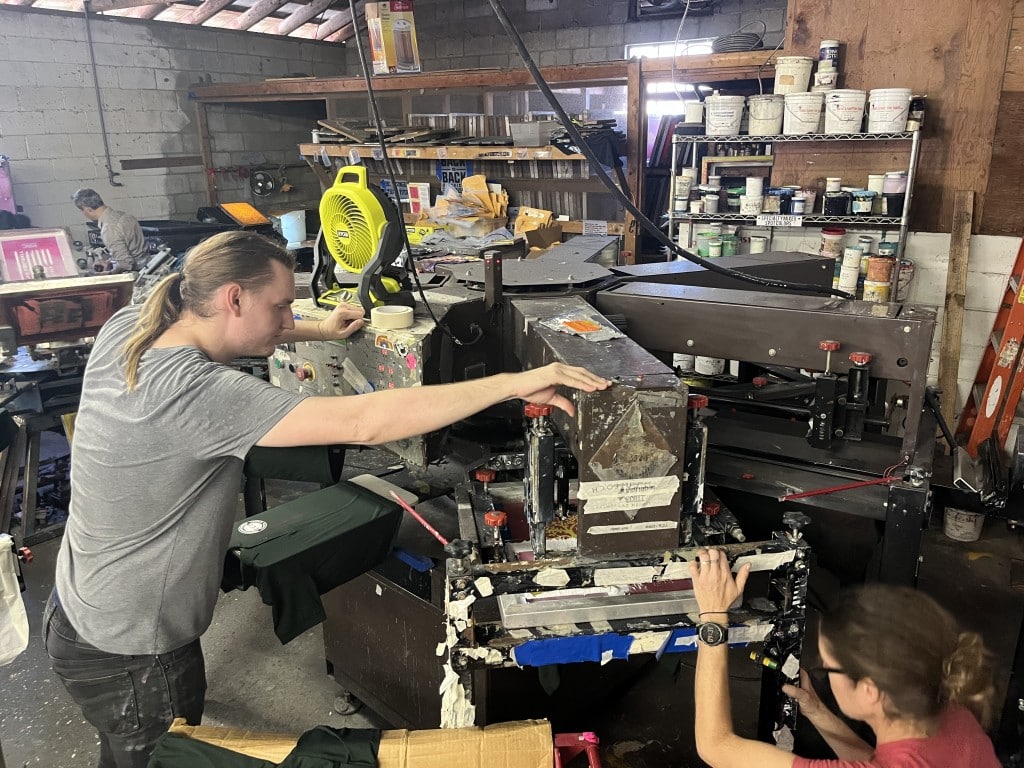
SanMar, a wholesale supplier based in Washington, keeps its client base updated on changes the company is making with each national update on tariff policies. On April 18, Atticus Printing co-owner Amy Ansbaugh received an email from SanMar CEO Jeremy Lott.
“Customers paying by credit card will see a new 3% surcharge,” Lott stated in the email. “This will offset credit card transaction fees we currently pay and has long been a standard practice among many industry suppliers.”
With the 3% surcharge from its wholesale supplier, Atticus Printing has had to shift gears on how they are purchasing gear for the company.
“All of our orders were always done through American Express, and it selfishly was because we got points,” Ansbaugh said. “But now with the 3% surcharge, those points don’t offset the 3%, so we just have to go to a cash basis, which is fine for us. For other companies that are living off of credit while they’re starting their companies up, I can see how debilitating it might be having to pay a 3% increase on the wholesale price, plus a 3% increase on a credit card because they don’t have the capital to buy the goods without putting it on credit…For us, it was just a matter of using some privilege.”
While not yet in effect, the reciprocal tariffs have raised concerns about some popular consumer products. The president’s plan includes a 46% tariff on goods imported from Vietnam, the world’s second-largest producer of coffee.
As of May, the average price for a cup of coffee in the U.S., 100%, Ground Roast, all sizes, was $7.93, a $1.94 increase from last year, according to a report by the Bureau of Labor’s Consumer Price Index average price data.
“It depends on what industry you’re in,” Silvey said. “You can hide the smaller products, more than the larger, like 3% on a cup of coffee, what are you talking, nine cents? Or 6% is about 18 cents? Is that going to be noticeable?”
Coffee is a commodity that Silvey believes consumers won’t notice a change in price in. Natalie Teuchert, Deputy Mayor of the City of Oviedo, suggests that standard utilities will have heavier impacts.
Teuchert, who manages The Wedding Barn, a family-owned wedding venue in Oviedo, had to buy parts for the venue’s air conditioning system. Teuchert said that the cost of these parts had increased, and her AC supplier claimed it was a direct result of tariffs.
“Putting an extra tariff and saying it’s taxing where the product is coming from, we all know it’s taxing the end user,” Teuchert said. “When I go to buy a part for my AC system and there’s a tariff because of whatever country it came from, the country it came from is not paying for it; I am, as I’m buying it, so I’m not a fan of that.”
Ansbaugh, whose company is dependent on cotton supply, said she is faced with a tariff when importing it.
“It’s hard to imagine that we’re growing most of the world’s cotton, but exporting it to another country so that we can only import it back to sell it to the people who are growing it, basically,” Ansbaugh said. “What’s weird is you’re gonna have a tariff on the export, but then you’re going to get slapped with a tariff from importing it, so it’s like in this loop, it’s a conundrum.”
Sean Snaith, the Director of the Institute for Economic Forecasting at the University of Central Florida, described in his Spring 2025 U.S. Forecast that businesses and consumers will adjust to these changes over time.
“The tariff and trade uncertainty will not result in the U.S. economy entering a recession. It may, however, cause growth to be somewhat lower than it would have been in the absence of the disorder,” Snaith stated in his report. “Tariffs do not cause inflation; inflation is the increase of the price level in the economy.”
Atticus Printing is holding off on alerting customers of the effects of the tariffs on prices, but has been in contact with its suppliers about being proactive.
“We’re not sure when we [will] actually have to raise the alarm,” Ansbaugh said. “For now, we’re just kind of absorbing it and doing our own cost-cutting here. I think everybody’s in the same mindset of let’s wait and see and just keep working as hard as we can to get our customers the best product possible.”
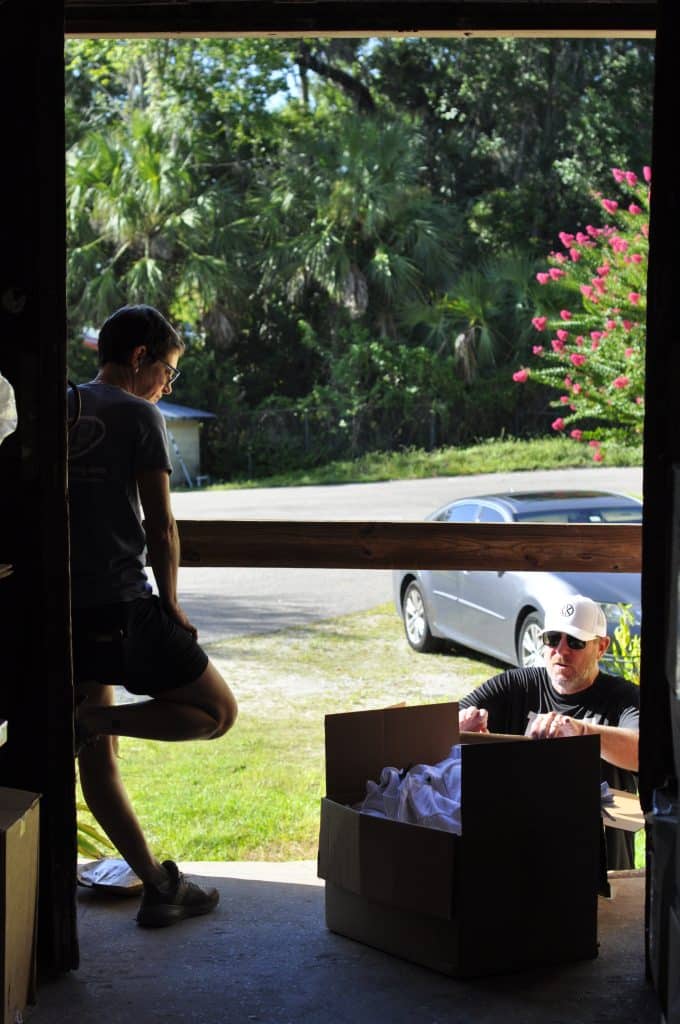
Silvey believes that if you go about the effects of tariffs the right way, any industry and any business, big or small, can be sustained.
“If you treat it right, and don’t get greedy and don’t miss the whole customer service piece of it,” Silvey said.
Silvey, being a member of the local Oviedo Business Network International (BNI) Chapter, said that it allowed him to grow his network. Financial Advisor for Thrivent Financial and fellow BNI member, Marc Abraham, said the chapter’s goal is to build relationships and benefit each other’s clients.
“You’re going to see the cost go up for the actual small business on different things that they purchase, depending on where and when they purchase it from,” Abraham said. “You’re going to see a tightening of the belt in terms of the staff. Is every position needed? Can it be cut down?”
Based on what Abraham has discussed with other individuals around the Oviedo area, the increase in prices is frustrating, but items have already been getting expensive recently due to inflation being high for years.
“There is that push and pull on people that want to pay a low price for things, but also recognize that there is some positive that comes with these tariffs, but the frustration of paying more sometimes doesn’t outweigh sometimes the morality of it or sometimes the good that could come from it long term,” Abraham said. “So that’s what I’m seeing quite a bit of.”
Abraham said he believes that this time is a chance for local businesses, small and new, to have a once-over to see what they are spending and see if they can do it more efficiently.
Spirit Gear Unlimited takes the time to educate its clients on the current state of tariffs, so there is no danger of losing them as loyal customers.
“I’m just a firm believer in being honest and being up front with people,” Silvey said. “You’ll get results that way.”
If small businesses either have focused or will focus on the relationship with their customers and clients, Abraham said the price increases as a result of tariffs will be absorbed because people will still want to go there.
“Loyal customers that will talk about you on Facebook and talk about you on social media and promote you,” Abraham said. “That is so much more important than just the next dollar.”.
Silvey and Teuchert agree that the Oviedo community is collaboratively supported by the individual consumers and businesses alike. In whatever storm or trouble that comes this way, Teuchert, a longtime Oviedo resident, has seen a steady response.
“One of the best things about Oviedo is absolutely our community,” Teuchert said. “…for the most part, people really look out for each other here.”
Sorry for the interruption but please take 1 minute to read this. The news depends on it.
Did you know each article on Oviedo Community News takes anywhere from 10-15 hours to produce and edit and costs between $325 and $600? Your support makes it possible.
We believe that access to local news is a right, not a privilege, which is why our journalism is free for everyone. But we rely on readers like you to keep this work going. Your contribution keeps us independent and dedicated to our community.
If you believe in the value of local journalism, please make a tax-deductible contribution today or choose a monthly gift to help us plan for the future.
Thank you for supporting Oviedo Community News!
With gratitude,
Megan Stokes, OCN editor-in-chief
Thank you for reading! Before you go...
We are interested about hearing news in our community! Let us know what's happening!
Share a story!
Authors


Related Articles

A one-shot deal: Jerry Vaughan honors veterans’ last wishes nationwide
Chuluota veteran Jerry Vaughan crafts reconstructed military uniforms to give deceased veterans a dignified final salute. His hope is, with a new federal bill, he could put himself out of a job.
Winter Springs approves $600,000 in emergency repairs to wastewater system
Officials say they’re 90 days away from breaking ground on a treatment plant – but equipment failures have the city keeping the environmental regulators appraised