As news of growing development east of town has residents anxious about more traffic woes around Oviedo, the city continues to push measures to alleviate congestion. But though a burgeoning grid system and microtransit routes have been put in place or are in development, bigger solutions are still in the distant future.
In March, Seminole County District 1 Commissioner Bob Dallari, a former Oviedo City Council chairman, listed transportation, traffic and congestion as some of the biggest issues in the city.
With new developments putting pressure on the city’s road system, Oviedo Community News asked some of Oviedo’s city staff and City Council about where the city is currently and where it’s going.
In 2020, Seminole County had an official population count of 470,856, with Oviedo’s just north of 42,000. According to the Bureau of Economic and Business Research at the University of Florida, the county’s population is projected to reach about 537,000 residents by 2045.
In the meantime, the city has been racing to keep up with that future figure, through a modernized system that draws from already-proven ideas of the past, with eyes toward current and future micro-mobility, commonly seen as electric scooters, motor-assisted bicycles, and other smaller transit vehicles.
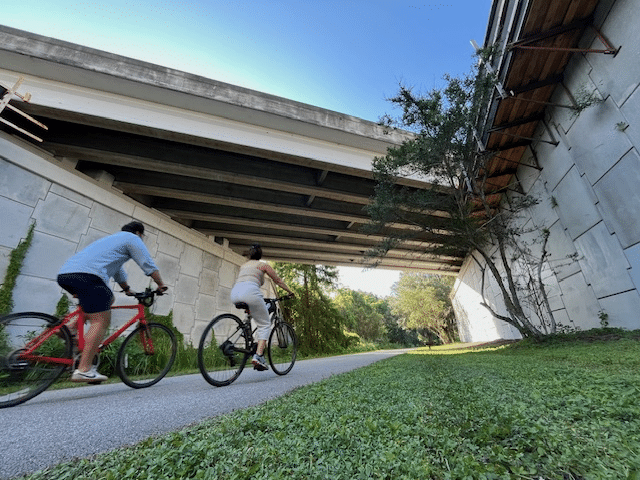
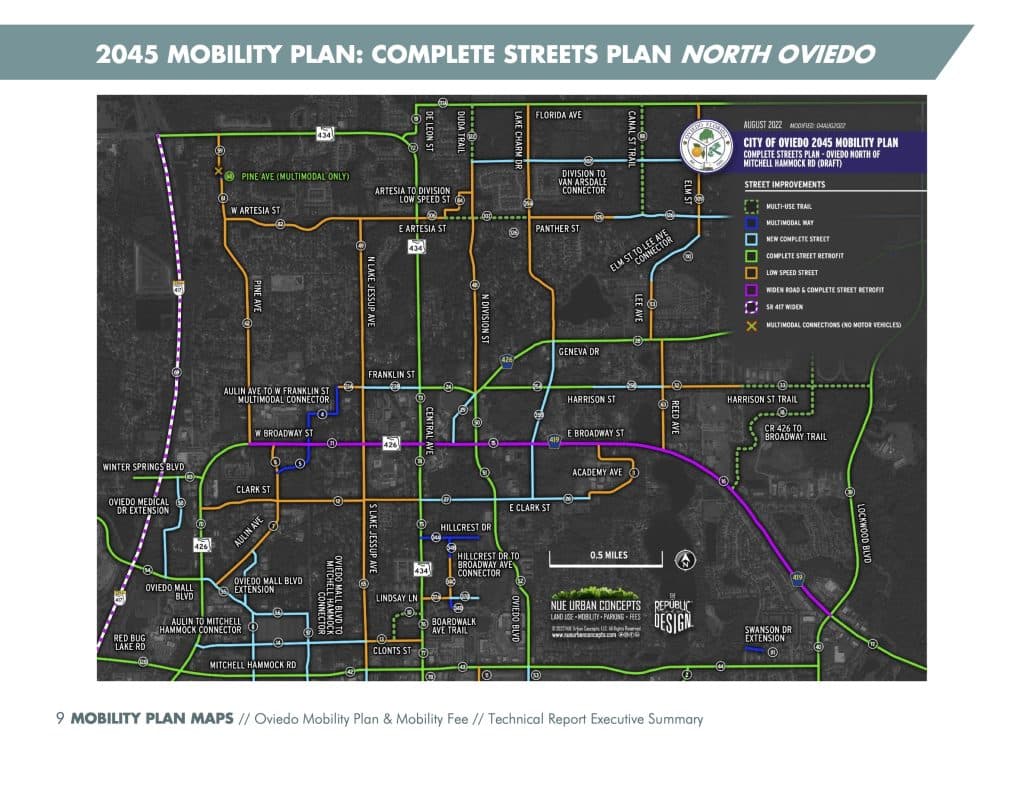
The city’s goals are highlighted in the city’s 2045 Mobility Plan.
In an email to OCN, Development Service Director Teresa Correa said projects included in the plan address the future mobility needs of its residents, businesses and visitors, focusing on “expanding the City’s existing multimodal transportation system by creating safer streets for all users of the transportation system.”
Grids and paths: a solution beyond road widening
As part of its mobility plan, Oviedo is also working to introduce a new grid route system for the city — something Correa said can be “challenging in situations where new development or re-development is occurring in areas where there is already consolidated development around it.”
But with pressure to widen roads reaching hard borders, Oviedo has started thinking smaller, like projects for Oviedo on the Park, which Correa said “promoted something similar to a grid system” through the creation of new roads and approvals for easements allowing connections using private developments.
Other projects that have already increased connectivity in the city’s transportation system include a new access to the Publix Plaza from Alexandria Boulevard and the creation of a multipurpose path allowing residents of the Chelonian Development to access Windy Pine Way, which threads its way into the center of Oviedo on the Park.
“This is to stimulate a micromobility strategy, where you have a safe path to promote safe walking or biking, not driving,” Correa wrote. “The idea is to shorten distances and promote a safe route for residents to commute in ways other than driving.”
Additionally, she said the realignment of Geneva Drive, construction of both the connector road and extension of Franklin Street over to Lake Jessup Avenue will create a grid pattern in Oviedo’s old downtown, otherwise known as the Water Tower District. The idea is to give people more options for through streets to take pressure off of heavily trafficked single roads.
Micromobility: thinking smaller to move more people
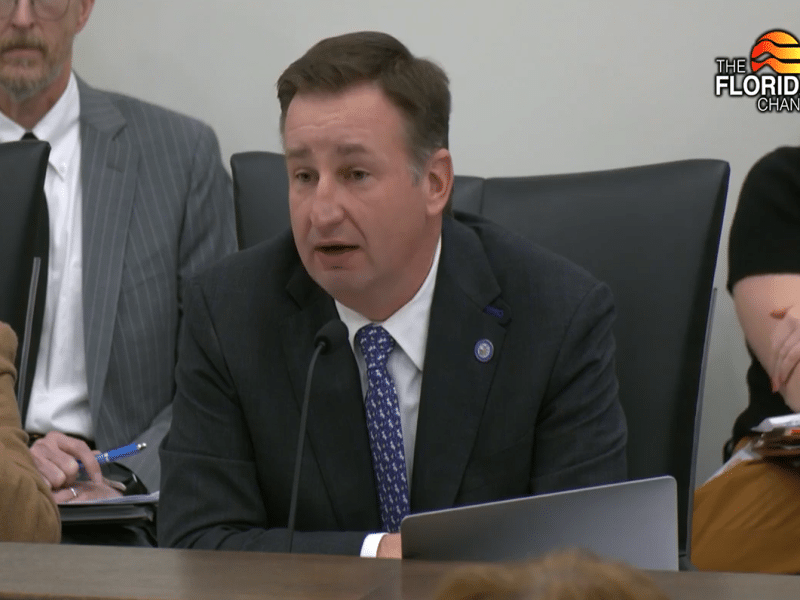
In an interview with OCN, Oviedo City Council member Natalie Teuchert said the bulk of the city’s work last year to develop its mobility plan had also focused on alternative transportation methods, like walking or electric bikes.
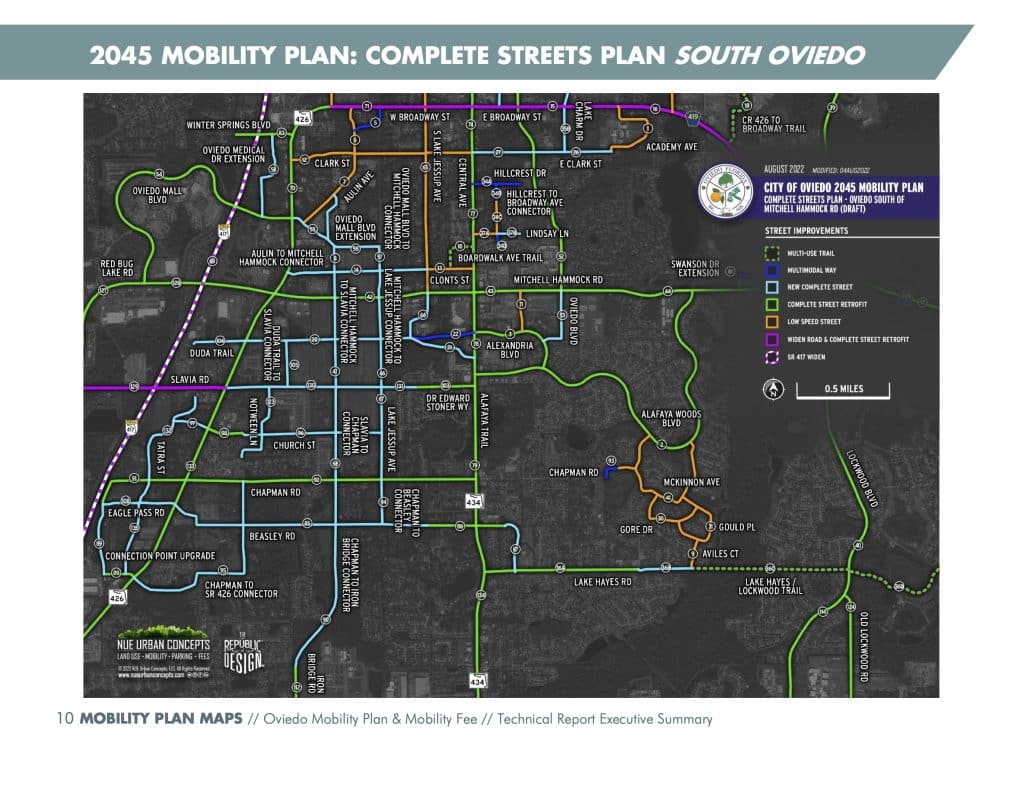
“We used to just look at how to move cars, and now we’re looking at how to move people,” Teuchert said. “…Putting in trail connectors, putting in alternatives to just the sidewalk next to the road, just safe alternatives to be able to ride those electronic means of transportation and kind of alleviate some of that traffic.”
That doesn’t mean the city won’t continue its focus on improving its roads, though.
“We’ve done a lot in the past couple years, as far as smaller projects that are more affordable that actually make a difference,” Teuchert said. “…[We’re] trying to improve traffic flow where we can, so we’re still going to keep tackling the stuff we can hit, but also expand the idea that improving traffic is just [about] roads — it’s also trail connectivity and interconnecting streets.”
She said infrastructure is needed to encourage more alternative transportation measures which could potentially assist with traffic issues.
“Even if you’re someone who’s like, ‘I’m never going to not use my car,’ any person you can get out of their car and onto one of those [alternative travel routes] is one less person sitting in traffic with you,” Teuchert said.
No quick traffic fix
One of the biggest improvements the city’s seen, Teuchert said, came from adding additional lanes and expanding traffic flow in its downtown area.
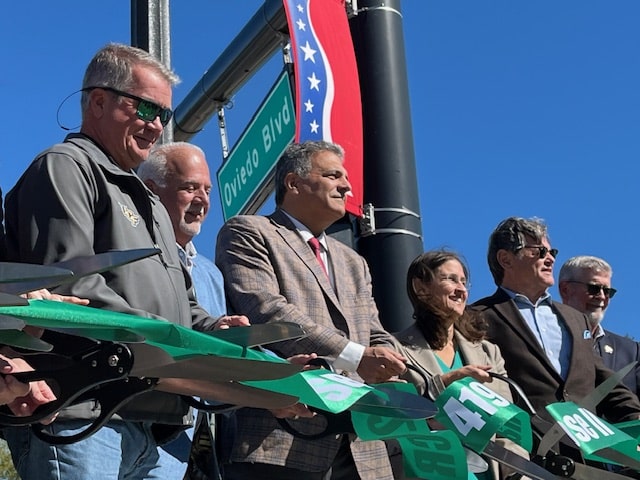
She said the March phase two completion of the C.R. 419 widening project via a four-lane corridor stretching 1.4 miles through the city’s old downtown is one of the most recently completed examples of the improvements, taking pressure off traffic that otherwise would funnel through Mitchell Hammock Road.
Some of the biggest roadway developments projects that could help address traffic needs in the area likely won’t begin to move forward anytime in the near future, however.
The Slavia Road extension: a big lift
One major project adjacent to the city that could impact travel to and from it is a proposal by Seminole County to extend Slavia Road — but it could be a while before it sees any actual progress.
The County has previously studied the possibility of extending the road to the east in order to provide another option for travel from Aloma Avenue (S.R. 426) to Alafaya Trail (S.R. 434) in Oviedo to address area congestion.
But Teuchert said there hasn’t been much progress made with the extension since the last time Seminole County held a public meeting about it, most recently back in Sept. 2023.
That’s likely due to the fact the extension would require the County to implement its use of eminent domain, essentially a government’s power to take private property for public use like road projects.
“I know back then, they were talking about how there’s no way around,” Teuchert said. “There would have to be a lot of eminent domain to make that road cut all the way through, so they kind of backed off it quite a bit…I’m not foreseeing that moving anytime soon, as far as addressing traffic problems and ongoing issues we have and what we can do to alleviate.”
In December, Seminole County Public Works Chief Design Engineer provided details for the project which would widen Slavia Road from two lanes to a four-lane median-divided roadway for the portion spanning from Red Bug Lake Road to S.R. 426.

With an expected cost of $10.2 million, the widening project is estimated to begin in the summer of 2026 and will potentially be completed by the summer of 2028.
But while Teuchert said some projects like the widening of Slavia Road are confirmed, she could only guess the County would likely not announce moving forward with the extension project in the near future.
“The widening is also [being done by the] County, and that is going to happen,” Teuchert said. “The extension is very much, from what I’ve heard, been on hold…I haven’t heard any movement on that.”
One of four major projects listed in the city’s mobility plan also includes a widening of Slavia Road, separate from its proposed extension.
Another potential project for the area would see widening via construction of a new two lane road stretching 0.18 miles from the Slavia Road extension to the exiting terminus of Dr. Edward Stoner Way, with a planning level cost of about $1.4 million and a projected time frame from 2031 to 2040.
It might be a long road ahead for Oviedo to address both its ongoing and expected future issues with traffic, but it’s a challenge city officials are already doing their best to try and tackle.
“Change is slow and expensive — but we’re working on it,” Teuchert said.
Want to contact your elected leaders and weigh in on this topic? Find their contact information here. Have a news tip or opinion to share with OCN? Do that here.
Sorry for the interruption but please take 1 minute to read this. The news depends on it.
Did you know each article on Oviedo Community News takes anywhere from 10-15 hours to produce and edit and costs between $325 and $600? Your support makes it possible.
We believe that access to local news is a right, not a privilege, which is why our journalism is free for everyone. But we rely on readers like you to keep this work going. Your contribution keeps us independent and dedicated to our community.
If you believe in the value of local journalism, please make a tax-deductible contribution today or choose a monthly gift to help us plan for the future.
Thank you for supporting Oviedo Community News!
With gratitude,
Megan Stokes, OCN editor-in-chief
Thank you for reading! Before you go...
We are interested about hearing news in our community! Let us know what's happening!
Share a story!