
Proposals to slash property taxes would hit Oviedo, Winter Springs especially hard
Commissioner says proposals would turn counties into ‘third-world counties,’ hollowing out budgets for parks, trails, roads and more.
Florida lawmakers have passed a resolution that could eventually eliminate property taxes, which would have a massive impact on Oviedo and Winter Springs, according to Seminole County’s property appraiser. Some elected leaders have floated the idea of eliminating police departments if the measure goes through.
Last week, the Florida House of Representatives passed House Joint Resolution 203. If passed by the Florida Senate and approved by 60 percent of voters in November, it would end property taxes in 2027.
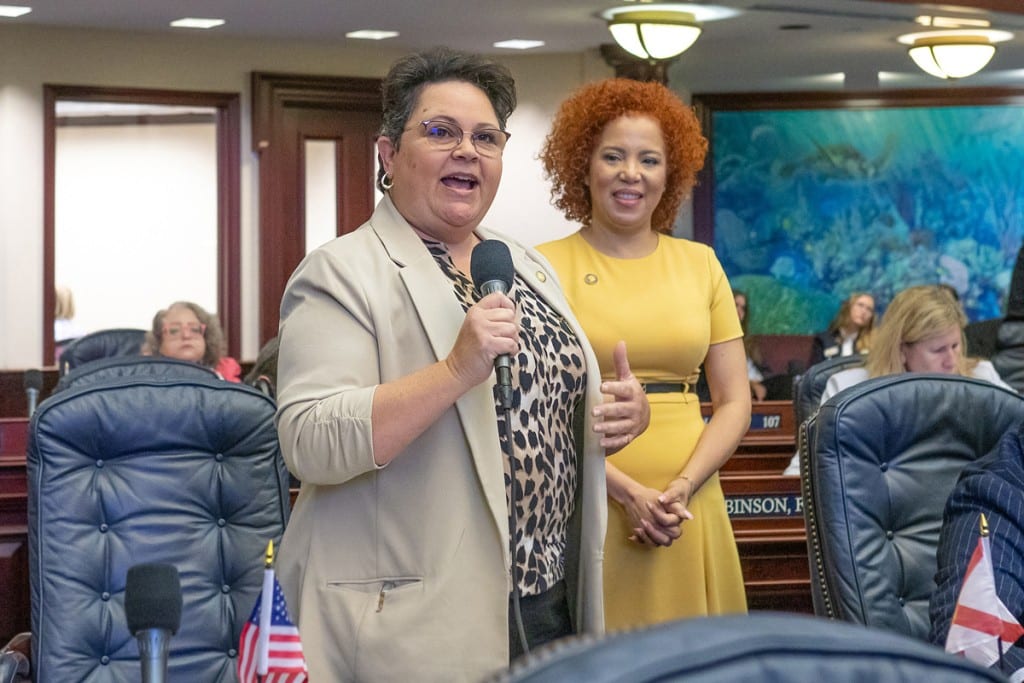
Rep. Susan Plasencia, whose district includes Oviedo, said she received letters and materials from local governments asking her not to vote for it.
“Respectfully, it is important to remember who government revenue belongs to,” Plasencia wrote on Facebook. “The money collected by government is not the government’s money. It belongs to the people. If voters decide that property taxes should be reduced or eliminated, that decision must be honored.”
Originally, the resolution would have phased in property tax exemptions $100,000 per year to a home’s property tax exemption for the next 10 years. But a last-minute amendment by Brevard County Republican Monique Miller made the elimination happen in 2027 instead.
The joint resolution also stops local governments from reducing funding for services provided by law enforcement, firefighters, and first responders The proposal would not affect public schools, which would still be allowed to levy property taxes. The resolution still needs the Florida Senate to approve it and, eventually, 60 percent of voters in 2026 to approve it as well.
Florida Gov. Ron DeSantis, who is in his last year as governor before being term-limited out, has been pushing for a major repeal of property taxes in a state that already has no income tax. But DeSantis has no direct way to get any proposal on the ballot.
The joint resolution, which has to be approved by 60% of both chambers, cannot be vetoed by the governor.
“Staff estimates that the amendment will have a negative cash impact of $4.8 billion, and a negative recurring impact of $14.7 billion on local non-school property tax revenues in Fiscal Year 2027-28,” the staff analysis reads.
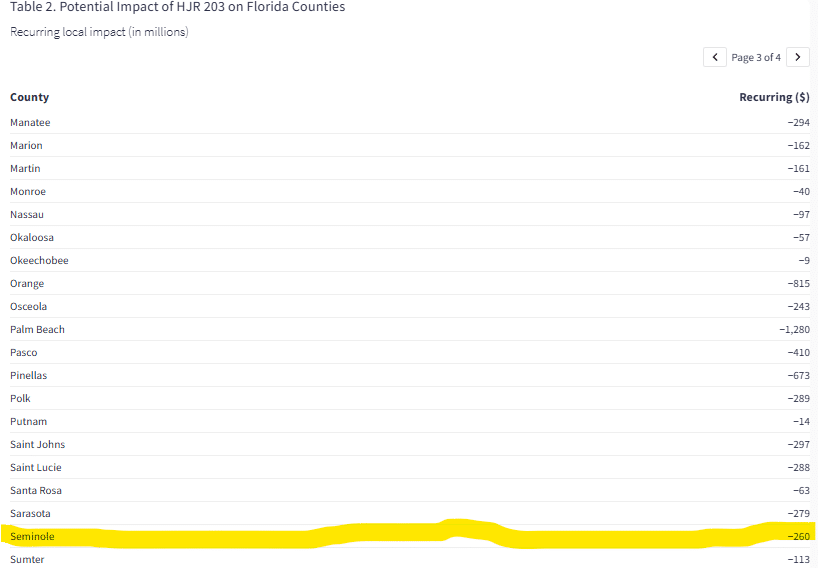
The Florida Policy Institute, which is an Orlando-based think tank, used Florida Revenue Estimating Conference data to put the impact to local governments at $13.3 billion annually.
That would also include a $260 million loss for governments in Seminole County, including the county and city governments.
Ultimately, the vote was 80-30 in favor of the bill, mostly along party lines with Republicans largely in favor of the bill. All four members of Seminole County’s Legislative Delegation voted in favor of the bill.
Sen. Jason Brodeur, who represents Seminole County in the Senate, said that, mechanically, a house resolution without a Senate companion bill can get referred to the Senate’s Rules Committee. If it passes there, it would go to the full Florida senate for a vote.
“Broadly, I think the Senate will have its own ideas,” Brodeur said.
Winter Springs a ‘stark example’ of a city that could get hurt by cuts
Any major changes to the property tax system could have an outsized impact in Oviedo and Winter Springs.
The two bedroom communities have a high proportion of residential properties. Seminole County Property Appraiser David Johnson said Winter Springs is the “most stark example.”
“About 82% of Winter Springs’ tax roll is residential in nature,” Johnson said. “A city like Winter Springs is going to be impacted greater than Altamonte Springs and Sanford. Oviedo is also heavily residential, about 75% residential.”
Winter Springs Mayor Kevin McCann said everyone wants to take the pressure off of residents as the cost of living goes up. But he echoed Johnson’s comments: It’s not magic, he said, it’s math.
“Do we close down parks? What are we going to do?” McCann said. “There’s no question: We either allow development, cut services or raise taxes.”
McCann said that the idea of property tax breaks sound good to voters, but ultimately end up shifting costs.
“This is not a tax break, it’s a tax shift,” McCann said. “It will drive up the burden to commercial and renters. I don’t know if that’s fair.”
The impacts for residents would vary as well. The average homeowner in Seminole County paid $537.51 for every $100,000 in taxable value. But for the highest-valued residential property in Seminole County, which is appraised at more than $5 million in Longwood, the proposal would possibly save about $25,500 per year.
Lawmakers don’t want governments to cut funding for schools and first responders, if the tax breaks go through. Oviedo has asked voters multiple times to approve issuing debt for a new police facility.
For sheriff’s offices, which are constitutional law enforcement officers in every county in Florida, there are already limits. If, for example, a County Commission approves a budget less that what a sheriff proposes, that decision can be appealed to a state board appointed by the governor.
That nuance, which was a reaction to calls to defund the police in the wake of George Floyd’s murder in 2020, came into focus in Seminole County last year. Commissioners raised the property tax rate for the first time in 16 years, and pointed to increases in the law enforcement budget as one cause.
The sheriff’s office said it needed to increase starting pay for sheriff’s deputies as other law enforcement agencies in the county, and across the state, have increased starting pay in the last few years.
For cities that have their own police department, if a department’s budget is cut more than 5 percent, the state attorney or a member of the governing body of the municipality may file a petition with the Division of Administrative Hearings to challenge the reduction.
You can read the full resolution here.
Seminole County spends 67 cents of every dollar on public safety. Commissioner Jay Zembower said with public safety exempt from the cuts, that leaves libraries, parks, trails, tree trimming and roads as possible areas of spending to get cut.
“That’s why it’s such a train wreck, (because) we have to fund public safety,” Zembower said.
“Public safety is a majority of our money. It’s being operated on a thin margin already.”
In Florida, there are already 29 counties – mostly rural – that are classified as “fiscally constrained,” meaning they get a distribution from the state budget because there isn’t enough tax base for them to operate. Zembower said that number would likely grow if the proposals pass.
“You’re going to make most, if not all, counties fiscally constrained,” Zembower said. “Or we let the infrastructure go by the wayside. Unless you’re going to turn all the counties into third-world counties.”
Zembower wasn’t alone in his concern. Oviedo Mayor Megan Sladek said the county is able to charge a flat fee for police and fire, which would give them other funding mechanisms for the sheriff’s office and the fire department.
Cities can charge a fire assessment fee, separate from property taxes. But Sladek said there’s no ongoing mechanism available for police.
“We would have to dissolve our police department unless someone hands us a bunch of money,” Sladek said. “How are we gonna pay for it? There’s no method for us to pay for it.”
More broadly, Sladek said it feels like the ultimate goal of the Florida Legislature is to force cities to unincorporate.
“They’re trying to dissolve cities,” Sladek said. “But for some reason it’s considered bad manners to talk about it.”
Want to weigh in? Seminole County’s Legislative Delegation includes:
Sen. Jason Brodeur, Senate District 10
Rep. Rachel Plakon, House District 36
Rep. Susan Plasencia, House District 37
Rep. David Smith, House District 38
Rep. Doug Bankson, House District 39
Below is a breakdown of different property tax reform bills making their way through the Florida Legislature, provided by the Florida League of Cities. Check here for a study analyzing the possible impacts.
HJR 201 (Kevin Steele) is a proposed constitutional amendment seeking to eliminate all non-school (local government) property tax levies on qualifying homestead properties. This bill also includes a new prohibition for counties and municipalities from lowering their total budgeted law enforcement funding below the higher level from either the 2025-26 or 2026-27 fiscal year. Statewide impact is $18.3 billion, for cities $4.4 billion.
CS/CS/HJR 203 (Monique Miller) is a proposed constitutional amendment that would establish a new, additional $100,000 homestead property tax exemption for non-school property tax levies (cities, counties, special districts) each year for the next 10 years. In 2037, any homestead properties with taxable valuation remaining will be considered fully exempt from non-school ad valorem property taxes. This bill also includes a new prohibition for counties and municipalities from lowering their total budgeted law enforcement funding below the higher level from either the 2025-26 or 2026-27 fiscal year. Statewide impact is $18.3 billion, for cities $3.2 billion.
HJR 205 (Juan Carlos Porras) is a proposed constitutional amendment seeking to fully exempt homestead properties from non-school property taxes if the owners of the property are 65 years old or older. This bill also includes a new prohibition for counties and municipalities from lowering their total budgeted law enforcement funding below the higher level from either the 2025-26 or 2026-27 fiscal year. Statewide impact up to $6.3 billion, for cities $1.4 billion.
HJR 207 (Shane Abbott) is a proposed constitutional amendment that would provide a homestead exemption equal to the amount of 25% of the property’s assessed value and applied after the existing exemptions for non-school property tax levies (cities, counties, special districts). The 25% calculation is not adjusted for inflation. This bill also includes a new prohibition for counties and municipalities from lowering their total budgeted law enforcement funding below the higher level from either the 2025- 26 or 2026-27 fiscal year. Statewide impact $4.6 billion, for cities $1.2 billion.
CS/CS/HJR 209 (Demi Busatta) is a proposed constitutional amendment to establish a new $200,000 homestead exemption from non-school ad valorem tax levies for homestead properties that are covered by multi-peril property insurance policies. This exemption is adjusted for inflation annually. This bill also includes a new prohibition for counties and municipalities from lowering their total budgeted law enforcement funding below the higher level from either the 2025-26 or 2026-27 fiscal year. Statewide impact $4.8 billion, for cities $1.12 billion.
HJR 211 (Tobin Rogers ‘Toby’ Overdorf) is a proposed constitutional amendment seeking to remove the $500,000 cap on the transferable Save-Our-Homes benefit (portability) for county and municipal levies, allowing for the full accrued benefit to apply upon establishing a new homestead. This bill also includes a new prohibition for counties and municipalities from lowering their total budgeted law enforcement funding below the higher level from either the 2025-26 or 2026-27 fiscal year. The statewide adopted estimate by the Revenue Estimating Conference is $337 million.
CS/CS/HJR 213 (Phillip Wayne ‘Griff’ Griffitts Jr.) proposes a constitutional amendment to change the assessment valuation caps for non-school property tax levies (cities, counties, special districts) from being adjusted each year, with homestead properties capped at 3% or the Consumer Price Index (CPI), whichever is lower, and non-homestead properties capped at 10% or CPI, whichever is lower. This amendment would change the assessment valuation changes from each year to every three years, with homestead properties capped at 3% or CPI, whichever is lower, and non-homestead properties capped at 15% or CPI, whichever is lower. This bill also includes a new prohibition for counties and municipalities from lowering their total budgeted law enforcement funding below the higher level from either the 2025-26 or 2026-27 fiscal year. CS/CS/HJR 213 was amended to include a prohibition on reducing law enforcement, firefighter, and other first-responder budgets, aiming to protect these services from potential budget cuts due to the loss of ad valorem revenues. CS/CS/HJR 213 was amended to prohibit assessment increases for non-school taxes when a property’s just value has decreased since the last assessment change. This prohibition does not apply when changes, additions, reductions, or improvements to the property occur. Statewide impacts $5.24 billion, for cities $1.52 billion.
Support critical, local news you rely on to stay informed, connected and empowered.
Choose a monthly amount
Hometown Hero
Community Champion
Rooster Society
Custom Amount
Thank you for your support!
Author

Related Articles
Watch: Winter Springs election candidates talk water quality, Amendment 3 and controversies
Oviedo Community News is adding video interviews with candidates from Oviedo, Winter Springs, Seminole County and beyond to its 2026 voter guide.
McCann, Phillips debate in election for Winter Springs mayor
Mayor Kevin McCann touts a water association award that Winter Springs won this month in a blind taste test involving six Central Florida counties.
Development, explained: How local governments plan for growth
How Oviedo, Winter Springs and Seminole County plan for growth, determine what can be built and navigate Florida law.