The Florida Department of Environmental Protection awarded Winter Springs more than $19 million in funding to rebuild its wastewater plants – a project that could start in 2026.
At a meeting Wednesday, FDEP’s State Revolving Fund’s 2026 supplemental appropriation for hurricanes Helene and Milton was announced, and Winter Springs was allotted a total of $19.1 million dollars. That includes a $9.5 million loan forgiveness portion, meaning Winter Springs would only have to pay back half of the money awarded.
It comes on the heels of the Winter Springs City Commission also approving the submission of an additional $20 million low-interest loan through the state of Florida for the East Wastewater Treatment Plant.
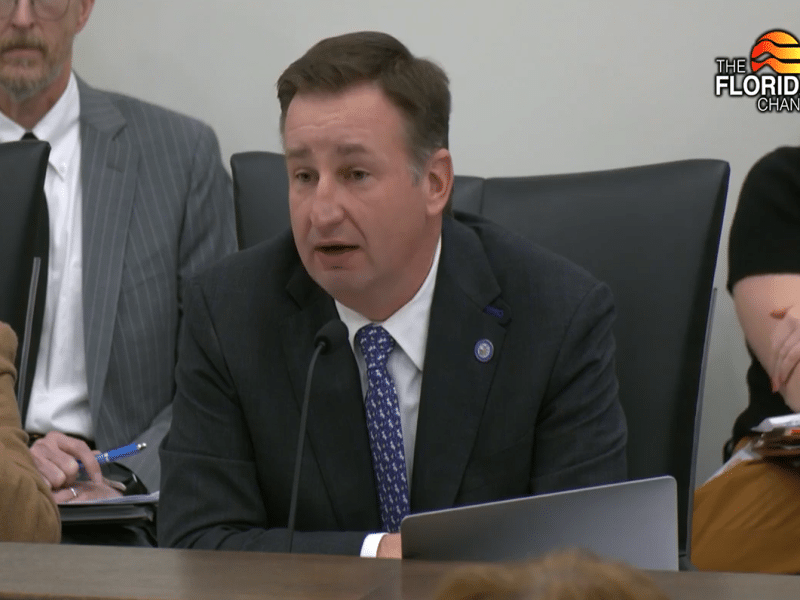
“That’s a grand slam,” said Winter Springs Mayor Kevin McCann said. “That’s going to be great for the residents and the utility rates.”
The Winter Springs City Commission approved submitting an application for a $20 million low-interest loan through the State of Florida to begin replacing its aging wastewater treatment plant Monday.
Ultimately, it means the financing is coming together to start construction on two new wastewater treatment plants for Winter Springs. The costs for two new wastewater treatment plants has ballooned more than 40% to $158 million total, in part because of inflation and tariffs as the project is delayed.
But rates may need to increase further beyond 2028 as costs continue to rise. Officials say Wednesday’s additional award of more than $19 million will help the construction project start sooner, and keep rates lower for residents.
Consultant: Winter Springs has enough money for planned capital projects – for now
Winter Springs got an update from Joe Williams, a senior manager with Raftelis Financial Consulting, which works with local governments on utilities.
In 2023, Winter Springs approved a series of rate increases to effectively double water rates over the course of five years. A home using the average of 5,000 gallons of water each month would see their bill go from about $55 a month in 2023 to $113 in 2028.
In 2026, with the rate set to progressively rise, a 5,000 gallon water bill would cost a Winter Springs resident $90.16 per month. Locally only Oviedo and Maitland are more expensive, with the same bill costing $101.28 in Oviedo and $96.69 in Maitland. The cheapest would be $45.55 in Lake Mary and $46.48 in Altamonte Springs.

Raftelis studied the current rates, finding that the city still has enough money to fund nearly $197 million in capital projects through 2030. That includes $9.7 million for drinking water improvements, $5.3 million for reclaimed water expansion projects and $4.1 million for sanitary sewer and lift station improvements.
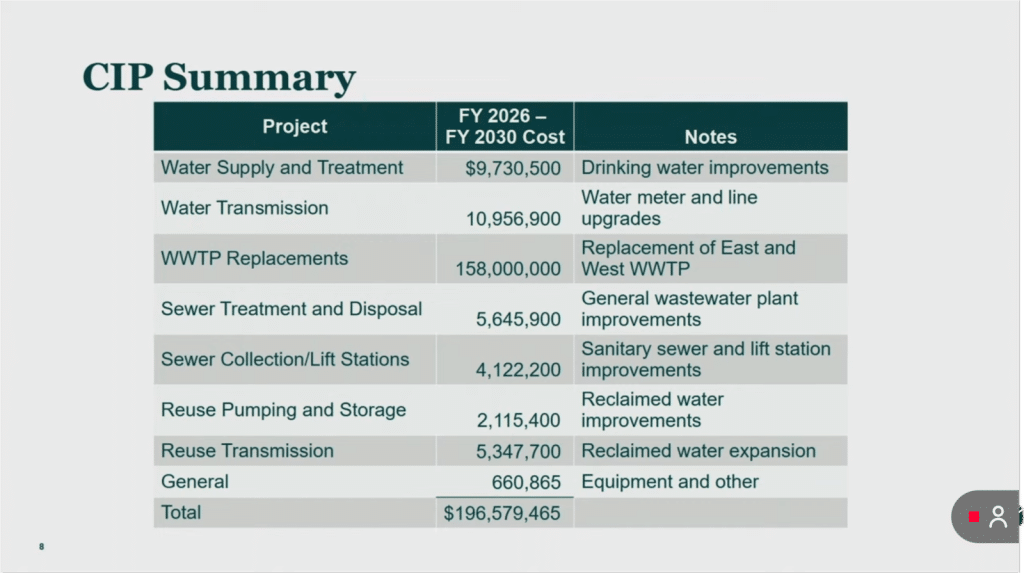
But by far the biggest project cost is $158 million for two new wastewater treatment plants. Commissioner Mark Caruso has previously said he would like to see Winter Springs find an alternative to the new plants.
“Just to be clear, so the residents hear it, the total cost of the wastewater plants are estimated at?” Caruso asked.
“$158 million,” Williams replied.
“So they’re not $100 million (anymore),” Caruso said. “They’re $158 million.”
The projected cost for the two plants had previously been estimated at $112 million in 2023.
“There’s been a lot of pressure on costs, especially for wastewater throughout the industry,” Williams said. “You’re not the only ones facing that pressure.”
Williams said that by delaying the start of construction, the city has saved up more cash reserves. That means Winter Springs does not have to increase rates more than what’s already planned in the coming years to pay for the projects.
McCann said that while Winter Springs has the third highest rates of nearby cities, others are also looking to raise their rates.
“Sanford, Casselberry and Orlando are in the middle of doing a rate study like we did in 2023 and I anticipate, speaking with leaders from those communities, that they’re going to see the same significant rate increases,” McCann said. “So although we might be in that top third right now, I suspect by next year we’ll be right smack in the middle of that group.”
Operating costs for the utility department have also increased from the 2023 projections by an average of $925,400 annually. With the plant happening later than expected, the currently planned increases are enough to cover funding – but there may be more rate hikes needed after 2028.
Winter Springs is projecting to borrow $63.9 million from the state to build the new East Wastewater Treatment Plant, as well as using American Rescue Plan Act dollars to design the plant and also spending more than $9.2 million in cash reserves. But Winter Springs can only borrow $20 million annually from the state, which means the city might have to look for higher-interest debt if it wants to start the project sooner.
“That spending curve is going to be pretty important over time, whether [State Revolving Funds] is going to be the ultimate solution or if you’re going to have to supplement SRF with additional loans from a revenue bond or a bank loan,” Williams said. “SRF is the best, it’s the lowest cost.”
Draft audit finds Winter Springs still racking up fines from FDEP on wastewater.
The issue of wastewater has become a political one as well in the city.
Winter Springs has had multiple wastewater spills over the last few years, including a spill during Hurricane Milton in 2024.
In January 2025, the FDEP sent a warning letter detailing multiple violations observed during inspections in September 2024 and January 2025 at the East plant. That includes:
- Excessive wastewater suspended solids (which include sand, algae and bacteria) in October, November, and December 2023, and in February, March, May, June, and August 2024.
- Elevated fecal bacteria levels in November 2023, and in March, April, and May 2024.
The East plant also was flagged by inspectors for having nitrate levels exceeding allowed levels in October and December 2023, and in January and February 2024. Because of those violations and others, Winter Springs paid $51,310 in penalties to the state and, in June, FDEP approved the City’s proposal of a mitigation project costing $695,850, which allows lift stations to electronically communicate with utility workers when there is an outage.
The city has also ended its contract with Veolia Water Technologies Inc. In September, Winter Springs selected Woordard & Curran as its new contractor.
Jesse Phillips is the cofounder of the Winter Springs Community Association, and frequently criticizes the city’s wastewater issues. Phillips, a rumored 2026 mayoral candidate, said Monday’s meeting was good news – but residents need relief on water rates.
“The city’s utility ordinance currently ties future rate increases to the Consumer Price Index starting in 2028,” Phillips wrote. “I believe that needs to change. Future rate adjustments should be tied to actual system savings, debt retirement, and efficiency improvements, not automatic inflation. If we don’t fix that, the higher rates residents are paying now will become the new normal.”
Winter Springs also looks to cut rates for nonprofits renting facilities
In other news, the Winter Springs City Commission also approved a 14-month extension of MTH Development’s permits to build the Legacy at Lake Talmo.
That’s a 4-sory, 140-unit Independent Living Facility located at the northwest corner of the intersection of State Road 434 and Fountraintree Drive. The developer said it had trouble getting construction financing, but has since secured the loan and is ready to start construction.
The city also amended its allowable uses for arbor or tree fees collected from developers. The money can be used for “planting and maintaining desirable trees on public lands or for meeting Tree City USA Standard.”
The updated policy clarified that the money can not be used to buy equipment. The change was first requested by City Commissioner Victoria Bruce in August.
The Winter Springs City Commission is also on the verge of changing policy when it comes to nonprofits paying for event permits.
The Wesley Seth Foundation requested the city waive its $2,000 fee to rent Central Winds Park for its planned Sizzle and Splash BBQ Cook-off and Festival. The event is scheduled for May 15 and 16 2026.
In response to the request, the City Commission directed the attorney to bring back a proposed ordinance that would allow Winter Springs-based nonprofits that can demonstrate a “tangible” benefit to the community to qualify for a 50% reduction in fees.
Winter Springs resident Libby Baity said she founded the Wesley Seth Foundation when her grandson Wesley Seth died by drowning in a pool at a home daycare in 2023.
“He was a child so full of love and laughter, the true love light of my life,” Baity said. “And you think this can never happen to you, but it can.”
Since 2023, the foundation has purchased 6,500 door and window alarms for pools. They’ve also funded 19 scholarships for swim lessons.
Baity said that if the city waived the fee, they would use the money to buy more door alarms.
“As a nonprofit organization, every expense matters,” Baity told commissioners Monday “Permits and facility fees, while necessary in many contexts, present a significant challenge for us. Waiving those fees would allow us to put more of our resources directly into servicing the community, instead of covering our overhead cost. For example, the $2,000 fee would purchase 300 door and window alarms for the community.”
Commissioners Cade Resnick and Mark Caruso voted against making the changes, saying it was a slippery slope and that other nonprofits – like churches, the chamber of commerce and the Scottish Highland Games – could also now request the discounts.
Resnick said if the city waived the fees for one foundation, it would have others also want to reduce fees.
“Part of being up here is to also look at all the other unintended consequences,” Resnick said. “We just asked a company that was providing us a tangible benefit, being the (UCF Business) Incubator to leave because we didn’t think the tangible benefit was enough.”
Commissioner Paul Diaz tried several times to get the fee fully waived.
But the reality is, here we have something tangible that is good for the community, just like when we have a business that is doing something for the community,” Diaz said. “And what do we want to do? We want to go ahead and give them a great explanation about how much we love you. But hey, you know what? We just don’t want to do it for you.”
Abe Aboraya is a Report for America corps member.
Sorry for the interruption but please take 1 minute to read this. The news depends on it.
Did you know each article on Oviedo Community News takes anywhere from 10-15 hours to produce and edit and costs between $325 and $600? Your support makes it possible.
We believe that access to local news is a right, not a privilege, which is why our journalism is free for everyone. But we rely on readers like you to keep this work going. Your contribution keeps us independent and dedicated to our community.
If you believe in the value of local journalism, please make a tax-deductible contribution today or choose a monthly gift to help us plan for the future.
Thank you for supporting Oviedo Community News!
With gratitude,
Megan Stokes, OCN editor-in-chief
Thank you for reading! Before you go...
We are interested about hearing news in our community! Let us know what's happening!
Share a story!