
Winter Springs delays referendum discussion on changing mayor’s powers
‘This is politics,’ Resnick tells OCN, saying he’s negotiating with Seminole County lawmakers
The Winter Springs City Commission quietly withdrew a resolution on Monday to have a 2026 referendum to give the city a voting mayor – by eliminating the elected position altogether.
Last month, Seminole County’s elected state lawmakers approved putting forth a local bill that would give the mayor a vote and, eventually, remove one city commission seat. The bill would need to be approved by the Florida Legislature and signed by the governor, and would require a majority of voters to approve it next November.
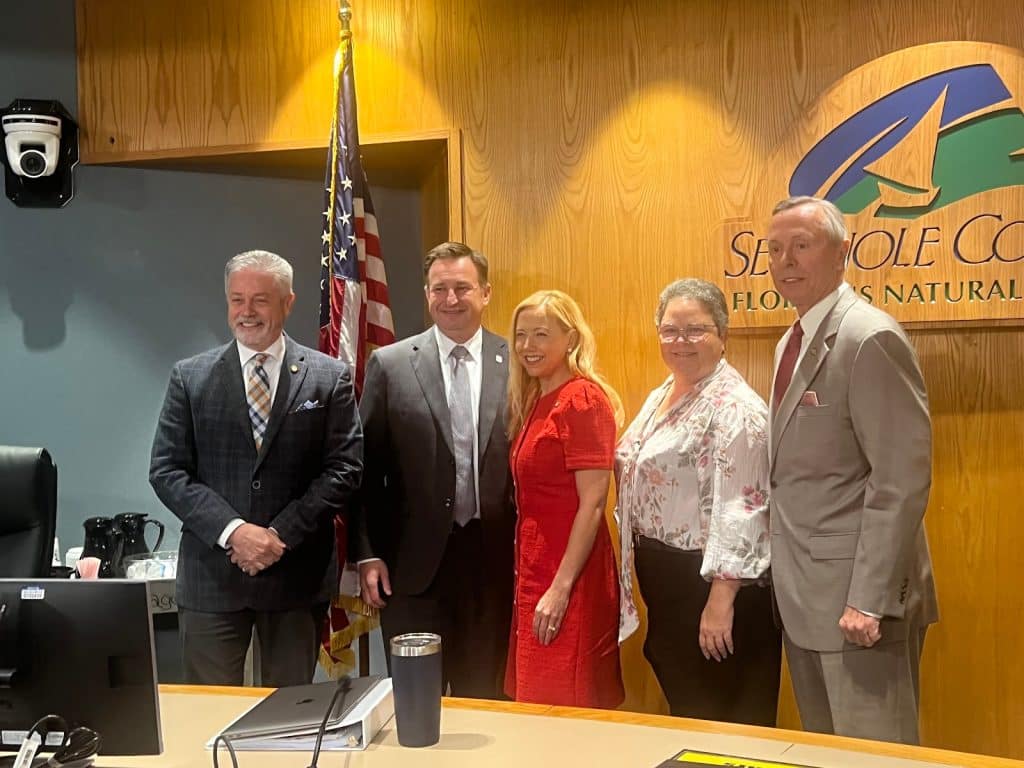
Winter Springs is trying to head that off by putting its own referendum on the ballot so lawmakers withdraw their bill. And Monday was supposed to be the first vote on the city’s own proposed referendum, which would eliminate the mayor as an elected position and let the City Commissioners choose a mayor after swearing in a new Commission.
Winter Springs resident David Bear, an attorney, told commissioners Monday that the Winter Springs referendum was fundamentally flawed.
“Flawed because it’s basically a response to this Tallahassee idea, and basically we shouldn’t give in to bullies,” Bear said.
Bear is most concerned with language in the bill that appears to give the City Commission the ability to add to the mayor’s role by a simple vote. According to a draft of the bill voted on, the mayor “shall have no administrative authority over city employees, except as expressly provided by this charter or by ordinance,” the draft bill reads.
That line – or by ordinance – seems to open the possibility that the commission could vote to give the mayor more authority down the road. That’s led to the criticism that the changes are meant to begin creating a “strong mayor” form of government in Winter Springs, without explicitly disclosing it to residents.
“We’ve all been taught to be humble,” Bear said. “An idea that somebody elected in what is effectively a popularity of ideas contest has the skills and professionalism to be a city attorney or a city accountant or an architect or in this case particularly, a city manager. And no offense to any of you, but you’re not professional technicians. You’re politicians.”
In an interview with Oviedo Community News, Commissioner Cade Resnick – who initially put forward the Winter Springs proposal – said he’s negotiating with state lawmakers from Seminole County. The Winter Springs proposal also includes having single-member districts, where only residents who live in a district would vote for their commissioner.
“The biggest issue that they had had was the single member districts,” Resnick said. “That is an absolute no. So that is out the window for sure.”
Resnick said state lawmakers have said if Winter Springs creates its own referendum to get a voting mayor, the they would withdraw their own bill.
“If you get something on the ballot, that is similar to what we’ve got, which includes a mayor who votes, we will pull our bill,” Resnick said. “Well, we did that. It wasn’t the way they wanted it. So now they’re like, well, we’re not going to pull our bill. You have to change these key pieces. So now again, (it) gets back to politics. We’re negotiating.”
Bill may have been written by potential mayoral candidate
The Local Bill – from state lawmakers representing Seminole County – was proposed by Rep. Rachel Plakon, and metadata from an earlier draft of the bill shows the author to be Jesse Phillips, a rumored mayoral candidate in Winter Springs in 2026. Phillips denies writing the bill, but said he did provide input to Plakon’s office on the bill.
The Winter Springs charter, which is basically a city’s constitution, defines the role of the mayor. The mayor is in charge of running City Commission meetings, and acts as the representative of Winter Springs to other governmental bodies. The mayor only votes in the rare instance when there’s a commissioner absent from a meeting and there’s a tie vote among the remaining four commissioners, or if a commissioner abstains from a vote.
In a text message, Plakon declined to comment before Monday’s vote, and also after it was withdrawn.
“I have no comment on that matter at this time,” Plakon wrote. “My priority is listening to my constituents as I prepare for the upcoming legislative session, so I can understand how to best serve our community.”
Abe Aboraya is a Report for America corps member.
Sorry for the interruption but please take 1 minute to read this. The news depends on it.
Did you know each article on Oviedo Community News takes anywhere from 10-15 hours to produce and edit and costs between $325 and $600? Your support makes it possible.
We believe that access to local news is a right, not a privilege, which is why our journalism is free for everyone. But we rely on readers like you to keep this work going. Your contribution keeps us independent and dedicated to our community.
If you believe in the value of local journalism, please make a tax-deductible contribution today or choose a monthly gift to help us plan for the future.
Thank you for supporting Oviedo Community News!
With gratitude,
Megan Stokes, OCN editor-in-chief
Thank you for reading! Before you go...
We are interested about hearing news in our community! Let us know what's happening!
Share a story!
Author

Related Articles

Bill to gut Seminole County rural boundary could apply outside of Central Florida
Florida Senate poised to take up the bill this Friday, as developer Chris Dorworth pushes county commissioners to support it.

Life as a Hagerty transgender student, explained
“I’ve been trying to figure myself out for a long time.” Hagerty transgender students find solace among ‘the same kind of different.’
Twin Rivers Golf Club to receive protections; Stormwater project updates
Bounded on both sides by the Econ and Little Econ rivers, Oviedo’s Twin Rivers Golf Club now could see new laws to keep it safe.