
Affordable housing, a canopy walk and tower could come with updated redevelopment plan
Oviedo approves an updated community redevelopment plan to align with 2045 city plans. And that could include a soaring canopy walk proposed by a former City Councilman.
Affordable housing, public art, a canopy walk through the trees and street projects are included in Oviedo’s updated Community Redevelopment Plan that will shape the future of downtown Oviedo.
Nothing was funded in the resolution that was unanimously approved by the Oviedo City Council on Jan. 20. The updated plan will frame how the historic downtown Oviedo, also known as the Water Tower District, could grow into a more walkable area. The plan also influences what projects will get completed first.
Oviedo’s Community Redevelopment Area (CRA) covers about 674 acres of developed and undeveloped land including Oviedo on the Park, Old Downtown and nearby surrounding neighborhoods. The CRA exists since the area is legally considered “blighted,” a term defined by the state as containing a “substantial number of deteriorated, or deteriorating structures in which conditions, as indicated by government-maintained statistics or other studies, are leading to economic distress or endanger life or property.”
The original plan was adopted in 2010 and last updated in 2018. Assistant City Manager Patrick Kelly said that since then, Oviedo has added a new comprehensive plan, a new mobility plan, a new land development code and a downtown master plan update, which were not compatible with the CRA and 2018 plan.
Kelly said that the historic downtown areas are the oldest infrastructure areas in the city with agricultural vestiges and railroads. He added that today’s Oviedo has different needs than past eras of the city that don’t include the old rails or agricultural land use.
“Part of the purpose of a CRA is to promote the redevelopment of the sort of older disuse that creates those conditions of blight into more modern and updated uses that attract developers to put in new uses, new commercial, new residential to make property more valuable,” Kelly said.
Canopy walk and tower
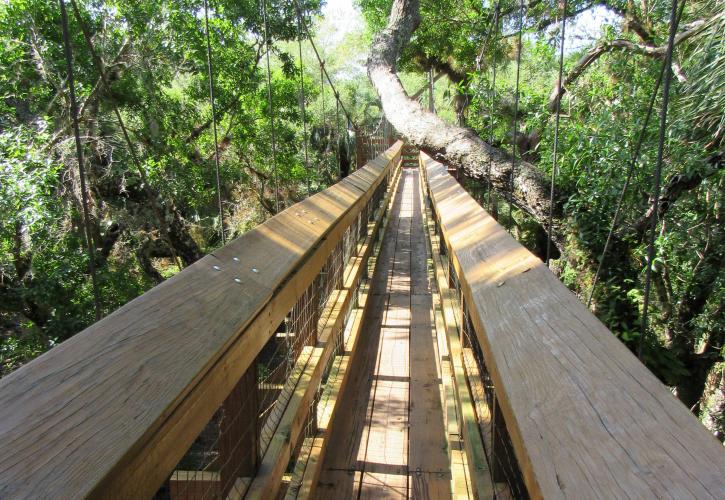
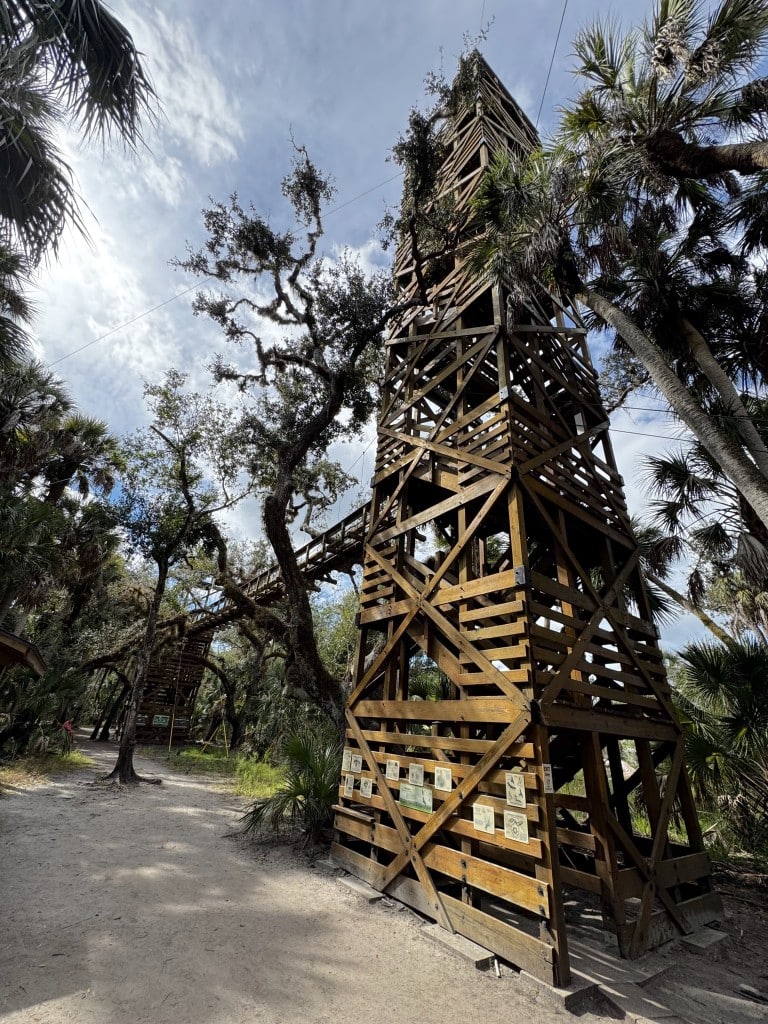
A canopy walk and tower that was added to the projects lists is a citizen-led initiative that was brought to the CRA board during the Nov. 17 meeting. Tom O’Hanlon, a longtime Oviedo resident and former council member who served five terms through the 80s, 90s and 2000s, pitched the idea to the CRA board to model the canopy trail and tower in Myakka River State Park in Southwest Florida.
The tower at Myakka stands 74-feet tall with a 25-feet high, 100-foot long suspension bridge. O’Hanlon said his interest in bringing the project to Oviedo is that the structure tripled attendance at the Southwest Florida park. He said one of his biggest concerns when creating the original plans for Oviedo on the Park was what would draw visitors in.
“… the big thing was the hook,” O’Hanlon said during the Nov. 17 meeting as he held up a shining, metal hook larger than his hand. “What’s gonna get people to come here and make our businesses successful?”
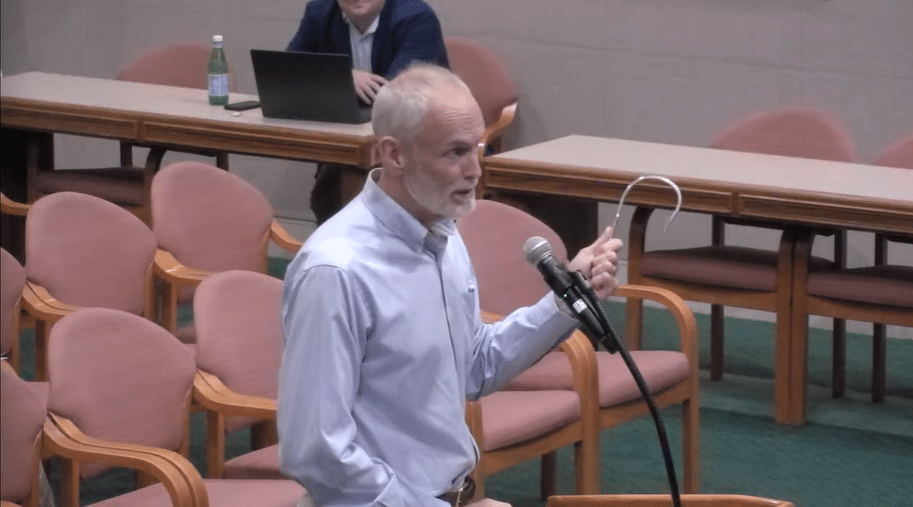
Tom O’Hanlon addresses the CRA board during the Nov. 17, 2025 meeting about a project that would hook visitors to Oviedo. Photo courtesy of Oviedo City Government livestream.
O’Hanlon said he estimates the project to cost $1.5 million if it is built by one contractor, but said it could “hopefully” cost $1 million if built by the community. He asked the CRA board to cover half of the project cost.
“I plan on raising the funds from the community to cover the other half, so I’m looking to you for half the cost,” O’Hanlon said.
Kelly said there is no timeline set since the project is in its early days, but they are in active discussions.
“Part of what he is bringing to the table is private dollars and his willingness to go out and do civic engagement in the public facing side of this,” Kelly said. “And raise private funds as well to help offset the cost of some of this project.”
Background
The city uses future tax revenue growth to help pay for CRA projects. Kelly explained that it is not an increase in taxes, and “takes a base year valuation and then each additional increase in valuation provides a percentage of a funding that stays within the CRA.”
Kelly said the CRA’s budget is “somewhere in the neighborhood” of $2.5 million for FY 2025-26.
The updated plan includes 55 projects in eight areas: administrative, streetscape, mobility, stormwater, utilities, property acquisition, business development and neighborhood enhancement, and cultural, recreation and public arts. About 65% of the 55 projects have been added since the 2018 plan, including improvements to the State Road 434 corridor and Lawn Street drainage.
“Not everything on that list has to be done,” Councilmember Alan Ott said. “But in order to do it it has to be on the list. So it’s a whole lot easier to add all of the maybes to the list … than it is to add stuff later.”
Ott added that there is “not necessarily much detail or planning” behind the project list yet.
In an interview with OCN in December, CRA Chairman Dave Axel said there is “no specific phasing program” for the redevelopment of downtown Oviedo, and that the timeline is primarily constrained by economics.
“This type of project could be generational,” Axel said. “It could be 20 or 30 years to completely come to fruition. And that’s actually better than doing something all at once, because those projects that are built all at once have a tendency, if they fail or if they reach the end of their economically viable life, it happens all at once. So the preference is to have things happen over time.”
The resolution does not approve construction contracts or costs, but it does make projects eligible for tax increment financing and later allow staff to move forward with the projects. Other projects on the CRA list include streetscaping the Cross Seminole Trail Activation, the Wings of Joy interactive sculpture and the Geneva Drive to S.R. 434 connector road now called Citizens Lane.
The boundaries of the CRA range from Mitchell Hammock Road to the south, Magnolia Street and Geneva Drive to the north, Central Avenue and Lake Jessup Avenue to the west and Stephen Avenue and Oviedo Boulevard to the east, according to the city.
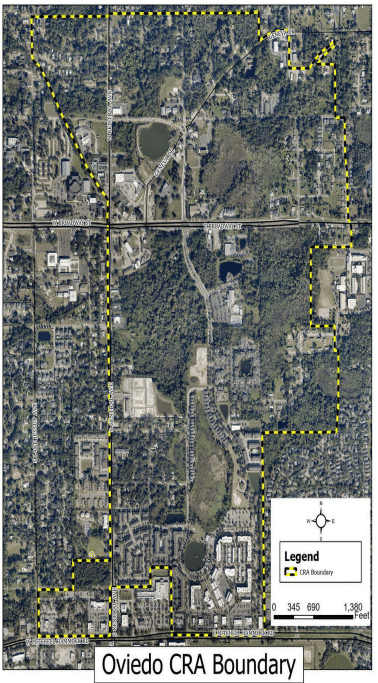
Oviedo’s CRA covers about 674 acres of developed and undeveloped land including Oviedo on the Park, Old Downtown and nearby surrounding neighborhoods. Photo courtesy of Oviedo City Government.
About 39% of the CRA’s future land use is for “downtown transition,” taking up about 224 acres, according to the city. “Downtown core,” the next biggest category, takes up about 19% of the total area. The remaining land usage consists of office, commercial, low density residential, medium density residential, public, conservation and trails.
The most immediate challenge of the CRA’s physical environment is that it is located at the heart of a historically rural city with many road intersections, according to the plan. The roads were not built with the intention of having pedestrians nearby, which results in a lack of pedestrian and bicycle facilities.
Axel said that Oviedo has been historically driven by suburban sprawl, and usually requires long drives to get places.
“The idea is to try to create a central core that, understanding of course it gets hot, it rains, it’s humid, people aren’t going to walk for miles, but to kind of give you an environment where you can park once and have a bunch of places you can go. Let’s say if you live in an apartment, you don’t necessarily have to get in your car to go to a restaurant, go to a bar, go to a grocer, go to a specialty store. The idea is, it’s all right there,” Axel said.
What changed in the update
While the CRA plan states it “establishes the redevelopment priorities,” Kelly said the projects are not listed in priority and will be set by the CRA board at a later time. However, he did say that Citizens Lane and Franklin Street have been mentioned at length.
The updated redevelopment plan adds affordable housing, reevaluates the area’s economic and physical conditions and aligns with the city’s masterplans. It also contains a clearer project list and removes previously completed projects, such as the Godwin Street sidewalk project.
Affordable housing was introduced in the updated plan, and included nods to rising housing costs and the need for mixed-income options near downtown. Kelly said the CRA is “fairly limited” with funding, but can work with the Seminole County Housing Authority to assist with future infrastructure needs.
Axel said that building affordable housing is “really difficult to do” since they can’t build an expensive product and without recovering the cost lost through rent.
“It’s very, very, very expensive to construct housing, and trying to construct [affordable housing] in a dense area without government subsidies is nearly impossible,” Axel said. “So everyone likes to talk about affordable housing, but it’s in the end, extraordinarily difficult.”
Want to contact your elected leaders and weigh in on this topic? Find their contact information here. Have a news tip or opinion to share with OCN? Do that here.
Sorry for the interruption but please take 1 minute to read this. The news depends on it.
Did you know each article on Oviedo Community News takes anywhere from 10-15 hours to produce and edit and costs between $325 and $600? Your support makes it possible.
We believe that access to local news is a right, not a privilege, which is why our journalism is free for everyone. But we rely on readers like you to keep this work going. Your contribution keeps us independent and dedicated to our community.
If you believe in the value of local journalism, please make a tax-deductible contribution today or choose a monthly gift to help us plan for the future.
Thank you for supporting Oviedo Community News!
With gratitude,
Megan Stokes, OCN editor-in-chief
Thank you for reading! Before you go...
We are interested about hearing news in our community! Let us know what's happening!
Share a story!
Author

Related Articles
A one-shot deal: Jerry Vaughan honors veterans’ last wishes nationwide
Chuluota veteran Jerry Vaughan crafts reconstructed military uniforms to give deceased veterans a dignified final salute. His hope is, with a new federal bill, he could put himself out of a job.
Seminole County Public Schools approves county’s first community school
Seminole County Public Schools finalized an agreement Tuesday to bring the county’s first community school to Sanford.