
Obesity drives cost for Seminole County Public Schools, raising weight-loss drug questions
With healthcare costs associated with obesity on the rise for Seminole County Public Schools, the district’s considering covering weight loss drugs to potentially lower healthcare costs long-term.
Health care costs are projected to rise for Seminole County Public Schools employees in the next school year – and one factor is the rising costs of GLP-1 drugs.
Glucagon-like-peptide-1 (GLP-1) is a medication made to manage blood sugar levels for people with type 2 diabetes. After being approved for weight loss in 2014, the use of these medications has continued to increase, rising by 500% between 2018 and 2023, according to the U.S. Centers for Disease Control and Prevention. And more patients have been using them for weight loss only. According to a health-tracking poll by the research firm KFF, one in five patients whose doctor told them they are overweight or obese had begun using the drug by 2024.

At a Seminole County Public Schools’ healthcare committee workshop held in April, board members floated the idea of covering GLP-1 drugs just for weight loss.
Currently, GLP-1s will not be covered for weight loss and will only be covered for diabetes.
“Since obesity is one of our biggest problems, leading to other problems, why don’t we authorize it for weight loss use?” Seminole County Public School board member Kristine Kraus asked.
Obesity is one of the driving costs for the district. Almost half of Seminole County Public Schools members have either obesity or hypertension, the health committee reported.
National figures the committee pulled show that in the next four years, nearly half of U.S. adults are predicted to be obese. Cigna informatics consultant Andrew Ajodhi said that stands out to him in the Seminole County Public Schools population, which is nearly 7,000 employees, the largest employer in Seminole County.
Within the district, Cigna found that 56% of members had either obesity, type 2 diabetes, or high blood pressure or high cholesterol, which drives the costs almost two and a half times higher than that of members without these conditions.
Although obesity was shown to be a driving cost in Seminole County Public Schools, GLP-1 medications are only covered for those who have diabetes or approved FDA diagnoses, according to Cigna.
Healthcare committee consultant Andria Herr said that there wasn’t anything proven to show that these medications are beneficial for that reason long-term. Herr also serves on the Seminole County Commission.
“Until we get a handle on managing the drug use [societally] along with changes in behavior that are sustainable over time, I don’t see that happening,” Herr said.
GLP-1 medications Mounjaro and Ozempic are the top two brand-name medications, according to an analysis of spending. Mounjaro costs the district $1.3 million annually, Ozempic’s costs are over $765,000, and Trulicity costs another $136,000.
The School Board is currently grappling with significant budget shortfalls. The overall cost to the school board for brand-name diabetes medications went up from $1.3 million in 2024 to about $7 million in 2025. The changes in that were mostly due to the diabetes cost, which increased mainly because of the GLP-1 medications.
About two years ago, the healthcare committee did a cost analysis and found that it would cost an additional $6 million for the school board to cover GLP-1 medications for weight loss alone. Even with the potential long-term benefit, they decided it wasn’t wise, Herr said.
“Most employers are not covering it for weight loss,” Herr said. “We’ve seen about 50% of them immediately turn it off when the cost escalated through the roof. And then, as time has gone by, we’re seeing more turn it off.”
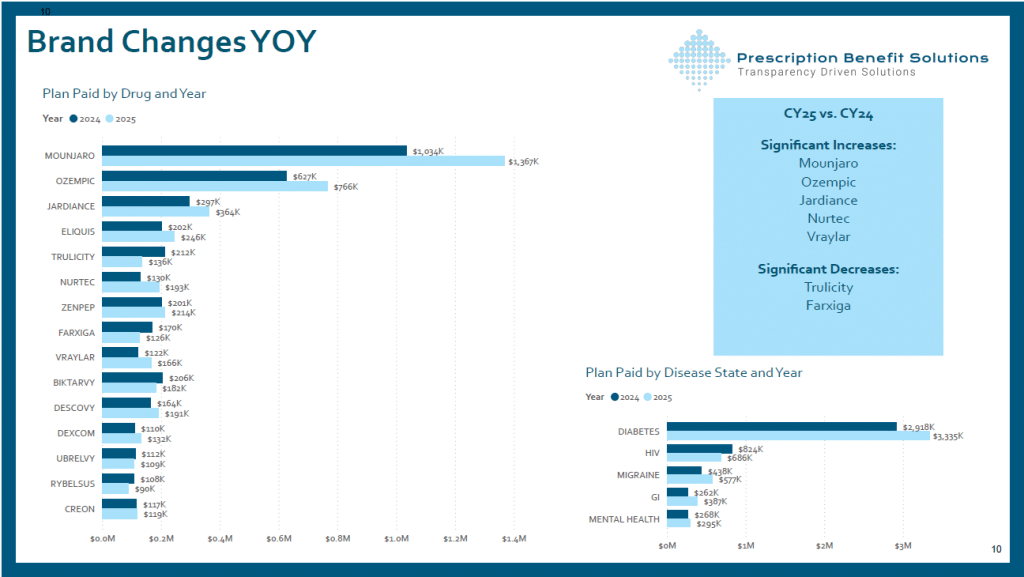
Overall, SCPS is expecting health care costs for employees to rise by 7.7 percent in the 2026-27 school year.
Costs for GLP-1 drugs have been rising, and is an increasing cost for employers and governments. Employers and Medicaid programs are restricting their coverage regardless of the benefits it has in treating obesity.
There is an economic impact of not treating obesity, Dr. Nikita Shah, obesity specialist physician and member of the Physicians Society of Central Florida, said. One of the impacts that can occur when companies don’t treat health conditions, Shah said, is higher direct medical costs from obesity related conditions.
“I do believe that people should have access to having their health helped,” Shah said. “We should be able to have discussions about having insurance cover treatment.”
Starting in 2027, the manufacturer of Ozempic, Novo Nordisk, plans to cut the cost of GLP-1 medications by up to about half of the current price. The impact on rebates won’t be visible yet, according to the pharmacy benefit review, but existing rebates might not change the employer’s net cost.
“We expect cost savings starting in 2027 for this class of drugs,” Healthcare committee consultant Rachel Sellinger said. “Hopefully, that’s going to put some market pressure on some of the other drugs that are already on the market as well.”
The committee’s recommendations are expected to come before the school board at the May 12 meeting. Union officials said the current expectation is that employees will not have to pay for the increased costs.
Want to contact your elected leaders and weigh in on this topic? Find their contact information here. Have a news tip or opinion to share with OCN? Do that here.
Support critical, local news you rely on to stay informed, connected and empowered.
Choose a monthly amount
Hometown Hero
Community Champion
Rooster Society
Custom Amount
Thank you for your support!
Author

Related Articles
Zoning board: former Pappy’s Patch should remain inside rural boundary
Chris Dorworth’s proposed Strawberry Lane project at the former Pappy’s Patch near Oviedo now goes to the County Commission for a final decision.

Apartments, townhomes on Seminole County agenda next week
Seminole County Commissioners could weigh in on two developments, including apartments near Lukas Nursery

Viva Oviedo! Festival gets special permit for upcoming event
An impassioned plea following months of delays and communication issues led to big changes for a major event in Oviedo.
The volunteer-run Viva Oviedo! Festival that celebrates Hispanic heritage saw thousands of people attend its inaugural event in October 2025. It’s set to take place again at Oviedo on the Park on Oct. 17. Organizers had hoped this year’s festival would be in partnership with the city, but despite having ongoing conversations with city officials since at least March, no decisions had been made until the Oct. 5 City Council meeting.