
State committee sends Winter Springs to governor for investigation
If Florida’s Chief Inspector, tapped by a state committee, finds the city is in a financial crisis, state officials could take over the city’s finances
A powerful state committee has referred Winter Springs to the governor’s office to investigate if the city is in financial emergency — raising the very real specter that Winter Springs’ finances could be taken over by a state committee of the governor’s choosing. But the reasoning behind the referral is unclear and doesn’t appear to follow state statutes for doing so.
The state’s Joint Legislative Audit Committee met on Dec. 11, one week after the committee gave Winter Springs a year-end deadline to get audited financial documents to the state or face a referral for a possible takeover. The committee offered the reprieve because Winter Springs Mayor Kevin McCann said the city had $92 million in reserves — more than a year’s budget.
State Sen. Jason Brodeur said he spoke to the city’s auditor and that the city does not have $92 million in reserves — “they may have it floating around somewhere, but that could be in pension, that could be in anything else,” Brodeur said.
Additionally, the city received notice of 23 more violations from the Florida Department of Environmental Protection for its aging wastewater plant. That could lead to more fines for the city and its contractor, Veolia North America, which it pays to operate the outdated plant.
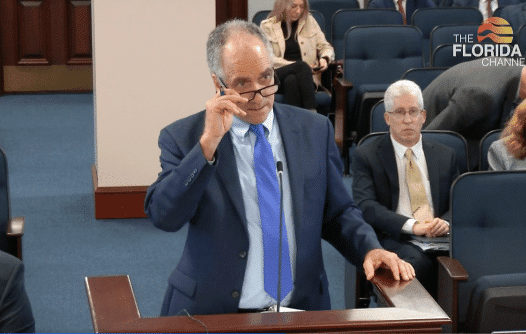
“Stop dumping poop in the water,” Brodeur said. “That’s why you’re here. It’s been a year and you haven’t done anything for it.”
State Sen. Jason Pizzo was clearly angry that the city’s auditor told him Winter Springs reserves were not the same as what the mayor said.
“I asked the mayor a very simple, straightforward question,” Pizzo said. “It’s math. It has one right answer: whether they actually have $92 million in reserves.”
Pizzo, along with the entirety of the JLAC board, voted to have the state’s chief inspector investigate Winter Springs’ finances.
“If we were lied to, it’s one of two things: They either knew, or they should have known,” Pizzo said. “The mayor here represented that he had $92 million on hand, 120% of the operating budget. And he does not. He either knew that he didn’t, or should have known that he didn’t. Both are dangerous. One makes you dumb. The other makes you nefarious.”
No one from Winter Springs was at the state hearing. But at Monday’s regularly scheduled City Commission hearing, the city approved raising water rates and approved hiring an engineer to design a new wastewater facility — both things the audit by JLAC flagged as major issues.
“I personally would rather stick to the agenda,” McCann said at Monday’s meeting. “Yes there was some disappointing news out of Tallahassee, but until we have a chance to actually consume it and understand what this means and process it, I would rather stick to the business at hand.”
Commissioner Cade Resnick asked the city attorney if he would recommend waiting on the big-ticket items until after the issues with the state are through.
“The political fallout can be severe enough,” to warrant waiting, Resnick said. “Is this something, mister attorney, would you share with us that it’s as bad as it sounds?”
Anthony Garganese, the city’s attorney, said he wasn’t aware of what the committee had done and couldn’t offer a recommendation one way or another.
After the meeting, McCann declined to comment directly about Pizzo’s comments at JLAC.
“Although the city worked closely with both the Auditor General’s office and the Joint Legislative Auditing committee, we are disappointed they have chosen not honor the agreement they offered,” McCann wrote in a statement. “We will continue to supply factual information regarding our financial health to the state and will continue moving forward serving our residents in the best manner possible.”
Lawmakers cited Florida statute 218.503 when they voted to send Winter Springs to Florida’s chief inspector to decide if the city is in financial distress. That law lists certain triggers of a financial emergency, such as not paying employee salaries, missing debt payments or missing pension payments.
None of those triggers have happened in Winter Springs, but the city is behind on its 2023 audited financial report.
Stetson Law Professor Paul Boudreaux said Florida statute 218.503 gives the governor broad authority, including to decide if a city is in a financial emergency and needs a board to oversee it.
“The way this statute is written, you would think that a court would say it’s up to the discretion of the governor and the state government to make this decision,” Boudreaux said. “But you could also have local governments saying the state is abusing their discretion. So I certainly think this could potentially form some litigation.”
City makes moves to address water trouble, but fails to approve a new city manager
The rates citizens pay for water are expected to double over the next five years, according to new rates finalized Monday.
Bills would go up by about 18% per year for the next three years, and then 10% per year for the last two years. Ultimately, for a house using about 5,000 gallons of water per month, the bill would go from $55 a month in 2023 to $110 per month in 2028.
But the money from that would be used on $166 million in wastewater construction projects — including two new wastewater processing sites in the east and west sides of town. The city also approved spending about $13 million to do the design work on the East and West Wastewater Treatment Facilities, and to have the city and an outside contractor do monthly inspections of the current facility.
“The reason we are here is because of the deferred maintenance,” Winter Springs Utilities Director Bilal Iftikhar said. “We want to make sure we don’t fall back into this kind of situation.”

Iftikhar said it would also help with the violation letters from the DEP to show the city is doing monthly inspections of the plant’s operations, as opposed to the yearly inspections the contract currently requires. “Absolutely, that is one of the reasons why we are doing this.”
One issue cited in the JLAC audits was the high turnover at the senior level of the city. Winter Springs’ top manager candidate withdrew after a contentious meeting where commissioners Resnick and Victoria (formerly Colangelo) Bruce said they weren’t happy with the city’s consultants or the city’s candidates. The second-place candidate, Christopher R. Miller, was brought in for in-person interviews.
But at Monday’s meeting, Miller — the county administrator of King George County in Virginia — only got three votes. That’s a majority, not the supermajority needed to secure the job. Both Resnick and Bruce voted against hiring Miller for city manager. It’s unclear how the city will proceed with hiring a new city manager, or what the timeline will be for that.
Resnick said he was not happy from the start with the process.
“You never said it before,” McCann said.
“I did,” Resnick said. “Actually, I did, at that meeting when I was told I was not supposed to be talking because we already ranked these people.”
“You responded, now it’s my turn,” McCann said. “Let me go on the record. You’re full of crap.”
There were audible gasps from the audience, and one audience member yelled at Resnick that there were six other candidates to choose from.
McCann apologized to Resnick for his remarks.
“This is absolutely about the next election,” McCann said. “They want a pro-development, someone who’s gonna do what they want, as opposed to what the residents want. This is all about power. … They know if we get someone that’s neutral, that comes from the outside, that they’re not gonna be able to manipulate as much.”
Sorry for the interruption but please take 1 minute to read this. The news depends on it.
Did you know each article on Oviedo Community News takes anywhere from 10-15 hours to produce and edit and costs between $325 and $600? Your support makes it possible.
We believe that access to local news is a right, not a privilege, which is why our journalism is free for everyone. But we rely on readers like you to keep this work going. Your contribution keeps us independent and dedicated to our community.
If you believe in the value of local journalism, please make a tax-deductible contribution today or choose a monthly gift to help us plan for the future.
Thank you for supporting Oviedo Community News!
With gratitude,
Megan Stokes, OCN editor-in-chief
Thank you for reading! Before you go...
We are interested about hearing news in our community! Let us know what's happening!
Share a story!
Author

Related Articles

A one-shot deal: Jerry Vaughan honors veterans’ last wishes nationwide
Chuluota veteran Jerry Vaughan crafts reconstructed military uniforms to give deceased veterans a dignified final salute. His hope is, with a new federal bill, he could put himself out of a job.
Seminole County Public Schools approves county’s first community school
Seminole County Public Schools finalized an agreement Tuesday to bring the county’s first community school to Sanford.