
Winter Springs resident concerns over flooding continue to mount
As Florida enters the peak of hurricane season in coming weeks, recurring flooding issues continue to pose a challenge to Winter Springs.
The city’s most recent city commission meeting on Sept. 9 saw multiple residents share stories of flooded streets and backyards, as well as concerns for the future of Winter Springs’ stormwater management.
Resident Leah Weisman, whose home is located near Gee Creek, said “it’s beyond what I remember after a tropical storm.”
“It’s gained a few feet as well as going fairly fast and there’s a current coming from the pond … I’m quite worried because all it will need is a few more days of this [rain], it’s already creeping into the neighbors and their backyards,” she added.
In September so far Winter Springs has received more than 7 inches of rain, with many tributaries from other areas flowing into creeks that must channel that water through Winter Springs before discharging into Lake Jesup.
Simple rainstorms aren’t the only concern of residents, as the peak of Florida’s hurricane season tends to occur between mid-August and late October.
Winter Springs saw significant flooding issues during Hurricane Ian in 2022 which, following its wake, left many residents concerned.
Resident Evan Pinellas questioned the commission during the meeting about how current stormwater and flooding efforts will hold up in the face of future hurricanes.
“Howell Creek, Gee Creek and No Name Creek have already flooded with the amount of rain that we’ve received this week, which has been addressed,” Pinellas said. “But how will our facilities fare in another inevitable hurricane? How long until the bandaid falls off?”
OCN also previously covered updates to Winter Springs stormwater infrastructure following the approval of a $1.5 million contract with Kimley-Horn and Associates Inc. to develop a plan over the next two years to limit flooding.
Former city commissioner Robert Miller addressed the current commission as well, warning the city is on the “verge of having another catastrophe” that could be “a repeat of [Hurricane] Ian.”
Miller began his time by speaking on behalf of the concerns of another present resident, Ruben Trevino, in addition to his own.
Prior to the purchase of his Winter Springs home nearly 30 years ago, Miller said the surrounding area was mostly wooded. Now, it consists of subdivisions that can contribute to the issue of flooding.
”Where that poor gentleman [Trevino] lives at the end of [Sailfish Road] abuts that next housing development and in between is No Name Creek,” Miller said. “There has been flooding there every year, on and off, even since I’ve been here.”
Trevino told the commission he doesn’t know what the solution to the flooding issue is.
”I got pictures of what I refer to as Sailfish Road, but it’s Lake Sailfish right now,” Trevino said. “Is there a way to get a no wake sign on the street?”
Trevino also referenced a Winter Springs City Commission informational document dated Jan. 12, 2009 regarding emergency access at Winding Hollow following Tropical Storm Fay, which hit the city in 2008. He pointed out to commissioners a section referencing No Name Creek, which according to the document “is considered to be an extremely hazardous area due to the potential velocity of floodwaters.”
He also noted that the document stated that, at the time, the culverts existing at the creek were not considered to have the “capacity to convey the 100-year storm flow.”
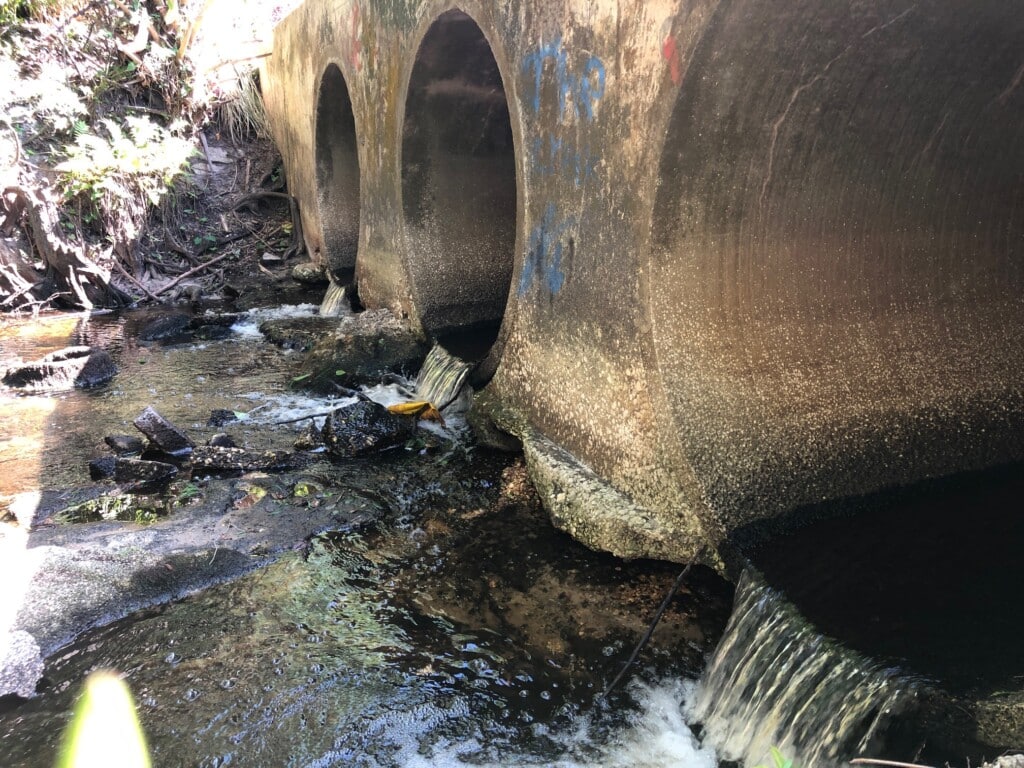
Culverts are a common part of stormwater drainage systems, which generally convey water beneath obstructions, such as roads. A series of culverts along Howell Creek and Gee Creek in Winter Springs are necessary to allow rain water to flow to Lake Jesup.
Mayor Kevin McCann said the city approved a $24 million dollar stormwater plan in June of this year which will help to “identify needs” when it comes to stormwater management and related issues.
“That includes the creeks and water basins that are having incredible problems,” McCann said. “That work is going to continue, but part of that is maintaining all those different ponds and what is the city going to do, how are we going to contribute?”
A press release on Sep. 5 informed residents that city contractors would begin to collect field data on Sep. 9 in order to “assess the City’s stormwater infrastructure and determine the appropriate staffing levels required to properly maintain the systems.
City Commissioners in the past had fretted over the complicated nature of controlling and maintaining ponds, which collect rainwater and work in concert to prevent flooding, when many are part of private neighborhoods.
The data collected would primarily focus on areas such as Mockingbird Lane, Holiday Lane,Lido Road, Sailfish Road, and the Oak Forest and Dunmar Estates subdivisions.
Resident and candidate for Winter Springs District 3 Commissioner Sarah Baker said she lives at the fork of Howell Creek and Bear Creek and that while she and many of her neighbors are still experiencing flooding, the issue can be more serious for some than others.
“We have the three acres that can maintain the flooding … but the people that surround us don’t,” Baker said. “I’m getting pictures sent to me on a regular basis saying, ‘What are we doing about this?’”
Baker previously spoke with OCN in March of this year following a wastewater lift station failure which caused an overflow of wastewater through a manhole in her backyard.
When it comes to who’s at fault, Baker said the city should try and “look inward” a little more.
“What we can blame is looking inward at what we’re doing to maintain our waterways and how we mitigate that runoff,” Baker said. “What are we doing to build those banks up higher, to keep the debris out on a regular basis? Not every two years, every three years, whatever it is.”
Resident Art Gallo, who said Howell Creek runs through his backyard, described the creek water level as “quite high.” However, he believes a large part of flooding issues stem from creeks being “used by the state for stormwater collection.”
“30 years ago that was probably a great idea, and it still is a good idea,” Gallo said. “Unfortunately, we haven’t done anything to improve the flow of water through those creeks so they can finally get to where that water has to go.”
Gallo said he doesn’t feel the blame lies completely with Winter Springs, as the city has no control over the actions of other cities connected to the creeks.
“We can build banks and whatever we have to do to stop the flow of water, but we can’t stop it from being dumped in the creeks from cities that we have no control over,” Gallo said.
“Go find the source of Howell Creek, of Bear Creek, it’s in other cities that in the old days were all open ground,” Miller said. “Now that whole thing is constrained by houses on both sides of those creeks. There’s no place for the water to go except come down here to Winter Springs.”
McCann said the city has a “lengthy list” of actions it has taken regarding stormwater, such as increasing new construction standards. Still, he said there’s other information Winter Springs residents should keep in mind.
“We need to have a conversation about FEMA and flood plains, and buyer beware when you buy a home that’s in a flood plain,” McCann said. “Understand that those floodplains are very old and outdated, and so they are significantly bigger … Any water that falls in Central Florida, North of Route 50 on Colonial [Drive] has to go to [The St. Johns River] and the majority of it comes through Winter Springs.”
As rain continues and pending the results of the city’s stormwater study, McCann said he welcomes any suggestions from residents, saying to “shoot me an email.”
“With these stormwater issues, we’re going to continue to work on them,” McCann said. “But there is not a silver bullet, folks. This is going to be long term hard work.”
Want to contact your elected leaders and weigh in on this topic? Find their contact information here. Have a news tip or opinion to share with OCN? Do that here.
Sorry for the interruption but please take 1 minute to read this. The news depends on it.
Did you know each article on Oviedo Community News takes anywhere from 10-15 hours to produce and edit and costs between $325 and $600? Your support makes it possible.
We believe that access to local news is a right, not a privilege, which is why our journalism is free for everyone. But we rely on readers like you to keep this work going. Your contribution keeps us independent and dedicated to our community.
If you believe in the value of local journalism, please make a tax-deductible contribution today or choose a monthly gift to help us plan for the future.
Thank you for supporting Oviedo Community News!
With gratitude,
Megan Stokes, OCN editor-in-chief
Thank you for reading! Before you go...
We are interested about hearing news in our community! Let us know what's happening!
Share a story!
Author

Related Articles
Oviedo residents may see significant increase in trash collection rates
Trash collection rates could rise several times in the next few years if a plan goes forward, in response to increasing costs from inflation and other factors.
Seminole County legislators: Rural boundary is safe ‘for now’
Local lawmakers anticipate three special sessions between now and August to tackle budget, redistricting and property taxes.
After Oak Forest Lake fish kill, the question looms: Who pays for cleanup on private lakes?
Winter Springs meeting next week to hash out a new stormwater policy, expected to lead to increases in stormwater fees for residents.