
New Winter Springs city manager faces daunting challenge
New Winter Springs city manager faces potential swath of sudden changes to government operations after election of new Commission.
In the aftermath of its elections, Winter Springs has seen a variety of changes to key city administration posts beyond just its newest commissioners.
The most notable example occurred during the city’s last commission meeting, which saw the ousting of now-former interim city manager Phil Hursh, who was fired in a 4-1 vote, with only Commissioner Paul Diaz dissenting.
Hursh’s original appointment to the interim position began after the sudden retirement of former city manager Shawn Boyle, who at the time cited “emotional and physical distress.” From there, the city spent more than a year and a half searching for a permanent city manager while dealing with two audits of the city’s finances as well as internal challenges to the candidate search.
Winter Springs spokesperson Matthew Reeser responded to OCN’s request for comment on the interim city manager changes, saying via email that Hursh has now returned to his previous position as the city’s director of Public Works.
“As for the interim city manager position changes, I refer you to the discussion held during the November 18 Commission meeting, as that role is determined by the Commission and not by staff,” Reeser’s email read.
Mayor Kevin McCann told OCN in an interview that he considered the decision to remove Hursh “personal” and “unfortunate,” citing his disappointment in what he calls a lost opportunity to heal the city and move forward.
“It does not reflect who we are as a community to publicly embarrass or harm someone like that,” McCann said. “With three weeks to go before his replacement starts, I believe it was unnecessary … To attempt to remove somebody when we need all hands on deck, I believe it’s a poor decision for sure.”
Commissioners also debated other matters with direct impacts to the operations of the city, such as limiting the ability of the mayor to comment during commission meetings and even a call for a complete upheaval of the city’s boards and committees.
With those major changes and proposals in mind, incoming city manager Kevin Sweet sat down with OCN to discuss his outlook on some of the issues and challenges he will be facing, as well as his goals for the city during his transfer from the role of town manager for Wrentham, Massachusetts.
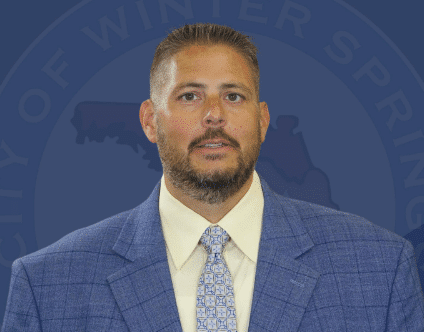
“I know there’s a lot of work to be done,” Sweet said. “I’m trying to absorb as much as I can and get up to speed as much as I can while being remote and not in the job, so there’s less that I need to kind of absorb when I get in there, because it’s going to be a lot to do.”
City infrastructure and development
Development, always an impactful issue for the city and its residents, is on Sweet’s list.
He said his involvement with numerous economic development initiatives in his previous jobs, such as his negotiations of Tax Incentive Financing agreements using property tax incentives to encourage business investment or his experiences serving on the 495/Metro West Suburban Edge Community Commission to assist with community development challenges, have given him the experience needed to advance what he calls “smart development”, reflecting the needs of a community as well as the wants of residents.
Sweet said he knows there are “limited areas” of development remaining in Winter Springs, but that key areas of land within the city still remain where conversations around development need to happen.
He also said while residents don’t appear to have interest in multi-family housing projects, there could be interest and benefits to bringing the “right businesses” to the city, such as new restaurants or entertainment opportunities in the downtown area while still respecting the development interests of the community.
“I think there’s some opportunities potentially … to get a little bit more commercial where it makes sense,” Sweet said.
Another major challenge for the city has been its stormwater infrastructure, with many residents often speaking out about their flooding experiences and concerns to the city commission and staff. It’s a problem Sweet is ready to get started working on.
“Specifically to the stormwater [issue], we need to look at the ponds that are throughout the city,” Sweet said. “If you look at the pushback, a lot of the conversations have been around whether they’re city owned or privately owned, and the access to be able to get in and clean those out and maintain.”
Beyond that, Sweet said there needs to be a “game plan” to handle the volume of water that goes through Winter Springs.
“I know there’s some legal issues and some logistical legal issues around the ability of the city to be able to do that,” Sweet said. “But I think we can get through a lot of those obstacles. At the end of the day, these are our residents that are going to be impacted when things back up and when things aren’t maintained.”
Openness and transparency
The commission’s last meeting also saw discussion surrounding the city’s public Facebook account, which currently does not allow residents the option to comment on posts.
Any information posted by the city is subject to the Government in the Sunshine Law, which establishes the public right to access state and local government agency meetings and records. The commission is essentially prohibited from responding to comments on social media posts about official business that could come before it, as those comments are considered public record and cannot be deleted.
The decision to limit commenting has been a point of contention for both residents and some city staff, a matter which Sweet said he’s aware of.
“I would say I’m not fully a yes or a no, but I do have a lot of questions about the expectations,” Sweet said. “If they are going to do that, I would just caution that there is definitely going to be a need for somebody to monitor and manage that of which we don’t have today, which obviously has budget impacts.”
From a public relations standpoint, Sweet said, many firms recommend not allowing a commenting feature on city government posts. While he supports freedom of speech and “transparency to the fullest extent,” he said there needs to be conversations to find a balance.
“If you have a specific question or concern, contact city hall or staff directly,” Sweet said. “We can’t be communicating through social media as the mechanism. I’m in favor of post transparency and folks being able to say their piece from a freedom of speech standpoint, but it can’t be the source of their information. We can provide one-way information, but we can’t get into a dialogue and back and forth.”
The meeting also saw another major discussion sparked by Deputy Mayor Cade Resnick’s proposal to bring back a commission decision made to limit the mayor’s ability to comment during meetings.
Sweet said one of his concerns surrounding that proposal would be figuring out what exactly it would entail, and how that might impact the operations of the city’s meetings.
“I think where they’re coming from is the mayor doesn’t have a vote and doesn’t want to allow the mayor to speak on an issue before a vote is taken that might be able to sway a vote a certain way,” Sweet said. “I think even for me to be able to provide my thoughts on it, I kind of need to understand what they are really intending to do here. … From the city’s function and operation, to basically silence the mayor, that’s extreme and drastic and probably not where we want to be going.”
Remaining clear and transparent is one of Sweet’s biggest priorities, not just with residents, but with city staff and officials as well. With that in mind, he thinks the proposal by Resnick should at least be examined to see what it specifically entails, a matter that will likely be brought up for discussion at the commission’s next meeting on Dec. 9.
“I think we need to understand exactly what they’re looking to do,” Sweet said. “We want to be able to allow everybody to have the opportunity to be transparent and have a voice and not shut people down.”
Boards and committees
The city commission’s last meeting saw a proposal from Diaz to evaluate all city boards, which includes groups like the city’s planning and zoning board or the parks and recreation advisory committee, for elimination following discussion on developing an infrastructure board.
“Other than the taxing districts that would have to exist, [I suggest] that we actually go ahead and wipe out all the boards,” Diaz said at the meeting. “We’ve got way too much government, [we’re] adding another layer of government again just for the sake of trying to appoint people to something.”
The proposal was met with opposition from both Resnick and McCann, the latter of whom expressed his lack of support for the new infrastructure board but defended the city’s existing ones.
“We can’t just wipe it out and start over,” McCann said. “You’re going to stop all development. Everything is going to grind to a halt with a lot of these things.”
Resnick suggested eliminating the Veteran and Veteran Family Advisory Committee due to lack of activity and meetings but still opposed Diaz’s proposal.
“I’m not in favor of wiping out all the boards,” Resnick said. “I know the value of some of the boards that we have.”
“I’m not saying they’re not valuable,” Diaz said. “I’m just saying, let’s have a discussion one by one to make sure that the size and scope of each board is clear … it’s easier to start fresh from zero.”
A motion to create the new infrastructure board was ultimately approved with a 4-1 vote, with Diaz dissenting. The board’s explicit purposes and functionality will be addressed further during the commission’s next meeting on Dec. 9.
“I would caution about too many boards, even here in my current city,” Sweet said, when asked about his thoughts on the introduction of the new infrastructure board. “We’ve eliminated some of those.”
In the meantime, Sweet said he’s “split” on the need for the board without further information being provided.
“I just don’t know what the charge of that board is going to be,” Sweet said. “I’ve had what we call capital planning committees, it’s the same thing as an infrastructure board. They put on residents that have a lot of great ideas and good things, but they’re not necessarily the subject-matter experts in the particular capital item that we’re talking about or need.”
Sweet said he previously eliminated Wrentham’s capital planning committee due to low interest and there not being enough members to have a quorum, but has since considered other venues to better provide valuable public input on infrastructure and other matters of importance for residents (Sweet was previously the town manager of Wrentham, Massachusetts).
“They could look at a quarterly coffee with the city manager, maybe an open town hall forum every once in a while and just invite residents in,” Sweet said. “Talk about what their concerns are, what they love about [the city] … have that open dialogue with residents and more freedom than just a public commission meeting.”
Message to city staff
Winter Springs city staff are no strangers to turnover and turmoil. And in the aftermath of Hursh’s firing, Sweet said he’s done his best to listen to those who’ve been around longest in the city and understand some of the dynamics and concerns at play within its government.
Ultimately, he wants to ensure that city staff understand he’s here to listen.
“I think the place to start is to do more listening and kind of hear from them of where the frustration points are,” Sweet said. “When you talk about the turnover, there’s some obvious reasons … change is not easy for anybody, even if they know and support it.”
Sweet also wants to assure them that while needed changes may not happen overnight, they will happen.
“I think we’ll get there,” Sweet said. “I think one of the benefits that I do bring in the role is this isn’t my first time. I’ve come into my prior municipalities … and we’ve changed the culture and we’ve changed the morale.”
Other municipalities Sweet previously served in include his role as the assistant executive director of public health for Taunton, Massachusetts, a city with a population of around 60,000, as well as the town administrator for Maynard, Massachusetts which has a population just over 10,000.
For his role in Winter Springs, part of building morale comes from developing more trust in the city and its operations.
“I think my goal would be to try to rebuild trust in city staff and in the city operations,” Sweet said. “But I’m also going to be working hard to reestablish relationships that are no longer there, and for whatever reason, have fallen apart.”
Establishing and building on relationships at the county level as well as throughout the state is something Sweet considers important for the success of the city, and ultimately, its residents.
“I think the big takeaway is just trying to rebuild the trust,” Sweet said. “Rebuild the trust and support of city staff, city operations, and then on a regional and statewide level … in order to be successful as a city and as a whole, we need to have those and reestablish those.”
Want to contact your elected leaders and weigh in on this topic? Find their contact information here. Have a news tip or opinion to share with OCN? Do that here.
Sorry for the interruption but please take 1 minute to read this. The news depends on it.
Did you know each article on Oviedo Community News takes anywhere from 10-15 hours to produce and edit and costs between $325 and $600? Your support makes it possible.
We believe that access to local news is a right, not a privilege, which is why our journalism is free for everyone. But we rely on readers like you to keep this work going. Your contribution keeps us independent and dedicated to our community.
If you believe in the value of local journalism, please make a tax-deductible contribution today or choose a monthly gift to help us plan for the future.
Thank you for supporting Oviedo Community News!
With gratitude,
Megan Stokes, OCN editor-in-chief
Thank you for reading! Before you go...
We are interested about hearing news in our community! Let us know what's happening!
Share a story!
Author

Related Articles
Winter Springs stormwater rate could go up to pay for pond maintenance
Rates would eventually double to $20 per month by 2030, under a proposal commissioners workshopped this week
Oviedo residents may see significant increase in trash collection rates
Trash collection rates could rise several times in the next few years if a plan goes forward, in response to increasing costs from inflation and other factors.
Seminole County legislators: Rural boundary is safe ‘for now’
Local lawmakers anticipate three special sessions between now and August to tackle budget, redistricting and property taxes.