
Tensions rise as Winter Springs commissioners critique mayor, trade barbs
As tensions rise on the Commission, attempts to defuse are followed by a unusual call to fire all volunteer city boards.
In its last meeting of the year, tensions rose amongst the Winter Springs Commission on Monday night as those on the dais revisited some of the most contentious issues brought to light during its controversial previous meeting.
The most recent meeting, which ran a minute short of five hours, discussed items such as the proposal to limit the mayor’s speaking abilities during meetings, opening the city’s social media pages to comments and a call made again by one commissioner for the removal of all city boards.
Deputy Mayor Cade Resnick, who previously introduced the mayor-related proposal while initiating the firing of former interim city manager Phil Hursh, told Mayor Kevin McCann the idea to bring back a commission decision made to limit the mayor’s ability to comment during meetings came out of frustration.
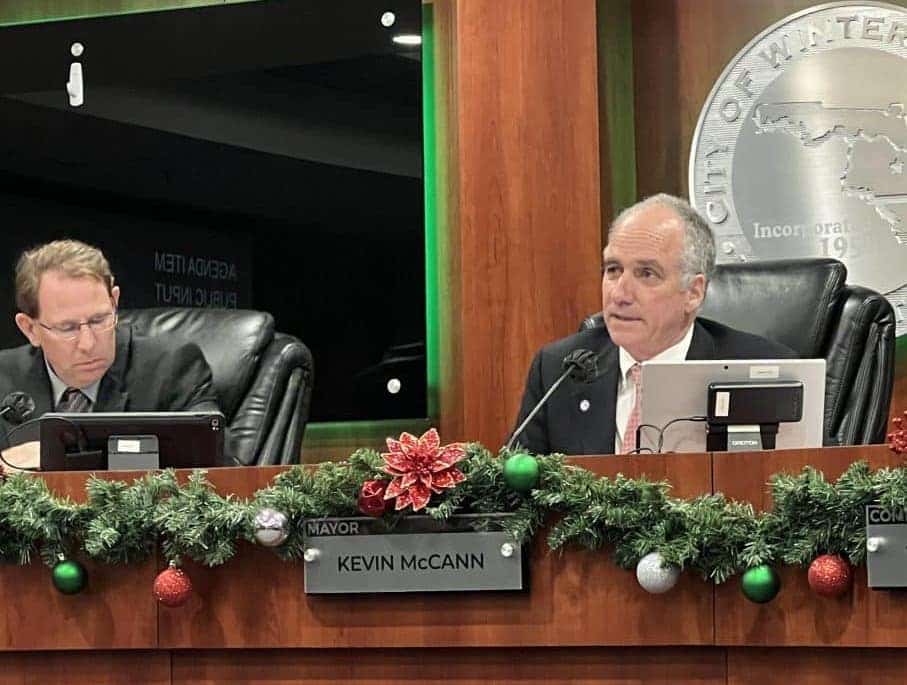
“Part of the reason that I bought it up … and I’ve mentioned it many times, is that you tend to go on rants,” Resnick said. “You tend to go on ways to educate people. And in the last meeting, I got frustrated by that.”
Resnick said his moment of frustration could perhaps serve as a “learning lesson.”
“I appreciate you educating us, but we don’t need to be educated every two minutes,” Resnick said. “Mayor, I am asking you to shepherd us and use less of your language of educating everybody over everything. That would be my request if we don’t move forward on this, that’s where I’d start the conversation.”
McCann then asked for discussion, prompting other members on the dais who focused less on the mayor’s commenting tendencies and more on making an effort to limit meeting times. Commissioner Sarah Baker told McCann that as long as meetings could be efficiently moved along and productive, she valued his input.
“I’d like to say that I do appreciate some of the history that you give us,” Baker said. “I think that your opinion is valued by a lot of people. I understand what they’re saying as far as keeping the meeting moving, but I don’t think anybody wants to see us put too strict of guidelines.”
Commissioner Mark Caruso voiced his support of the mayor but said he thinks the commission simply wants for him to “tone it down a little bit.”
“I’m not comfortable with trying to put you in your place, or whatever the terms are to use for that,” Caruso said. “I like you, I think we work great together, but I just want you to see everything and everyone’s opinion, that’s it.”
“I’m kind of torn on how to respond,” McCann said, adding the criticisms could have been brought to him privately for consideration.
He described the public analysis of his position as “embarrassing” and referenced the action to limit the mayor’s speaking as a form of “payback,” originally instigated during a December 2020 commission meeting, which successfully limited former mayor Charles Lacey’s ability to speak during agenda items.
“I’m also an elected official,” McCann said. “I’m elected by the entire city and just like our residents have the opportunity to come before and speak, the mayor certainly as an elected person should have that right.”
Diaz said that he considered the conversation on limiting the mayor’s speaking abilities to be an example of “bad government”, positioning the matter as an attack on the right of speech while telling Resnick that “after you pull the trigger, it’s pretty hard to get that bullet back.”
“This is exactly what I am opposed to at my deepest core, because at the end of the day the reason we have a constitution today is because the founders decided with the Federalists and the Anti-Federalists … to have a bill of rights,” Diaz said. “We’re not talking about the mayor, we’re talking about a very fundamental point, which is what do we believe as a democratic society in a republic? … “I’m absolutely appalled that we’re even having a conversation of limiting anybody’s speech.”
“So section 405 of the charter specifically states that you are wrong, sir,” Resnick responded. “Now we can have this fight outside if you’d like, verbally, because it’s going to be an intellectual challenge and I enjoy that. But please read the charter before you go on your rampages.”
The section of the city charter which Resnick referenced outlines the responsibilities and role of the mayor and states he “shall preside at meetings of the city commission” and “perform other duties specified by the commission.”
Resnick then apologized to McCann directly and clarified that he had not retaliated but expressed his frustration, before adding that the mayor’s role is guaranteed by the commission.
“We decide how he interacts,” Resnick said, responding again to Diaz. “I know that is against your Federalist mindset, but please understand by no uncertain means was I violating the rules of government. I was sharing a way upon which we can move meetings ahead … I never violated anybody’s freedoms.”
“We’ll make a note of the adult, reasonable expectations and the parts of what I can take away as colleagues and professionals,” McCann said. “I’ll hook on the positives and try to stay focused on those … and try to ignore some of the other stuff, the bringing it up in public and doing it like this. And we’re moving on, we’re healing.”
The discussion ended with no motion made.
“We had a bump in the road at the last meeting,” McCann said. “It came back up a little bit today, but I think we’ve got a lot of really important work to do for the residents. Let’s get to it.”
Opening city social media
Another major issue revisited was the matter of the city’s social media pages, which do not allow public commenting features, much to the dissatisfaction of both residents and commission members alike.
Comments are not allowed per the city’s social media policy, which was adopted in May 2015, interim city manager Brian Dunigan said.
“The commenting section of most of these channels is disabled pursuant to that policy,” Dunigan said.
Dunigan also outlined to the commission three options for best practices the city could choose to follow in regards to its social media policies and interactions, or lack thereof.
“The first option is if you’re going to have a one-way communication platform, which is essentially what we have right now, it’s similar to managing a billboard or a digital sign or any type of public notice,” Dunigan said. “The second one would be, if we are going to hypothetically open up comments … the questions that are answered are substantive in nature. We correct them from misinformation, we ignore and not engage in emotional or heated comments. And then the other option would be that you turn on the comments but not engage in a back and forth.”
Diaz proposed the commission move to allow city meetings to be livestreamed on YouTube, a platform which violates the city’s current social media policies as the livestream feature does not allow for live commenting to be turned off. He said the current meeting live stream option provided by the city, which can be found here, is “ridiculously difficult” to access for some residents like the city’s seniors.
Opening the stream on YouTube and subsequently allowing for comments would be a positive development, Diaz argued, one that outweighs the potential negative comments or discussions that might be made.
“If we have good speech, and the city’s putting its best face forward, and each one of us make a commitment as elected leaders of the city to put the best face forward for the city all the time, I would say I don’t gamble but if I had to gamble, I put money on our comments are going to be good,” Diaz said.
Baker said in her own professional experience, running a social media page can be a full-time job that could require multiple people.
“While I am for opening comments up, I think that it’s going to take a huge process of rebuilding what our policy is internally,” Baker said. “I think this needs to be a workshop at the very least.”
McCann, who has expressed his hesitations on opening the city’s social media comments before, said he worried what the repercussions of opening comments might be without having a dedicated staff member to monitor them.
“People will be reporting things there,” McCann said. “They will be asking questions, and then they’re going to get mad that nobody is responding. We can’t just put it out there, because people will assume and rely on it.”
Dunigan said staff would need to be aware of the expectations of the commission to draft the new policy specifics, and also told the commissioners that the city’s public communications officer, Matthew Reeser, might have to refocus his priorities from matters like city press releases to accommodate any new social media responsibilities.
“If you all would like him to refocus a large portion of his day to managing Facebook comments, that’s certainly an expectation that could be given,” Dunigan said. “But there may be less of some of those other efforts being done on his part … I think from our perspective, it’s just about understanding what expectations are and then trying to allocate resources to meet those.”
After discussion, the agenda item ended with three motions unanimously passed by the commission to allow for the live streaming of city meetings on YouTube with commenting features, as well as opening comments on the city’s Facebook and Instagram page, with the clarification that each will include notice that comments are not monitored by city staff.
Dunigan said in terms of next steps, the city can’t immediately open the approved social media pages for comments as staff must now develop new social media policy standards for review.
“The commission’s giving clear direction to staff on what they want to see moving forward,” Dunigan said. “It’s now incumbent on us at the staff level, in conjunction with [the city attorney] to bring a revised policy back to you all for approval that meets the criteria that you laid out tonight through these three motions in front of me.”
Repeated call to eliminate city boards
One of the final points brought back to the commission came when Diaz revisited his call from the last meeting to eliminate all city boards, a move he has touted as part of his beliefs in efficiency through shrinking government.
“I think that the prudent thing to do would be to start completely fresh,” Diaz said. “We don’t have to bother with all these meetings and all these postponements and all these cancellations. We can, as a body, come back and say, ‘Hey, we really want to have this board.’ And then let’s have a robust debate about each one.”
Caruso said while he agrees there are some boards that could be potentially eliminated with discussion, moving to eliminate them all at once isn’t something he can support.
“I agree, but we cannot eliminate all the boards,” Caruso said. “We [would] have to hire people to do what those volunteers do, and that’s not shrinking government.”
Diaz eventually motioned to eliminate all city boards except for code enforcement and the board of trustees. It did not receive a second from his fellow commissioners and failed to move forward.
Resick told Diaz he could continue to present the idea “every which way”, but that he ultimately believes boards matter.
“If nothing else, they help build community,” Resnick said. “They bring people in here. To make them feel necessary, to make them feel involved … To me, boards play a necessary benefit in growing our community, growing our city, because there are more voices out there talking about what we’re doing.”
Want to contact your elected leaders and weigh in on this topic? Find their contact information here. Have a news tip or opinion to share with OCN? Do that here.
Sorry for the interruption but please take 1 minute to read this. The news depends on it.
Did you know each article on Oviedo Community News takes anywhere from 10-15 hours to produce and edit and costs between $325 and $600? Your support makes it possible.
We believe that access to local news is a right, not a privilege, which is why our journalism is free for everyone. But we rely on readers like you to keep this work going. Your contribution keeps us independent and dedicated to our community.
If you believe in the value of local journalism, please make a tax-deductible contribution today or choose a monthly gift to help us plan for the future.
Thank you for supporting Oviedo Community News!
With gratitude,
Megan Stokes, OCN editor-in-chief
Thank you for reading! Before you go...
We are interested about hearing news in our community! Let us know what's happening!
Share a story!
Author

Related Articles

Winter Springs stormwater rate could go up to pay for pond maintenance
Rates would eventually double to $20 per month by 2030, under a proposal commissioners workshopped this week

After Oak Forest Lake fish kill, the question looms: Who pays for cleanup on private lakes?
Winter Springs meeting next week to hash out a new stormwater policy, expected to lead to increases in stormwater fees for residents.

Winter Springs approves $65.8M replacement to aging wastewater plant – cheaper than budgeted
After years of planning, the city moves forward to replace water facilities. Winter Springs also appoints new charter review committee members who could oversee major changes to the city.