
Oviedo Arya development brings Live Local Act issues to forefront
In the wake of a razor-thin vote to pass a mixed residential-retail tower, questions remain how the Live Local Act forced a city’s hand, and what implications it has for cities’ futures.
A public hearing about a proposed development — Arya at Oviedo — and the future land use amendment for it brought along significant outcry and concerns about future projects in Oviedo at the marathon-length May 5 City Council meeting.
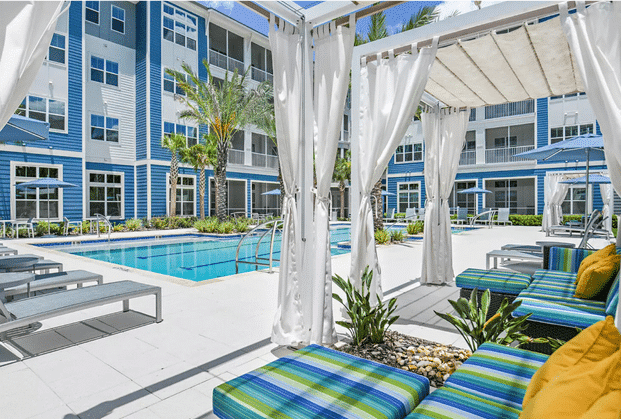
The meeting, which lasted more than three-and-a-half hours, focused primarily on Arya, a mixed-use project that is part of a 100-acre development called River Oaks Reserve. It’s just 300 yards west of the rural boundary, where the density of projects is more restrictive. Arya is planned for the northeast corner of County Road 419 and Lockwood Boulevard and includes a 5-story, 172-unit apartment building for residents 55 and older. It also calls for 6,200 square feet of retail commercial space, but needs an amendment to change the land use from low-density residential to a mixed-use development.
However, larger issues may be at stake, including how the city and developers adhere to Oviedo’s Comprehensive Plan, which lays out policies and priorities for future development.

A map showing where the proposed Arya development would be located (Map via City of Oviedo)
A dozen people spoke at the meeting against the development and amendment, with concerns ranging from environmental and wildlife impacts to fire safety and traffic.
While much of the City Council voiced concerns about the project, it was ultimately passed on a 3-2 vote, with Councilmembers Alan Ott and Keith Britton voting against.
Mayor Megan Sladek, who otherwise would have been against approving the project due to it not fitting into the Comprehensive Plan “and people don’t want it,” ultimately voted for it for one major reason: Florida’s Live Local Act.
“I’d rather [the site] be empty; we’d all rather it be empty,” Sladek said. “That’s not one of the choices.”
The Live Local problem
The Live Local Act is meant to increase the availability of affordable housing throughout the state through tax breaks, density allowances and other developer benefits for offering at least 40% of units in a project at affordable prices. “Affordable” is defined as rent not exceeding 90% of the fair market value to households earning up to 120% of the Area Median Income (AMI).
According to Oviedo City Manager Bryan Cobb, Seminole County’s AMI in 2024 was $90,400. Eighty percent of that would be $72,320, and 120% of it would be $108,480 — the numbers the tax exemptions would be based off of. Based off of those numbers, developers could charge upward of $2,500 a month for rent and still be eligible for Live Local Act benefits.

The fair-market rent for Seminole County (via ushousingdata.com)
The average or fair-market rent for two-bedroom housing in Seminole County is $1,958, according to ushousingdata.com.
Oviedo opted out of providing the tax breaks in 2024, but developers would still be able to benefit from the density and other allowances.
However, officials say that the Live Local Act does not quite do what it is intended to and, because of that, could hamper the city’s future development plans.
Deputy Mayor Natalie Teuchert called it “misleading” in 2024, and said at the meeting “I hate calling it affordable housing … it is definitely not affordable housing; it is luxury housing at a tax discount.
“If it was actual affordable housing, I would go that route,” she said.
By using the Live Local Act, developers would not have to go in front of the City Council for approval for zoning or future land use map amendments, and would not need to hold or advertise public hearings, Oviedo’s Development Services Director Teresa Correa said.
“If they have deviations on the site plan or the [architectural design order] greater than 20%, they will have to come to Council for a public meeting, not for a public hearing,” Correa said.
Building without regard to the city’s Comprehensive Plan makes it difficult for the city to grow as expected, Teuchert said.
“We’ve had a lot of local leaders say, ‘Don’t do this, or they can build apartments in industrial zones and commercial zones,’” she said. “What’s the point of having a comp plan with planned zoning and making a commitment to our residents, that this is what we’re going to build, and then you’re going to go and make a law [like the Live Local Act] that preempts that?”
While Sladek said no developer has built through the Live Local Act in Oviedo yet, Teuchert said “other cities are seeing this, where there are developers coming in and building units through Live Local that are called affordable, but are not affordable.
“If you’re putting in $2,000 a month for rent, that’s ‘affordable housing’ according to Live Local, which we all know is not affordable,” Teuchert said.
”Maybe one day ‘affordable’ is going to be way different than [fair market value], but right now it’s not,” she said.
If the Arya was developed on the site through the Live Local Act, it could build 50 dwelling units per acre, which would come out to about 410 total, without City Council approval. The Act additionally would allow for at least 615 parking spaces for that many units. In the current proposal, the development is asking for 294 parking spaces.

A comparison of impacts of the Arya development through its current state and the Live Local Act (Chart via City of Oviedo)
Since developers could move ahead with projects without needing the City Council’s approval if they do them through the Live Local Act, Sladek said she would rather work with the developers on compromises on both sides.
“I would rather if we have a developer who is willing to have a conversation with us and they’re asking for something less intense than Live Local, and they can show that it’ll do something affirmatively good for the people who already live here and be less intense than Live Local,” Sladek said. “If they can fall into that space, I’d like to have that conversation with them and continue to do so.
“I think that [the May 5] vote makes us look like a reasonable city that understands the law and is willing to work with people in a rational way,” she said.
Location, location, location
The Arya project itself is not a problem for councilmembers, but rather the location is — land that will most likely be built on eventually if it isn’t the Arya.
”I would say I think this is a really good project,” Teuchert said. “I would prefer the location to be where we designated the density.”
The city’s Comprehensive Plan focuses higher density in specific areas, such as Downtown Core, Gateway West (on the western part of the city near West Mitchell Hammock Road), the Mitchell Hammock Corridor and south of Mitchell Hammock. The location of the Arya project does not fall into one of those growth areas.

A map of Oviedo showing the four major density zones. (Map via City of Oviedo)
But due to the Live Local Act hanging over the city, if the Arya was not approved for the site, “there is a really good chance you get something a lot worse” at the location in the future, Teuchert, who voted to pass the amendment, said.
“We don’t have to do this, this is something we get to decide here, and so what we’re deciding is not whether we have to, but whether we should. Whether it’s better to take this thing that would go in now and have it be, or have the thing that could happen next year, in five years or never,” Councilmember Alan Ott said. “We don’t really know when a commercial development could go in there.
“It’s very much, to bend the metaphor, a bird in the hand [is worth] two in the bush kind of thing going on here,” he said.
In working with the city to develop at the site, the Arya is offering a number of concessions, including providing 38% open space vs. the Comprehensive Plan’s minimum of 25% and the Live Local Act’s minimum of 30% and a crosswalk with safety lights on Lockwood Boulevard at the north entrance of the development.
Additionally, during the meeting, councilmembers asked representatives for the Arya development if they would reduce the building height maximum from 70 feet to 60 feet, which they agreed to. The Live Local Act only allows for a maximum of 60 feet in height.
Teuchert said if the developer, Kimaya Real Estate, had not lowered the maximum height, “I would have not gotten on board on giving them more than Live Local.”
Looking upward
While the Council asked for and received a concession for the Arya to not be built above 60 feet, that does not mean taller buildings are not on the horizon for Oviedo.
“The height is coming,” Correa said. “The height is coming in other areas.
Correa said at the meeting that the Downtown Core, Gateway West, Mitchell Hammock Corridor and Marketplace zoning districts allow for building heights ranging from 60 to 84 feet.

A development proposal for the old Downtown Oviedo would include residential and retail to follow a realigned Geneva Drive. Rendering courtesy of Dave Axel.
“We made the decision of, OK, our residents don’t want this in their neighborhoods, so let’s establish some core areas not in their neighborhoods, put the density there that we’re required and create a downtown feel that we can all enjoy and make sure you keep your way of living in the suburbs,” Teuchert said. “Which is also why Live Local is so tough, because now it’s putting that high-rise density in places we agreed not to.
“We really do take everything into account when we’re making decisions,” she said. “I’m trying to just make the best decision we can.”
Sladek said that she is not against taller buildings in Oviedo, but “if you’re going to do a taller building, make it count [with more units]. Making things tall just for the sake of tall ceilings, that’s inconsiderate.”
Building the Arya at 60 feet does reach a goal for Correa.
“We want the development to bring more open space,” she said. “If I have to choose, I’d rather have more open space than less height.”
The motto of “building up, not out” is one that local, county and state officials and environmental advocates agree is important to deal with limited available space while protecting areas such as the rural boundary and Florida’s Wildlife Corridor.
“It’s incumbent upon the current elected officials to ensure that in the core area of the county that we incentivize redevelopment, we incentivize going up instead of out,” Seminole County Commissioner Jay Zembower said, explaining that this means more high-rise buildings, rather than sprawling single-family communities.
“We cannot continue to develop [single-family communities],” Correa said. “We are consuming more and more land. We have to go mixed-use and we have to go vertical for new development. That’s the future. And it’s not me saying it, it’s the whole world saying that’s the way to be sustainable.
“We have to develop in an efficient way, in a smart way,” she said.
Citizen concerns
The dozen impassioned residents at the meeting were united in their disapproval of the development, for a variety of reasons.
– On bald eagles living in the area:
“I am here to defend our country’s symbol of freedom: the American bald eagle,” Oviedo resident Nina Blankenship said. “I have seen the American bald eagle [at the project’s site] almost every day at 9:15 a.m. The last time I saw the eagle was [Sunday] at their favorite hangout spot, which is at the top of the power lines at Publix on Lockwood, right across from the Walgreens.”

A bald eagle at Lake Harney Wilderness Area. Photo by David Pellar.
Oviedo’s environmental consultant, David Mahnken, said that while the bald eagle is no longer listed under the Endangered Species Act, they are protected under the Bald and Golden Eagle Protection Act and the Migratory Bird Treaty Act. Due to the protections, there are buffer zones developers have to abide by, including a 660-foot buffer that would require a permit for work, as well as a 330-foot zone where no work or activity is allowed during nesting season, which runs from Oct. 1 to May 15.
“It would be in [the developer’s] best interest to conduct surveys during that period of time,” Mankin said. “They can conduct surveys now and find existing nests that may or may not be in use. But those nests, if they were to find one, would still be regulated.”
Logan Opsahl, the attorney representing the Arya developers, said “we have to comply with the eagle requirements to the extent that [the environmental impact assessment] report needs to be updated, or we need to go out there and survey for the eagles. We absolutely will because we have to.”
– On fire safety: Blankenship and fellow Oviedo resident Gail Hudson-Marko also raised concerns about Oviedo’s ability to handle fire safety at a building as high as the Arya’s proposed height.
Oviedo Fire Chief Michael Woodward confirmed that the city owns a 100-foot tower truck.
“It’s capable of reaching, depending on how close the truck can stage to the building, seven, eight, nine stories, depending on how close they can get to the building,” he said. “We shouldn’t have any problem accessing the roof.”
– On traffic: Most of the concerns focused on the potential traffic increases at an already-busy roadway.
“Traffic there is horrendous right now,” Oviedo resident Howard Rand said. “It is the primary concern of a lot of residents in that area, especially in the times when traffic piles up.”

A rendering of where the entrance for the Arya development will be located (Rendering via City of Oviedo)
In response to concerns brought up at a Feb. 13 community meeting by the developer, the developers proposed adding “enhanced striping with plastic delineators and a dedicated turn lane into the development along Lockwood Blvd.,” according to the ordinance’s supporting documents.
The supporting documents also state that the development would generate 1,020 daily weekday trips, as opposed to 9,099 daily trips if it were to be built as a 96,300 square-foot commercial development, and 1,861 trips if built at the maximum capacity of the Live Local Act.
Kok Wan Mah, Oviedo’s traffic consultant, said that a mixed-use space shortens trip lengths, which is what happened as Oviedo on the Park was developed, he said.
Ott was skeptical, however.
“The thing that makes more traffic is more people, not more shops,” he said. “That much seems very clear to me.”
Taking a risk
While the development is consistent with the goals, objectives and policies of the Comprehensive Plan, Ott said, it is not consistent with the future land use or current zoning.
“When the comp plan was amended in 2022, it was decided to put all of the new density downtown, and changes were made to the future land use downtown,” he said. “I know when this kind of stuff comes up, there’s a lot of the feeling of ‘not in my backyard,’ however, in this case, that really is consistent with the map that we’ve drawn of the city, that this kind of thing is supposed to go somewhere else, and we’ve identified where that is.
“It’s not just a matter of ‘don’t do it where I am,’ it’s a matter of there is a place, we agreed on that, and this kind of place should go there,” he said. “I believe it’s our job to do the will of the residents when we have these kinds of options.”
“There is a risk that you could build [at the site] now, or something else could come later, and it looks like that the residents are overwhelmingly willing to take that risk on something that perhaps they like less coming in the future,” Ott said.
And while councilmembers say they will continue to work with developers to keep them from building with fewer inputs from the Council and the public through the Live Local Act, Teuchert does have a request to help the city grow as planned.
“I want people to build where the comp plan says,” she said. “If they don’t, they’re going to have to make concessions, I think that’s the angle, not, ‘Hey, we’re open to it.’ It’s more of, ‘Please build where our map says, and if not, no, we are not going to be a lockstep approval.’ You need to come to the table at least.”
Want to contact your elected leaders and weigh in on this topic? Find their contact information here. Have a news tip or opinion to share with OCN? Do that here.
Sorry for the interruption but please take 1 minute to read this. The news depends on it.
Did you know each article on Oviedo Community News takes anywhere from 10-15 hours to produce and edit and costs between $325 and $600? Your support makes it possible.
We believe that access to local news is a right, not a privilege, which is why our journalism is free for everyone. But we rely on readers like you to keep this work going. Your contribution keeps us independent and dedicated to our community.
If you believe in the value of local journalism, please make a tax-deductible contribution today or choose a monthly gift to help us plan for the future.
Thank you for supporting Oviedo Community News!
With gratitude,
Megan Stokes, OCN editor-in-chief
Thank you for reading! Before you go...
We are interested about hearing news in our community! Let us know what's happening!
Share a story!
Author

Related Articles
Bill to gut Seminole County rural boundary could apply outside of Central Florida
Florida Senate poised to take up the bill this Friday, as developer Chris Dorworth pushes county commissioners to support it.

Life as a Hagerty transgender student, explained
“I’ve been trying to figure myself out for a long time.” Hagerty transgender students find solace among ‘the same kind of different.’
Twin Rivers Golf Club to receive protections; Stormwater project updates
Bounded on both sides by the Econ and Little Econ rivers, Oviedo’s Twin Rivers Golf Club now could see new laws to keep it safe.