
Oviedo approves deal with county that could put more bike lanes in city
And after the vote that could help build bike lanes, micromobility in the city, a 22-unit duplex complex next door to Oviedo High School moves to final vote.
Oviedo City Council approved its updated mobility fee agreement with Seminole County after including provisions to ensure county-collected funds will benefit the city directly for bike path projects and more, and can be refunded if unspent by the county after five years.
The agreement passed unanimously during the council’s Aug. 18 meeting.
“I think this is a huge one,” Deputy Mayor Natalie Teuchert said. “It’s a lot more equitable for us and the county.”
Additionally, council members approved the public hearing for a proposed zoning amendment to a 3.8-acre property planned for a 22-unit residential development across from Oviedo High School (more on that below.)
Paying for multi-mobility
Mobility fees are assessed to new developments, not as taxes on existing homeowners, and are paid when building permits are acquired to help fund multimodal projects like multi-use paths and bike lanes in the city’s mobility plan.

Per the city’s current agreement, the county collects 25% of the funds generated by the city’s mobility fees to mitigate transportation impacts to its mobility system. The council previously voted to postpone its decision on the interlocal agreement back in May, before later directing staff to confer with the county regarding proposed changes.
“There were three main points,” City Manager Bryan Cobb said. “One of them dealt with if the county had not spent the money [collected] within five years, that it would give the money back to the city. Then there would be an additional two years in which we could utilize the money, before it would have to go back to the fee payer.”
That change was accepted, as well as a provision allowing the development of joint funding between the city and county for eligible mobility projects outlined in Oviedo or Seminole County’s approved mobility plan.
“The county actually thought it was a great idea that we could look at coming together with our mobility fees and to fund our mobility plans,” Cobb added.
City Attorney Wade Vose said the bulk of remaining changes came from a contested provision eventually agreed to by the county stipulating the mobility fees it collects from the city’s associated unincorporated areas, or Extrajurisdictional Benefit District, will be spent solely within that district and the city limits, or the Oviedo Benefit District.
“Basically, it takes those county mobility fees that could otherwise wander off to anywhere within the suburban area within the county, and keeps it right in the Oviedo study area,” Vose said.

Photo credit Oviedo City Government
“That was a big deal for them,” Cobb said. “Their ordinance allows them to go spend it elsewhere. But if there’s fees collected inside of our benefit district, it’ll be spent here.”
Mayor Megan Sladek said she was “elated” with how the agreement had turned out, thanking staff for their efforts with the county as well as council members for pausing when the agreement had been presented to them months prior.
“This is light years better than before and I think it’s really fair,” Sladek said. “I think it’ll be good for not just the city of Oviedo, but for the residents of Seminole County who are going to benefit from that provision being in there. That all that money is going to be spent in the most urban places that we know from our study are going to make the biggest impact.”
Duplex development zoning advances
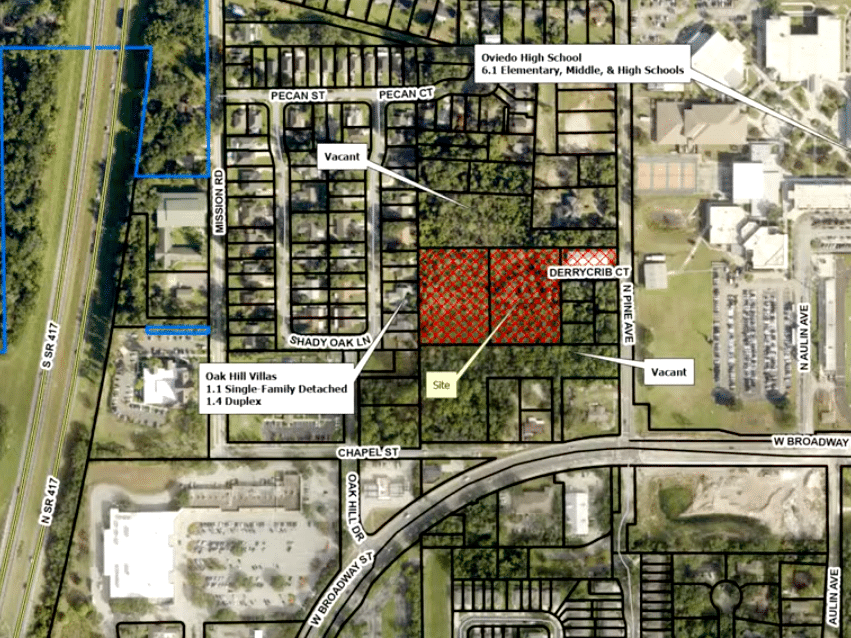
The council also heard a request by applicant Roy Jones for a zoning amendment of the 3.8-acre property located on the west side of Pine Avenue and north of State Road 426.
The property is planned for the development of 11 multi-family duplexes, totalling 22 housing units.
The surrounding area and property itself are currently zoned as an R-2 Residential District which, according to the city’s land development code, allows for duplexes but not multi-family units unless “density limitations are followed and approved as a special exception use order by the City Council.”
R-3 Residential Districts, however, allow for both.
“It gives them the ability to develop [the property] as one consolidated campus, you might say,” Cobb said. “That was the reason why the staff was using the term multi-family, because it would be 22 units developed on one tract of land, rather than individual lots. That’s really the big need for rezoning the property to R-3.”
The good news, he said, was that the rezoning wouldn’t change anything as far as density goes.
“They can’t get any more density than they would if it was under the R-2 zoning district,” Cobb said. “But that’s the primary reason [for the request], is so that they can develop the property utilizing all 22 units on one tract of land.”
During the city’s Local Planning Agency meeting on July 29, the project’s civil engineering consultant, Chris Thompson, said the owner of the three parcels which make up the property plans to construct duplexes similar to others nearby.
“The reason for the rezoning request is that we are not desiring to subdivide at this time,” Thompson said. “It’s considered a multifamily product if we don’t subdivide the development, so that’s the reason for the request from R-2 to R-3 zoning … We’re not changing the nature of the development in the area, it’s just the fact that we’re not wanting to subdivide.”
Deputy Development Services Director Debra Pierre explained that technically, even without zoning changes, the applicant could construct more than its planned 22 units based on the current density.
“If it were to remain R-2, they could still construct a total of 30 dwelling units,” Pierre said. “[But] there’s no change to the future land use, there’s no change to the maximum of what they could actually construct.”
Pierre said staff had reviewed the nearby existing land uses and found the zoning change to be compatible with the area.
“If you look to the west, you have the Oak Hill Villas which would be duplexes as well,” Pierre said. “To the south, it’s vacant. North, you’ll see some single family [units and vacant lots] there… and Oviedo High School is to the east.”
Currently, there is no estimated construction or completion date known for the project.
In terms of traffic, Pierre said the development would allow for a reduction in anticipated daily trip generation as the project would have less than the maximum number of dwelling units currently allowed.
“We saw a decrease in the impacts only because of what the applicant is proposing to do, which is 22 [units], compared to what they are allowed to do,” Pierre said. “So we saw a decrease in the traffic, as well as water and sewer — those impacts have decreased based on what the applicant is proposing to do.”
The development is anticipated to increase demand for recreation, parks and school facilities, but Seminole County’s school impact analysis found the additional student capacity could be accommodated.
City Council member Alan Ott questioned what impacts the zoning change could lead to regarding additional future development.
“I want to be sure we’re talking about the same thing when you talk about things being less or this having less impact than what they could build,” Ott said. “In fact, there’s no developer agreement there. There is nothing binding saying that once this is changed to R-3 that this owner or future owner could not build attached houses all the way down in one building.”
That’s why staff always shares the maximum amount that could be developed on a property, Pierre said, as restrictions cannot be placed on zonings unless its a planned united development with a developer agreement.
“This is a straight zoning,” Pierre said. “So we tell you the maximum just in case this person decides to sell the property to someone else, [but] they cannot exceed the maximum of 30 dwelling units per acre.”
The council voted unanimously to approve the amendment and send it for its second and final public hearing, scheduled for Sept. 15.
In other news
Council members also adopted the city’s Street Light Rate assessment resolution for the current fiscal year, which funds costs for operation, upgrades and maintenance for public right-of-way street lighting. No changes were made to the city’s current rate of $78.13 per equivalent unit.
Want to contact your elected leaders and weigh in on this topic? Find their contact information here. Have a news tip or opinion to share with OCN? Do that here.
Support critical, local news you rely on to stay informed, connected and empowered.
Choose a monthly amount
Hometown Hero
Community Champion
Rooster Society
Custom Amount
Thank you for your support!
Author

Related Articles

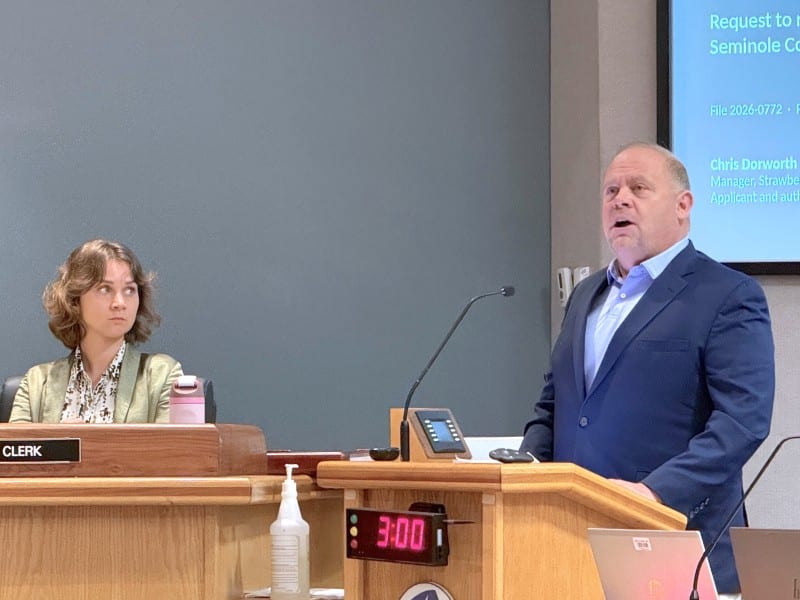
Zoning board: former Pappy’s Patch should remain inside rural boundary
Chris Dorworth’s proposed Strawberry Lane project at the former Pappy’s Patch near Oviedo now goes to the County Commission for a final decision.
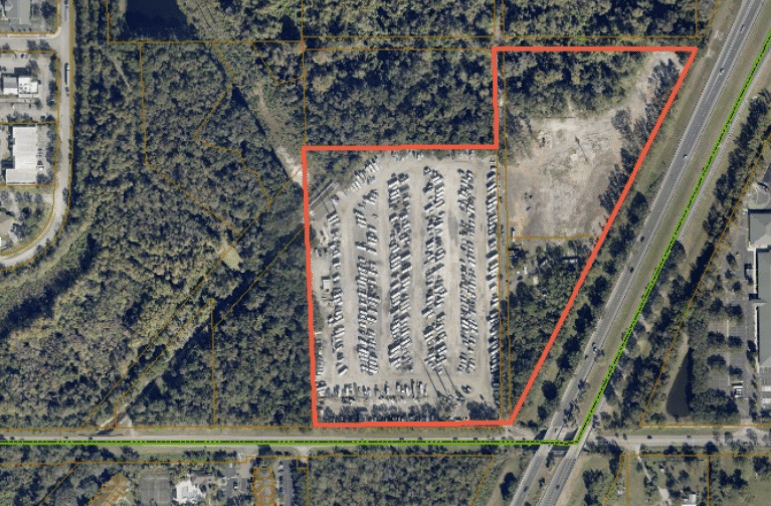
Apartments, townhomes on Seminole County agenda next week
Seminole County Commissioners could weigh in on two developments, including apartments near Lukas Nursery