
Oviedo School ‘weapon’ incident highlights human element in AI security systems
Emphasizing safety over risk, an Oviedo school went into lockdown after an AI security system detected a ‘weapon’ that looked like a gun.
It’s the call you never want to hear. “Active shooter.” “Middle school.”
The morning of Dec. 9, 2025, the Oviedo Police department received the call they never want to hear, but had trained for: A suspected weapon in the band hallway at Lawton Chiles Middle School.
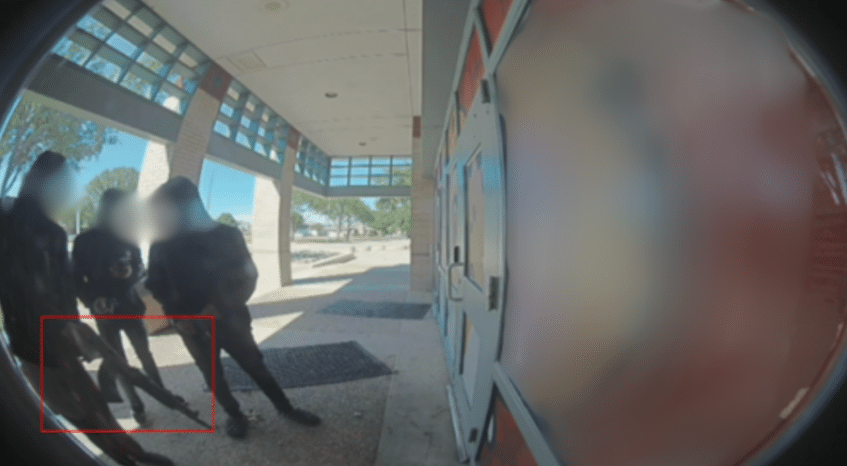
The middle school was placed on a code red lock down, and police arrived at the school a minute after they were dispatched. A still photo from the school security camera showed what appeared to be a white male dressed in camo with a tactical vest, pointing the suspected weapon as if it were a shouldered rifle down a hallway, according to the police report.
The school resource officer immediately responded to the band hallway in building five, but did not see anyone who matched the description, or hear gunshots. Upon further view of the security cameras, dispatch told the officers that the suspected weapon may not be a weapon after all – but could be a band instrument.
After entering the band room where the students were hiding, the officer found a student dressed in camouflage, and the student’s clarinet.
How was a clarinet mistaken for a weapon? The question seems laughable, but the AI firearm detection company that flagged the image said every time, they would rather be safe than sorry.
“Would you rather us dispatch the thing that 99.9% looks like an active shooter situation every single time? The answer is yes,” Sam Alaimo, the co-founder of ZeroEyes, said.
Human verified, AI firearm detection
ZeroEyes has worked with Seminole County Public Schools since 2021, and held a live demonstration of the company’s technology at Oviedo High School when the partnership began.
Alaimo said the company is in about 46 states across K-12 education, colleges, hospitals, churches, casinos, subways and other locations. He added that the company’s top two states in terms of clients are Florida and Texas. ZeroEyes is used in 24 districts and “countless schools” in Florida, according to the company.
“To date, we’ve dispatched over 1,000 true positives. So we’ve picked up guns where they should not be. We’ve had dozens of people arrested. Law enforcement has confiscated dozens of guns where they should not have been … it’s been a good fight.”
Alaimo, a retired Navy Seal, co-founded ZeroEyes in 2018 as a result of the Parkland Massacre in South Florida. He said his co-founder’s daughter had been upset about having to prepare for when an active shooter could arrive at her school. Alaimo said they had asked the school what they were doing with the already installed security cameras, and after hearing they were “to be used after the fact if there was some kind of shooting,” decided to do something about it.
“So we said, ‘All right, how do we take this security technology, this archaic security technology that everybody already has, and make it so that if a gun is seen on that camera before a shot is fired, we can dispatch that to law enforcement and to the school to keep people safe from gun violence,’” Alaimo said.
From the moment the camera detects a potential threat to the dispatch, Alaimo said the company’s standard response time is three to five seconds. He said the system is almost instantaneous, and it takes a few seconds to get into the real world and include a human in the detection process every time.
In the ZeroEyes Operations Center (ZOC), the company’s object-detection algorithm identifies anything that could be a gun, from T-shirt designs to nerf guns. Alaimo said they do not live stream video due to privacy concerns, to avoid recognizing faces and seeing biometric data. A human, military trained or law enforcement, then views the identified potential threat in a still frame that appears on the previously blank screen, and decides whether to dispatch local authorities. Alaimo said once dispatched, the company is “automatically plugged in with local 911,” notifying the police at the same time as the client.
The ZOC was built so human, military-trained verification could filter and prevent false positives from reaching their clients, such as JROTC rifles or squirt guns. Olga Shmuklyer said the analysts in the ZOC get bombarded with false positives and identify them as such, so they “almost never” reach their clients. Alaimo said having humans verify the AI system was a “deliberate business move” so clients could take true positives seriously.
“Companies in the AI space that don’t do that, they bombard the end user with false positives to the point where they can’t use the information anymore,” Alaimo said. “It’s the boy who cried wolf. They’ll get 200 false positives a day and then stop looking at it, because nobody could see that many false positives and then take the true one seriously. We took that burden on ourselves.”
A common false positive at the ZOC are strollers, Alaimo said, due to the algorithm detecting the curvature of the frame as an AK 47. These false positives and hundreds of others are not dispatched to clients. In the case of the clarinet at Lawton Chiles Middle School, the company treated it as a true positive until the investigation on the ground realized there was no assault rifle, then classified the case as a false positive.
Comparing the human review layer of the ZOC to air traffic control, Alaimo said ZeroEyes “always staffs up” and has someone moving around the floor if an analyst is ever unsure about dispatching an alert.
Shmuklyer clarified that ZeroEyes provides information; the company does not trigger lockdowns or code reds in schools.
What happened at Lawton Chiles Middle
When officers questioned the band student, he said he was dressed up in costume for the school’s “North Pole Career Day,” where students were encouraged to dress up as a job in the North Pole for the holiday season. The student said he was dressed up as a member of the military protection team for the North Pole from the PG-13 Christmas movie “Red One.”
No weapons were located in the student’s backpack or instrument case. Once the student’s clarinet was assembled out of the case, the officers determined the cork and keys matched the “suspected weapon” in the still photo from the security camera. The student said he was not aware that holding his instrument over his shoulder while walking down the hallway would raise a flag.
No further action from law enforcement was taken since the detective determined the incident was not a crime, according to the police report.
Seminole County is not the only school district in Central Florida that has turned to AI security systems. Brevard, Osceola and Marion County schools use OpenGate, while Volusia and Orange County use Evolv.
Seminole County Public Schools spokesperson Katherine Crnkovich would not give interviews with Oviedo Community News about school safety systems and would not grant interviews with school staff.
In a statement sent out to parents, LCHMS’ principal Melissa Laudani wrote, “While there was no threat to campus, I’d like to ask you to speak with your student about the dangers of pretending to have a weapon on a school campus.”
Yogesh Rawat is a faculty member at UCF’s Center for Research in Computer Vision and a member of the university’s Institute of Artificial Intelligence. His research focuses on video understanding, human activity and AI. He said that including human verification is very important when deploying AI security systems, and should become the standard procedure.
“It’s very crucial,” Rawat said. “And the sole reason, systems are not perfect … so even if the system is saying ‘maybe there is an active shooter’ or ‘there’s someone with a gun,’ we cannot act upon that without human verification.”
Rawat said he doesn’t think AI detection systems will cause fatigue on the human-worker side of detection since it reduces human work on the job and narrows down the role into monitoring, since humans cannot process the excess of data like a machine.
“There is no way humans can sit and analyze that data. It’s not humanly possible. So we need these systems,” Rawat said.
However, Rawat did warn against the possibility of false positive fatigue causing distrust from the public, further insisting the importance of human verification in the process.
Beyond schools, Rawat said installing AI detection technology in pre-existing cameras in other locations would benefit society, and not taking advantage of them and existing technology “doesn’t make any sense.”
“It’s not just schools, right? It’s your shopping malls, it’s your train stations, bus stations … wherever we have people, wherever we need security, I think there is a use case there,” Rawat said.
Response over risk
Gun violence has become a growing epidemic in America, with school shootings spiking by 124% between the 2020–21 and 2021–22 school years, according to data from the National Center for Education Statistics. Between 2000 and 2022, there have been 485 casualties due to active shooter incidents at elementary and secondary schools, and postsecondary institutions, according to the NCES. The website did not include data for 2022 to present.
The Oviedo Police Department posted on facebook after the code red at Lawton Chiles Middle School issued the all clear, writing that “The code red was a precaution and the children were never in any danger.”
Parents and other members of the community took to the comments, thanking the agency for their quick response.
Councilmember Natalie Teuchert thanked the police for their quick response during a council meeting on Dec. 15.
“… that has to be a nightmare call for a police department and I just want to say the response that happened, even though it didn’t end up being a real scenario, was incredible,” Teuchert said. “ … it showed that if it did, our team and your police forced everything they needed to do and I think that should be spoken of highly.”
When asked if repeated false positives might lead to a “boy who cried wolf” effect, Alaimo pointed to fire alarms as a comparison.
“We have fire alarms everywhere. But how often are there fires? And I think we also have to think about … if your fire alarm goes off because you burned a steak, you’re not going to rip out all your fire alarms, are you?”
Naveed Shahzad’s sons attend Evans Elementary and Jackson Heights Middle in Seminole County. He said he heard about the code red at Lawton Chiles regarding the AI gun detection system, and said it was good to have those precautions in place.
“The kids are young,” Shahzad said. “They should not be a situation like this, but still for the sake of safety of the kids, they should have those systems in place.”
He said he agreed with the company’s decision to dispatch for the potential threat, and was glad the response time was so quick.
“I mean, it was kind of panic. Whenever we get such a situation, emails or communication that something is happening, or they detected something, we get worried. But it’s good to be informed and it’s good to know that the [county and schools] are taking care of any abnormalities,” Shahzad said.
Alaimo said dispatching authorities to Lawton Chiles Middle was not a mistake, and “worked exactly how we wanted it to.”
“We admire our response, their response with law enforcement, and they would have it no other way. So we would do the same thing again, like this. This was not a loss to us and it was not a loss to the client,” Alaimo said. “This was how it’s supposed to be, because 99 times out of 100 that could be a real shooter with a real weapon system doing a real mass shooting.”
Editor’s note: The original version of this story said that Seminole County Public Schools spokesperson Katherine Crnkovich declined to comment, which is not the case. She agreed to comment but denied interviews with Oviedo Community News about school safety systems or with school staff.
Want to contact your elected leaders and weigh in on this topic? Find their contact information here. Have a news tip or opinion to share with OCN? Do that here.
Sorry for the interruption but please take 1 minute to read this. The news depends on it.
Did you know each article on Oviedo Community News takes anywhere from 10-15 hours to produce and edit and costs between $325 and $600? Your support makes it possible.
We believe that access to local news is a right, not a privilege, which is why our journalism is free for everyone. But we rely on readers like you to keep this work going. Your contribution keeps us independent and dedicated to our community.
If you believe in the value of local journalism, please make a tax-deductible contribution today or choose a monthly gift to help us plan for the future.
Thank you for supporting Oviedo Community News!
With gratitude,
Megan Stokes, OCN editor-in-chief
Thank you for reading! Before you go...
We are interested about hearing news in our community! Let us know what's happening!
Share a story!
Author

Related Articles
A foggy start to Oviedo Run Club’s 6th Oviedo Spring Rising 5K and 10K
Oviedo Community News’ team did our second 5K in two weekends at the Oviedo Run Club’s Spring Rising 5K and 10K, where local runner Giles Williams finished his 1,000th 5K.
Questions raised about Winter Springs commissioners’ spending at hotel
A Winter Springs advocacy group wants to see receipts after purchases by commissioners on city-issued cards at an Orlando hotel.
Seminole County’s rural boundary survives the 2026 Legislative Session
A bill that would have granted near-automatic development rights in parts of rural areas failed in the Florida Senate’s final day.