
Ali’s Hope Hub opens to help struggling students before it’s too late
Winter Springs students’ graduation gift to younger students: a permanent place for emotional support and new friendships during tough times.
Editor’s note: This story contains difficult subject matter, including mentions of suicide. The goal of the Ali’s Hope organization and programs profiled in this story, in part, is to prevent self harm before it’s too late.
A few minutes after campus had cleared out on one of the last days of the school year, an upstairs classroom tucked away in a corner of Winter Springs High School slowly filled with students and school officials, welcomed by overstuffed couches, soft lights from table lamps, blankets and teddy bears. On the far wall, the painted blue silhouette of a young woman sits on a beach, watching as dark waves brighten into a cascade of orange and yellow by a rising sun.
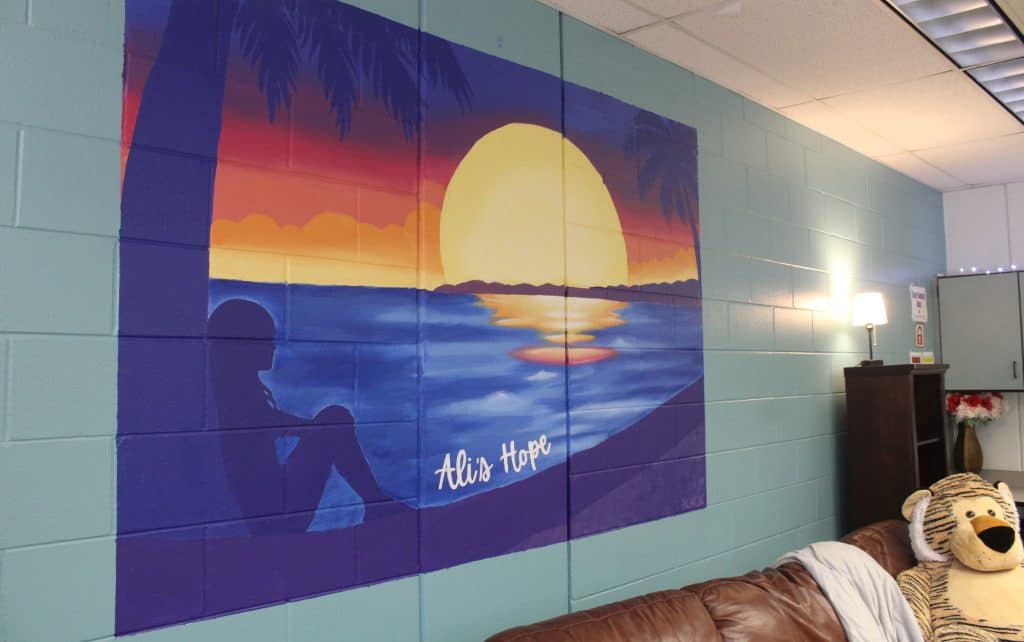
“It started off as just this little thing,” English teacher Carrie Crowe said. “We wanted to paint it, we wanted this, we wanted that, and it just took off. It’s humbling for me just to see how beautiful this is.”
It was an idea that had already been growing in Seminole County: Ali’s Hope Hubs, created by the local Ali’s Hope Foundation and made possible by Seminole County Public Schools in partnership with local businesses. A special place in schools focused on mental health.
The idea was simple, but with a complicated mission, Winter Springs High School social worker Wondra Higgins said: Create a place for kids to, in a way, “hit the pause button” to calm down when they’re under stress, recovering from a crisis, dealing with bullying at school or problems at home. There’s no pause button in life, she said. But the Hope Hub, coupled with counseling and opening up with conversations in this room, comes close.
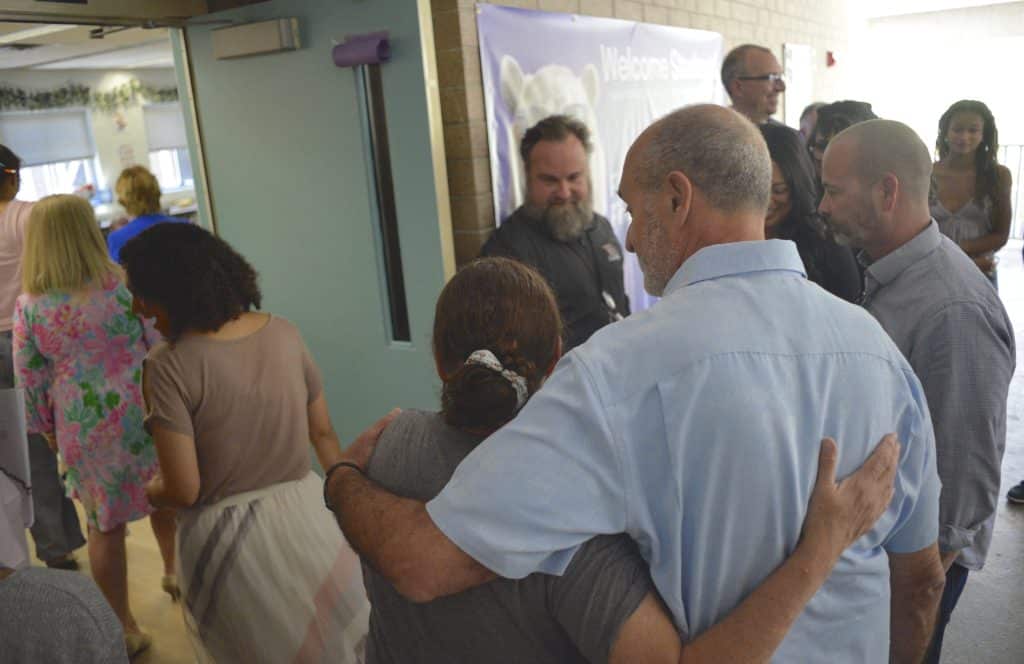
A place to hit “pause”
Inside the Hope Hub is a room the size of a basketball half-court, decorated with calming colors, inspiring phrases on the wall, more relaxed lighting, wood floors, couches, and big stuffed chairs. It all works together to help kids forget where they are for a little while, Ali’s Hope founder Joe Gallagher said. Then Higgins and fellow students can work to help stop a mental health crisis before it’s too late.
Sometimes that just comes from talking things through.
“Not only do they get support from me, but they get support from each other,” Higgins said.
She remembers a time that a student told her during lunch that some students had been hiding in a bathroom rather than face other students in the lunchroom.
“I got to see it with my own eyes,” she said. “I came in there, and there were students eating in there, and there was a student crying in there.”
Now they come to the Hope Hub.
Alandrya Hayes, a junior at Winter Springs, says she’s determined to help those kids get out of the stall and into friendships.
Hayes says she was introduced to the program through her teachers. She said before exploring the Wellness Club, she found it awkward to sit outside during lunch all alone. The Ali’s Hope Room gave her a space to be “alone” without being the only person in the room.
“I’m not a very social person, but I love talking,” Hayes said. “So, when I was introduced to something where I could just talk to people, I was like, I would love to do that.”
Students have crises every day, Higgins said, some big, some small, but places like the Ali’s Hope Hub are where the recovery starts. She remembers a girl in another Seminole County school who’d just had a family member commit suicide.
“She had to come back to school; her mother had to go to work,” Higgins said. “She wasn’t able to just sit in the classroom and do that. This being there for her, for about a week she came almost every day. Where else on campus could that happen? Nowhere on campus but here. She was able to come in, she talked a little bit, she slept a little bit. She cried. We just worked through the day. She was amazing. We set plans. I reached out to her teachers to get her back on track. Every goal we set, she met. I think the difference was she had a safe space to come to and had that time to create her own pause button. She was able to get that moment by being in that room with me. Now she’ll come by, she’ll say ‘Hi,’ give me a hug. She’s passing her classes and getting through it. It was crucial.”
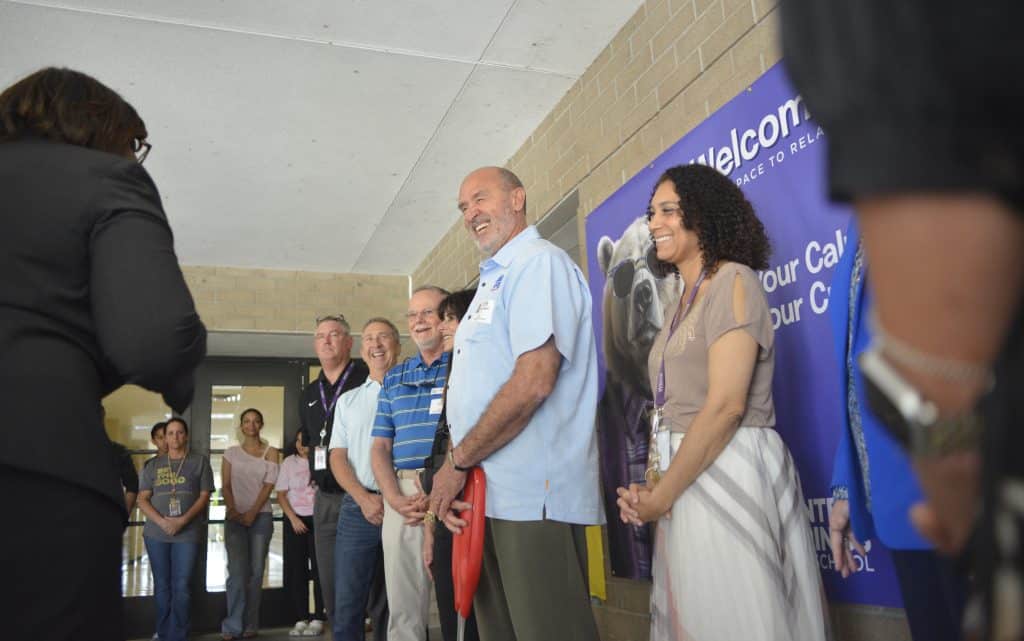
Another Hope Hub opens its doors
Winter Springs High School Principal Pete Gaffney said Vice Principal Kenny Bevan pitched the idea after speaking with Gallagher about how the program can save lives.
“He said, ‘We’re gonna make this happen here,’” Gaffney said. A few weeks before the end of the school year, after months of work, it did, thanks in part to an $80,000 donation from Ali’s Hope to help pay for a social worker, shared between Lake Mary and Winter Springs high schools.
Students helped decorate it and paint it. The construction firm Wharton-Smith Inc. donated all of the wood floor. The commercial furniture company Marc Shore Associates donated the furniture.
“It’s a place for kids to feel safe, and kids to go to,” Gaffney said. “No one needs to feel alone, ever.”
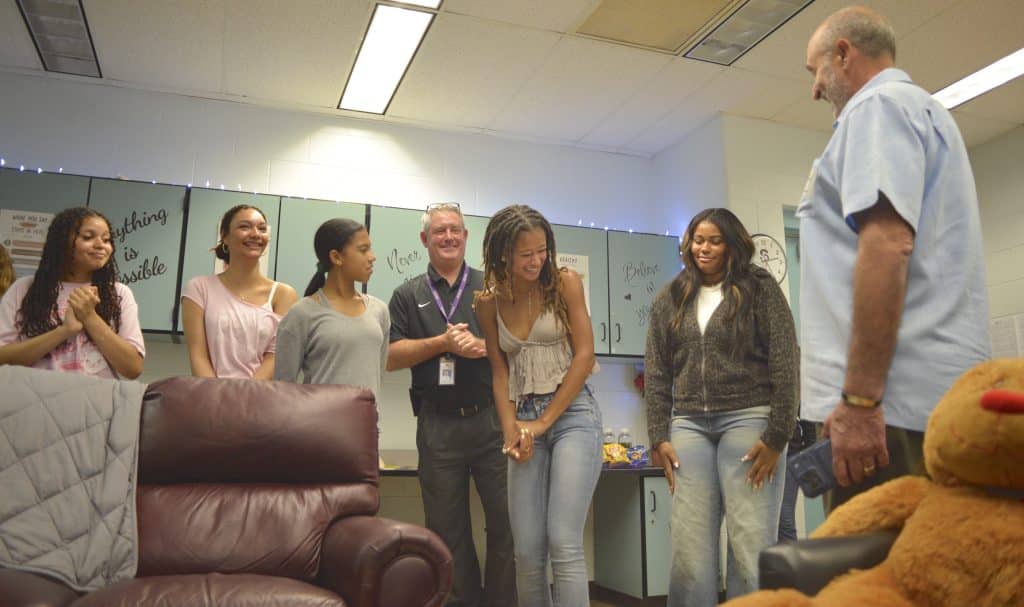
A few minutes after the ceremony outside, where a dozen or so volunteers cut a ribbon at once, Gallagher stood in the middle of the room proudly shaking hands and saying ‘Hi,’ chatting with officials and volunteers, but his smile was at times tinged with an almost imperceptible wince. The group of teenage girls talking and laughing over to the side, though they helped build this place, didn’t know the blue girl on the wall. But they know her name: It’s Ali.
The students here couldn’t have known her, her father said. But in a way, they do.
“She was very athletic, but she loved art and she loved to help other people,” he said. “In her best times she always had a kind word to say; she cared about people. Even when she struggled, she always wanted to help.”
Almost to the day, 19 years ago, Alyson Gallagher took her own life.
A common bond
When Nikki Cepeda was in middle school, someone like Alyson died by suicide, too. Word spread, echoing between hallway walls and towering lockers.
She might not have personally known them, but the reaction of peers inspired her to create a brightness for those being swallowed up by darkness.
Now, Nikki’s the president of the Winter Springs High School’s Wellness Club, which now meets at the Hope Hub.
In her sophomore year, she decided to “go all in” and commit her personal time to improving the club. She said it made her feel comforted and supported. Now she’s on a mission to make the space feel like home for the more than 2,000 students who attend Winter Springs High School.
“We should fight as a generation,” she said. “I’m grateful for my generation, trying to fight for and advocate for mental health, and defeat stigmas. I’m just so grateful that my generation is the one that decided to care.”
A race against time
According to the American Foundation for Suicide Prevention, suicide is the second leading cause of death for Americans ages 15-34.
In an especially bleak October of last year, three Seminole County high school students died by suicide in a one-week span. That includes Luke Jenson, the multi-sport Hagerty High School athlete who loved cooking, and Kennedy Jackson, a star softball player at Winter Springs High School.
In one of the last photos of Kennedy she’s holding a district championship trophy, smiling.
“Every time I think of her, I see that smile,” Winter Springs Softball Coach Farah Gordon said at a celebration of Kennedy’s life on Oct. 28.
Relatively recent changes have been made to try to reduce the suicide rate in Florida. In 2007 Florida law established the Statewide Office for Suicide Prevention, currently within the Department of Children and Families under the Office of Substance Abuse and Mental Health, to improve statewide suicide prevention initiatives. But there are missing checkpoints along the way, according to the AFSP.
In Florida, schools are required to discuss mental health, but not required to discuss suicide prevention, according to the AFSP. Teachers aren’t required to report suicide risks, either.
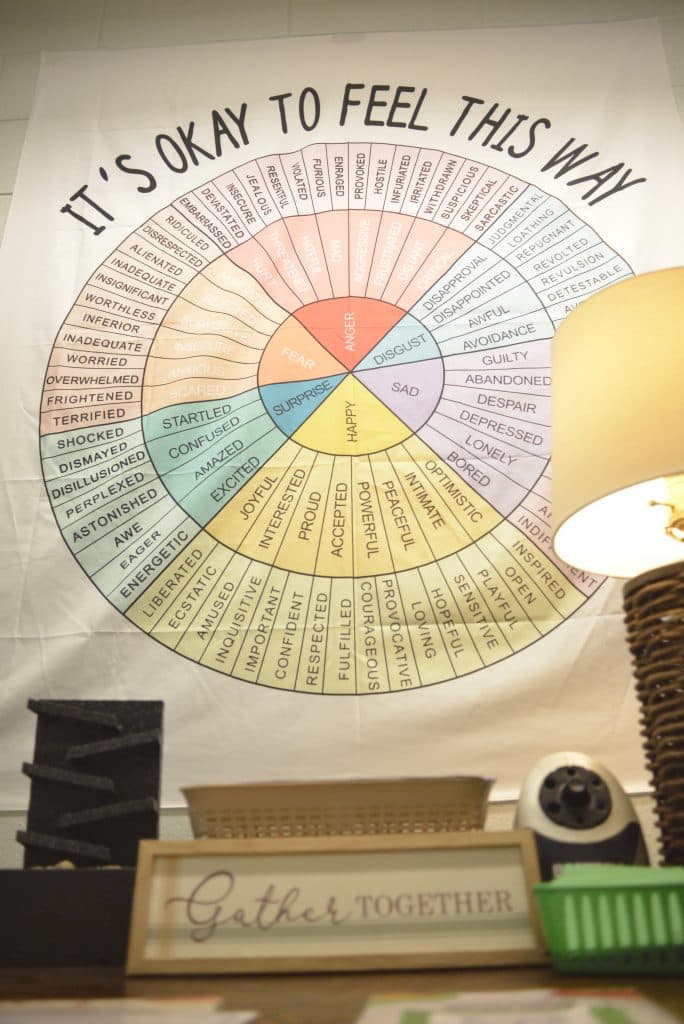
With the current generation of high school students, that “discussion” part may be resonating, according to Higgins and school officials, with students getting more proactive about talking to each other about mental struggles. It’s taken nudges in key areas to get there.
“It’s not normal to be so insensitive. It should not be a normal thing,” Cepeda said. “I really want to try to make a difference. I want our club to make a difference and just let people know that it’s okay.”
Starting the conversation
At the start of May the AFSP, along with the National Alliance for Mental Illness and the Ad Council, launched a new series of Public Service Announcements all under one banner: “Let’s be real,” showcasing interactions between friends, checking in on each other about mental health.
“Connection is a critical part of mental health,” said Daniel H. Gillison, Jr., chief executive officer with NAMI in a release announcing the new initiative. “Especially for young people navigating so much change in today’s world.”
That message of “connection” repeats itself when talking to students and teachers with the Wellness Club inside the Hope Hub.
“Coming to this room, for me personally, it’s helped me be more observant to other people around me,” Hayes, the Winter Springs High School junior, said. “It’s definitely made me a little bit more sociable and I feel like I can really just talk to anyone. And that’s something that I didn’t have before because I was encouraged to just get out there and talk to people.
“There is this one girl, she was having a very hard day, and Ms. Crowe told me to go talk to her, and by the end of it, we’re friends now,” Hayes said. “It was very sad to see… but I was happy that I was able to help her and improve the way that she was feeling.”
The club also finds ways to make an impact outside of it, throughout the year. One day club members handed out goody bags filled with candies and handwritten positive affirmations.
“It was super simple,” Crowe said.
The gesture, they found, went a long way.
“One of my students was really nervous about going and just handing it to somebody,” Crowe said. “So he goes and he hands it to this girl, and this girl opens it, and whatever the message said was just a super positive message that the kids hand wrote. And then she started crying, and she’s like, ‘You don’t understand how much this means to me’.”
With two years left before she graduates, Cepeda said she wants to expand the club beyond Winter Springs students. She hopes to collaborate with other wellness clubs, such as Lyman High School’s. Lyman’s Wellness Club worked with Ali’s Hope to open its own Hope Hub in 2025.
Continuing that growth is Gallagher’s hope too. And it’s working. Lake Mary High School also has a Hope Hub now. Hagerty High School started a Wellness Club, among six that are now in the county.
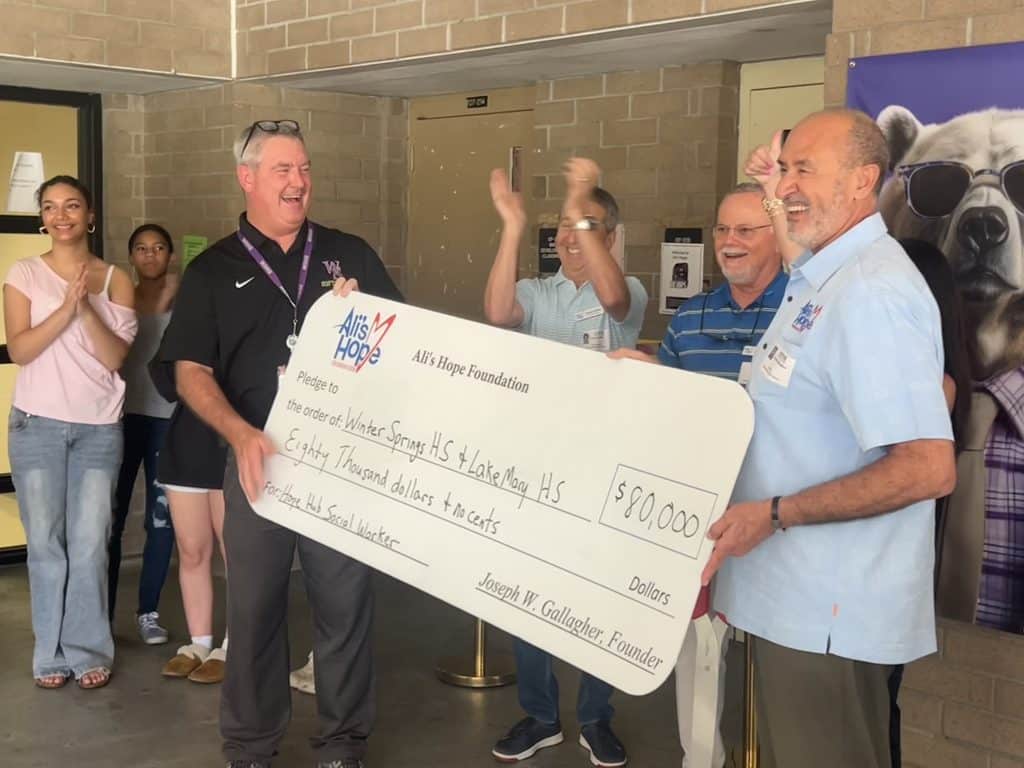
“My goal is that each high school in the county has something like this,” Gallagher said. “We have the buy-in from the school district. Now we need the buy-in from each school. The principal ultimately says either I need this room for a classroom, or you know what, I can give you this classroom and you can make it a Hope Hub.”
He’s already looking into starting them in middle schools, or maybe even colleges. All it takes is making a little bit of room, he said.
“Six Lyman seniors are graduating this year, and they’re going over to Seminole State, and they asked me, ‘Mr. Joe, do you have this over at Seminole State? Can you put one there?’”
A continuing mission
Nikki said she doesn’t intend to stop what she’s doing when she walks out of these halls for the last time in May of 2028. The Wellness Club, along with the Hope Hub and the school’s mental health classes, she said, have inspired her to do more.
Beyond high school, the rising junior says she’s always wanted to help the people around her. She’s already made up her mind for the future – she wants to be a teacher.
“I hope whatever I learn, I can help my students, because at the end of the day, I just want to help someone feel better,” Cepeda said.
But for right now, she wants to focus on those who are too scared to come to someone for help. When asked about what she thinks students should know, she spoke to those who think no one will listen.
“I want everyone to know we’re here, that we’re a resource that they have available and that it’s not bad to feel depressed or have anxiety,” she said. “You’re not weak to feel sad and there are people who want to talk to you. Speak openly about it.”
That’s what that living room atmosphere in the Ali’s Hope Hub is for, Gallagher said. The couches and chairs are a comfortable distance, but facing each other. There’s a podcasting setup, with four microphones, so kids can share their experiences and struggles with each other. But not all the chairs are together. If nothing else, Higgins said, the Hope Hope is a place where students can be alone, but not feel alone. In the corner, a few feet away from the painting of Alyson, right in front of the row of windows, there are tables for artists to be themselves. She would have loved it here, Gallagher said.
“Alyson would have benefited dramatically from a place like this,” he said.
But he also said he wished she could have been here, because she’d want to help. Looking past the chair with the teddy bear facing the couch, he imagines the moment for her. A student is having a rough day in class, struggling to find a way through it, and she remembers the Hope Hub is here. She climbs the 20 steps or so, opens the door, and finds Ali sitting there, as he hopes she would be, waiting to say hello.
Support local news!
Choose a monthly amount
Hometown Hero
Community Champion
Golden Rooster Society
Custom Amount
Thank you for your support!
Author

Related Articles

Flock license plate reader discussion leads to possible de-Flocking of Oviedo
Oviedo considers removing Flock license plate readers, among the reported 190 cameras installed in Seminole County.
Oviedo Mall kennel approved following dramatic public hearing
Pet rescue nonprofit in Oviedo gets go-ahead to begin boarding dogs over the weekend, despite neighbor’s claims that dog noise issues haven’t stopped.
Ryan Elijah upsets Rep. Cory Mills for U.S. House District 7
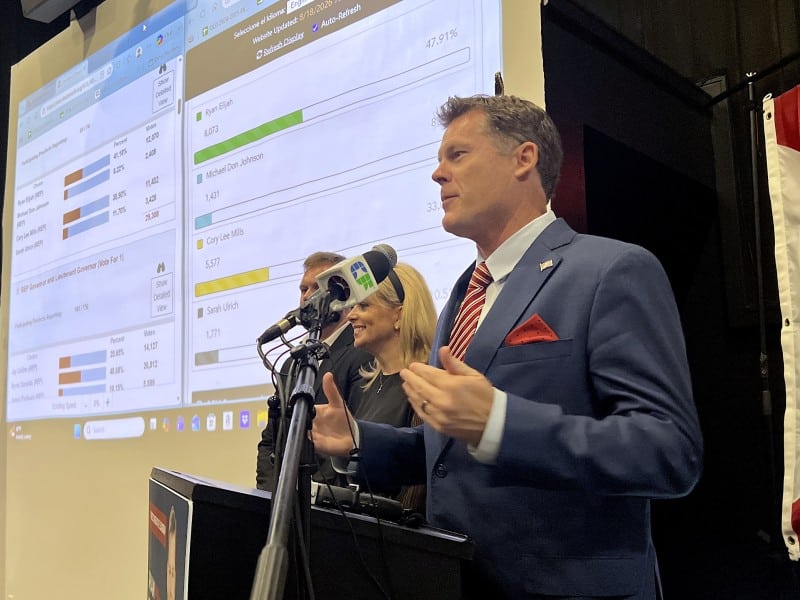
Embattled incumbent Cory Mills, facing ethics investigations, falls to former Fox 35 anchor Ryan Elijah, who now hopes to reach across the aisle.