
Upcoming vote: Should Oviedo have four-year terms?
Four Oviedo City Charter amendments set for public hearing Monday.
There could be four Oviedo City Charter amendments coming to the November ballot, and residents have a chance to weigh in at the City Council meeting on Monday, June 15. A proposal to double the length of City Council terms of office, aligning them with high-profile presidential and gubernatorial elections, tops the list.

The Oviedo City Charter is the city’s foundational document, the equivalent of a local constitution. It spells out the powers and roles of the government. The amendments were decided on following a months-long review where the Charter Review Committee met seven times between January and April. The proposals include:
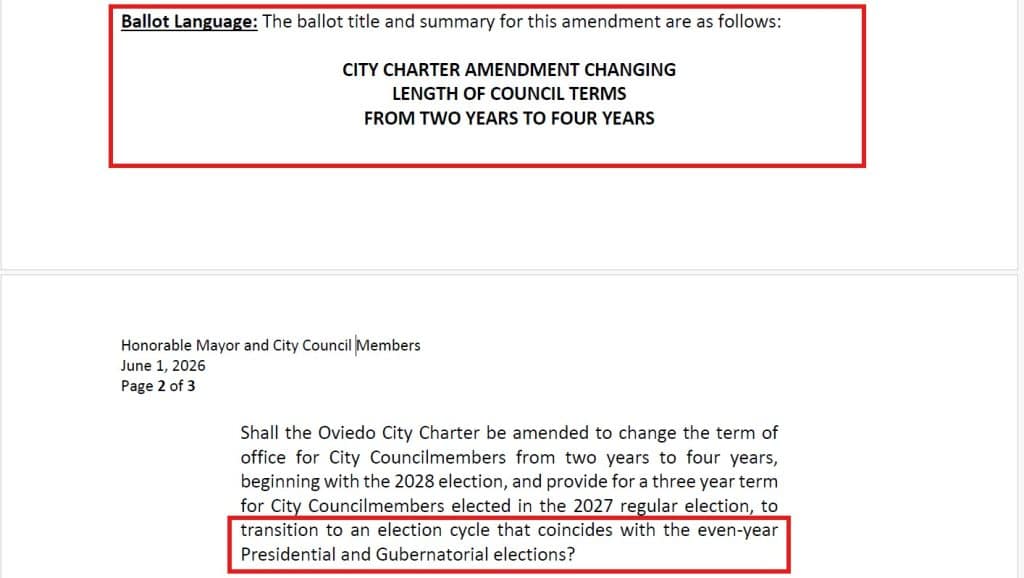
- Changing length of Council terms from two to four years
- Revising Council voting procedures for ordinances and resolutions
- Revising the timeframe for holding special elections
- Moving the qualifying period to run for City Council
The public hearing will occur at the June 15 meeting, which takes place at Oviedo City Hall, 400 Alexandria Blvd., at 6:30 p.m. If approved by the Council, the ballot language would be finalized by July 6, and the amendments would appear on the Nov. 3 ballots for voters to decide upon.
This is the second reading of the language. Check here to watch the Oviedo City Council discuss the amendments at the June 1 meeting.
Want to contact your elected leaders and weigh in on this topic? Find their contact information here. Have a news tip or opinion to share with OCN? Do that here.
Council terms
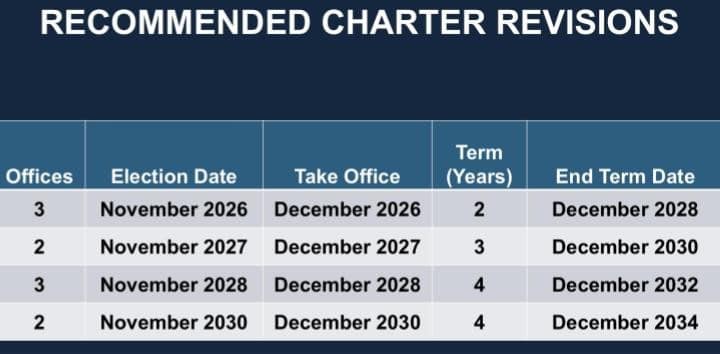
If approved by voters, a staggered transition from councilmembers serving two-year to four-year terms would begin in 2027. The two councilmembers (including the mayor) up for reelection that year would each have a three-year term to align them with the 2030 election. Once they get to 2030, those seats would have four-year terms going forward. The three councilmembers up for election in 2028 would have four-year terms from that point onward.
“The purpose of this, or the end result of it being to transition to an election cycle that coincides with the even-year presidential and gubernatorial elections,” Oviedo City Attorney Wade Vose, who served as the CRC facilitator, said at City Council’s May 27 work session.
This change has previously gone to the voters a number of times — most recently in 2021 — and has consistently been rejected at the ballot. Oviedo pays the cost of off-year elections, which can cost around $45,000 to administer.
“It’s almost insulting to the voters to just keep bringing it up in a way that looks like it benefits us,” Councilmember Alan Ott said.
While Ott acknowledged that moving the elections to coincide with presidential and gubernatorial elections would bring out higher turnout — the 2024 election, which Ott won, saw almost 20,000 ballots cast for the seat, while the 2023 off-year mayoral election had fewer than 8,000 — he said that the two-year terms give voters more of a voice to make changes to Council more frequently.
“If you don’t like what the Council is doing, [currently] every single year you have the ability to vote off a significant portion; in some cases [you can] vote off a majority,” Ott said. “It really ties the voters to what is happening at the City Council.
“I think two years is good enough for Congress, and it should be good enough for us,” Ott said.
Oviedo Mayor Megan Sladek, however, leaned into the decision of the committee. She said she had no questions, comments or recommendations for changes.
“I said right from the get-go: Whatever [the] Charter Review Committee comes up with, that is what I believe we should pass along with no changes whatsoever,” Sladek said. “I think this should go straight through to the voters because [City Council] should not be tinkering with it. These rules probably impact [Councilmembers] more than people who are not elected, and we had non-elected people representing the public in general come up with this, and we should send it straight on to all the voters.”
Qualifying period for City Council
If approved, the qualifying period for running for City Council would move from its current deadline of August of an election year to June.
“One of the points of discussions on this was basically for greater awareness for potential candidates,” Vose said. “The discussion with regard to [the] amendment was, among other things, the thought that putting it at or around the same time as other offices’ qualifying for elections may provide greater public notice or notoriety about the idea that folks can run for elections.”
Ott, however, expressed issues with the wording of the amendment as well as the substance.
“I think that most voters don’t understand what [qualifying period] means,” he said during the June 1 City Council meeting. “I think it’s a term of art that really implies a certain amount of inside baseball that, it’s not difficult to understand, it’s just not something most people have studied, or, honestly, care to study.”
By the qualification deadline, a potential candidate for Oviedo City Council needs to turn in at least 150 resident-signed petitions they have collected, pay a fee of 1% of the position’s annual salary and numerous required forms, including a financial disclosure, Ott said.
“Moving qualifying to when county does qualifying — it works for county because county offices are either partisan, and they have a primary in August, or they have their election in August, so, for school board or the others, and then they have a run-off in November — so, either way, you qualify in June for an election in August,” Ott said. “Our election is not in August, nothing about our election is August, it’s not [until] November.

Ott said that if the city moves qualifying to June, and keeps two-year terms, that would expand the window of time where someone cannot file to run against an incumbent.
“That means, fully, for one-quarter of your term, somebody is not able to decide to run against you,” he said. “It is a long time to have qualifying closed between June and November. I think, perhaps, the ramifications of all of these things are more complex and nuanced than are in the small number of words that are on this ballot language.”
Voting procedures
This amendment would remove the roll-call vote requirement for City Council votes. Members would still vote on the record and have votes recorded, but they would not need to be done in sequential, roll-call order.
“A number of folks [on the CRC] were indicating a thought that a roll-call requirement can sometimes lend itself to gamesmanship in the idea of folks waiting to see how other people will vote and then making their decisions accordingly,” Vose said.
If, for example, a member of the City Council is opposed to an item, but sees that it already has three yes votes, they might vote in favor of it anyway. That’s because a member voting in the affirmative on a measure is allowed to bring it back up for discussion, while a member who lost a vote can’t.
“A Motion to Reconsider can be made by a Councilmember on the prevailing side of a decision to request that the City Council reconsider the decision during the same meeting at which the decision was made,” wrote the Oviedo City Clerk’s office. “A request to rescind must be made at the next meeting and it can be made by any of the council.”
Special election timeframe
Currently, the timeframe for holding special elections is a 60- to 90-day window. If approved, the timeframe would expand to a 90- to 120-day window. This would be done to better coordinate with “current state elections procedures,” Vose said.
After seeking feedback from Seminole County’s Supervisor of Elections Amy Pennock’s office, it was explained that the current timeline “could be tight,” Vose said.
“They would much prefer being in a situation where they can very clearly comply with [the timeline] while also, of course, complying with federal and state law,” he said. “The recommendation from [Pennock’s] office was to, if it was the will of the Council, to recommend to the voters to make this tweak to give their office a little bit more breathing room.”
Sorry for the interruption but please take 1 minute to read this. The news depends on it.
Did you know each article on Oviedo Community News takes anywhere from 10-15 hours to produce and edit and costs between $325 and $600? Your support makes it possible.
We believe that access to local news is a right, not a privilege, which is why our journalism is free for everyone. But we rely on readers like you to keep this work going. Your contribution keeps us independent and dedicated to our community.
If you believe in the value of local journalism, please make a tax-deductible contribution today or choose a monthly gift to help us plan for the future.
Thank you for supporting Oviedo Community News!
With gratitude,
Megan Stokes, OCN editor-in-chief
Thank you for reading! Before you go...
We are interested about hearing news in our community! Let us know what's happening!
Share a story!
Author

Related Articles
DeSantis vetoes Seminole County appropriations worth $2.5M
Projects included a smart water meter system upgrades, an AI system to monitor schools for guns and crosswalk projects, but were vetoed by DeSantis.

City of Oviedo plants Liberty Tree as part of America’s 250th anniversary celebration
Newly planted hickory tree is one of seven planned Liberty Trees across Seminole County to commemorate semiquincentennial.
Oviedo begins preparing for potential property tax vote impact
“There are places in this state, cities that will probably not continue to exist,” Seminole County Property Appraiser Johnson said.
