
Oviedo’s controversial Flock cameras have been removed. Now what?
A single curious Oviedo resident spoke up about the Flock cameras a month ago. Within weeks there was more public concern. Then in one night at the end of August the system was gone.
With Oviedo’s eight controversial Flock license plate reader cameras officially removed, what comes next, and what was learned from the yearlong experiment with them?
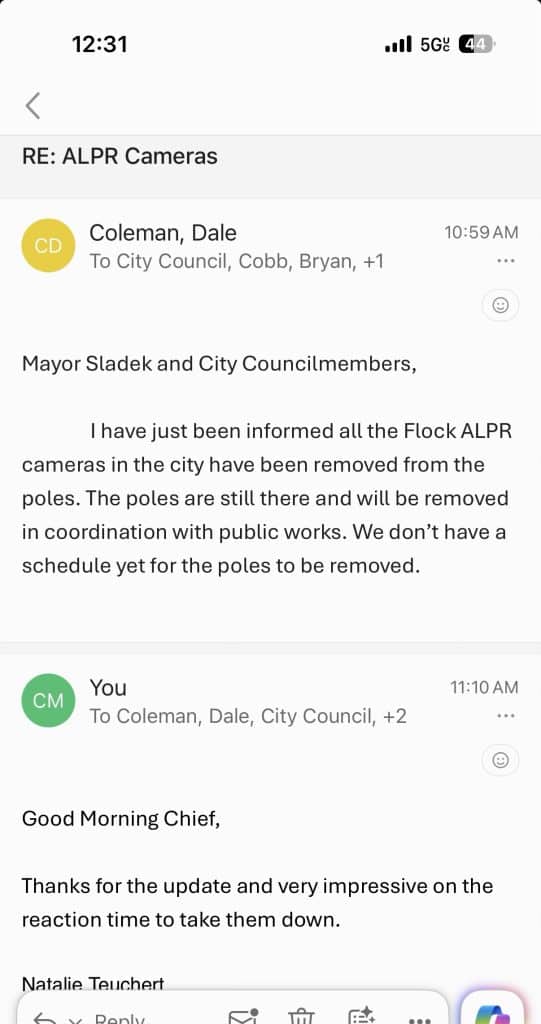
Those are questions city and police officials are pondering following an hourslong City Council work session on Aug. 31 that saw Council members instruct city staff to both not add funding for the cameras into the upcoming 2026-27 budget and to have them removed. The cameras came down on the morning of Sept. 1, after only being installed in February.
The decision came on the heels of Florida Gov. Ron DeSantis coming out against the cameras and the Florida Department of Transportation ordering them removed from right-of-ways that are part of the State Highway System within 30 days. Multiple counties, including Seminole, also suspended or ended the use of them.
At the work session, nearly 20 people shared their concerns about the cameras, including Gwynne Guthrie, who donned a yellow “Don’t Spy on Me” shirt in a similar design as the “Don’t Tread on Me” slogan on the yellow Gadsden flag from the American Revolution, and former Florida Republican gubernatorial primary candidate James Fishback. The members of the public raised issues ranging from violations of constitutional rights to privacy and misuse of the cameras by law enforcement officers across the country.
“Flock has created a system where we, as free citizens in our republic, must prove our innocence,” Fishback said. “That is the wrong way to think about what we are signing up here for.”
The people who spoke against the cameras were from across the political spectrum, something that did not go unnoticed.
“It has been a while since we’ve seen a nonpartisan effort to do something, which is really American and a good thing,” Oviedo Deputy Mayor Natalie Teuchert said. “You had Republicans, Democrats, nonpartisan. All sorts of backgrounds.”
Following the public comments, Flock representative Karl Bach gave a presentation about the company, the cameras and its software, and took questions from the City Council.
Oviedo Deputy Police Chief Mike Beavers related a story from Altamonte Springs about a person who was possibly about to commit suicide, and license plate readers were used and officers found the apparent vehicle of the person in Oviedo, and the person was taken in for care.
“If we get rid of [the cameras], could we have saved them otherwise?” Councilmember Jeff Boddiford said. “I would think you’d want every tool available to find somebody that you cared for if something like that happened.
“There’s cases of people misusing it. I get that,” he said. “When we talk about saving people’s lives, there’s a flip side to it that I don’t think gets brought out a lot.”
After significant back-and-forth and confirming that funding for the cameras was not yet in the city’s upcoming budget because the first two years of the agreement were funded in the 2025-26 budget, the City Council made the decision to not have it added and have the cameras removed before the end of the lease agreement, which runs through the end of September.
Oviedo Police Chief Dale Coleman said the decision was “not unanticipated.”
What changed?
In September 2025, the Oviedo City Council approved the lease agreement for eight Flock cameras, which were installed in February 2026.
During the 2025 meeting, Councilmember Alan Ott and Oviedo Mayor Megan Sladek voiced similar mass-surveillance and Fourth-Amendment concerns to those brought up a year later. However, Coleman said during that meeting that Oviedo was the only city in Seminole County, at the time, to not have license-plate readers.
The cameras were approved on a 3-2 vote, with Councilmembers Jeff Boddiford and Keith Britton, as well as Deputy Mayor Natalie Teuchert voting in favor, prior to much of the public sentiment turning against the cameras with news of misuse of the system.
“I think if we had the information we had last night at the beginning, they never would have been put up, personally,” Teuchert said. “I’ve gotten a lot more information over the past couple months, highly concerning information as you can see from [Monday] night.”
Oviedo City Attorney Wade Vose said at the work session that there were issues with Flock’s terms and conditions from the beginning. He said that there was a revision in them between the July 2025 and September 2025 versions.
“When that changeover happened, from the time the Council approved going with Flock and the time we were getting the final work order all signed up and so on, I reviewed both versions and, I’m not going to say the version that was in the subsequent one was categorically a different direction than what you’ve heard. I was much more comfortable with the language referencing customer data as it was stated in the July 2025 one,” he said. “Quite frankly, I thought I saw a lot of language creeping in there that had a lot more caveats.
“I’m not suggesting that’s in fact the intention or anything like this, but when I had those two options available in front of me, I knew which one I was much more comfortable with and I had a very fair legal argument that they signed up then, that that’s the one it needs to go,” he said. “Flock agreed and so we locked it in under that one that I felt better about that language.
“I just felt much more comfortable with the July 2025 language,” he said.
Teuchert felt similarly after her recent learnings.
“I think it’s pretty clear that what they sell, the sales pitch, is not accurate of what it does,” she said. “I think every leader should make the best decision they have with the information they have, and when you get new information, you should make your decision accordingly.”
The cameras had come under fire in Oviedo after it was revealed police had used a fake Flock camera as bait in order to catch camera vandals or thieves, which put the city briefly in the national spotlight.
Coleman, however, defended that decision of using a 3D printer to make the decoy camera because some of the city’s eight Flock cameras had apparently been stolen and found in a retention pond.
”I put it out there because somebody was breaking city equipment, and I want to put a stop to it,” he said. “I think [the Flock controversies] brought more attention to it. I think the attention was nationally just because it was something different.”
Coleman said the OPD does similar things around the holidays by placing “bait” packages at doorsteps with residents’ permission, or leaving bicycles or cars around the city to see if anyone would steal or damage them.
Want to contact your elected leaders and weigh in on this topic? Find their contact information here. Have a news tip or opinion to share with OCN? Do that here.
What’s next?
With the cameras now removed, is Oviedo less safe than it was a day earlier, when the cameras were running?
“Oviedo is not less safe,” Coleman said. “What [the removal] does is we’ll spend more energy and time solving crimes because we don’t have the same technology we were using.”
In lieu of the Flock cameras, Coleman said they will rely on things they did previously like using data from toll road cameras.
Coleman said he could have asked more questions about the system’s overall capabilities, such as bumper sticker readers and heat maps, and not just the version the city was leasing.
“We didn’t need any of that, so we didn’t ask the questions,” he said.
He also said going forward, he would communicate more with the public about how new systems are expected to function, and listen to their concerns.
“Sometimes even with the best intentions, the message doesn’t come out clear,” he said. “I’m pretty open to talking to people. I don’t shy away from hard issues.
“I want people to understand what they’re getting,” he said.
Teuchert said in the future she also would ask even more questions from the start, and keep an attitude of “never close your mind to information.
”We got more information [and] I didn’t hesitate to change my mind,” she said.
And will Oviedo have license plate readers in the future?
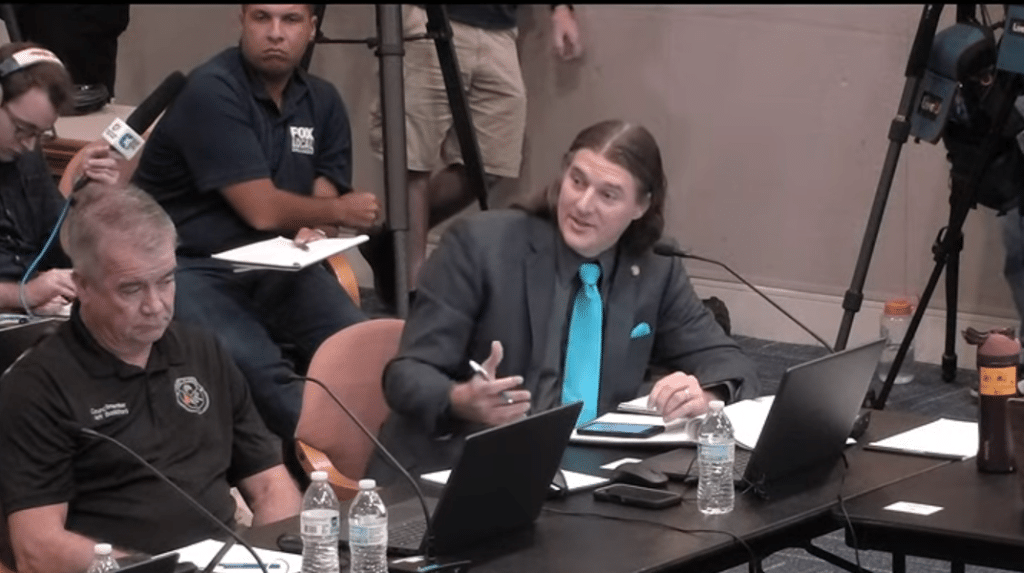
“I hope not,” Ott said. “I don’t want to say absolutes … but I don’t envision myself ever voting for LPRs in Oviedo,” referring to license-plate readers.
If they do ever come back, Coleman said he would want the state to give better guidelines for them, and he will work to implement better safeguards into the system. Previously, any officer who did the required training to access and use the Flock camera database would be allowed to. In the future, he could see that access greatly limited to specific investigators, and triggering a notification to a supervisor if there is unusual activity being searched.
While Teuchert agreed with Ott, saying “at this point, we’ve made it really clear we’re just done with LPRs,” Sladek echoed Coleman’s safeguards, saying “I think there’s a possibility they might [come back], but there would have to be a lot of safeguards so people feel like their Fourth Amendment rights are not being violated.”
Difference-maker
The nearly 20 people speaking at the work session followed the Council’s Aug. 17 meeting where nine people spoke out about the cameras. But neither of those groups may have joined to speak against the cameras if it wasn’t for a single Oviedo resident.
Concerned about the cameras, Gabriella Mengel began speaking to Council members in public — first to Alan Ott at the Oviedo Farmer’s Market and outside of meetings in July, before being the lone member of the public to speak about Flock at the Aug. 3 Council meeting.
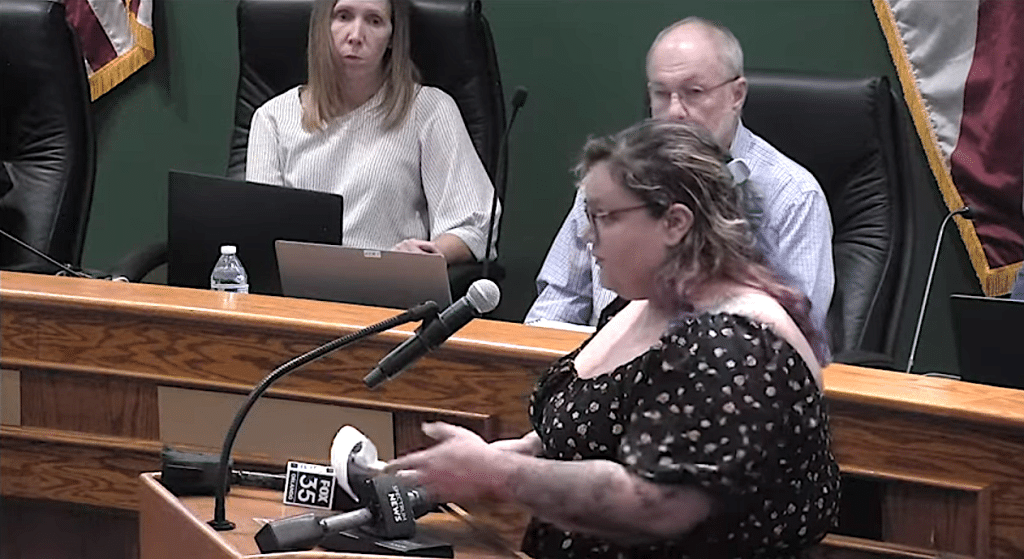
“There’s been issues with them since they’ve been installed — not in Oviedo specifically, but across the country,” Mengel said. “I don’t want our police department to have another thing that separates them from the community that they’re supposed to be serving, and when there’s a lack of trust because we’re being spied on constantly, that’s not going to foster a good environment to be able to effectively do law enforcement.
“So I decided, OK, no one else is talking to the Council about it, and they’re the people that would be able to do something about it,” she said. “I’ll go up there and I’ll talk to them about it. So I did it by myself very nervously.”
Mengel continued to speak with Council members and even met with the police chief about them.
“One person can absolutely make a difference,” Mayor Sladek said. “[Mengel] showed up kind of out of the blue.
“One person got up and said, ‘I’m very concerned about the Flock cameras, and here’s all the reasons why, and here’s the questions I would like answered,’” Sladek said. “And then, the next meeting, a whole lot of people came for the discussion. … That’s what started the whole thing, this one person.”
Support local news!
Choose a monthly amount
Hometown Hero
Community Champion
Rooster Society
Custom Amount
Thank you for your support!
Author

Related Articles

Vote next week could help pull former Pappy’s Patch from rural boundary
Developer Chris Dorworth is ultimately looking to build 136 single-family homes in a move conservationists call a fight over the future of Seminole County’s rural boundary.
Winter Springs City Commission candidate Kyle Stewart: ‘I’m not a Christian nationalist’
Five-year-old podcast resurfaces where Stewart says ‘Amen’ after the host says non-Christians should be barred from office.
Winter Springs Commissioner Paul Diaz wants to see comparisons for county to provide police
In the wake of Amendment 3, Diaz says the big-ticket items – parks and police – should be on the table.