
Why Seminole County’s rural boundary is an important issue for Oviedo
To bolster defenses against development beyond Seminole County’s rural boundary, voters will have two questions this election.
Editor’s note: An earlier version of this article focused on how the rural boundary affects Oviedo and also pressing Oviedo City Council candidate Darrell Lopez with questions he didn’t answer during the candidate forum. The updated version includes Oviedo City Council candidate Alan Ott’s comments regarding that issue.
With early voting underway, Oviedo voters have the opportunity to decide on two amendments to the Seminole County charter, both affecting Seminole County’s rural boundary and how easily it can be changed.
The referendums would change the county’s charter to require a supermajority vote — 4-1 in the Board’s current makeup — to sell off or change any usage of natural lands owned by taxpayers or to move the lines and remove land from the county’s rural area. Seminole’s rural boundary separates the urbanized area of the county from the East Rural Area, which is about 75,000 acres on the east side of the county. Currently, it would only take a 3-2 County Commission vote to move the lines or sell off land.
“The referendum designates a supermajority to change anything in the rural boundary,” Seminole County Commissioner Jay Zembower said.
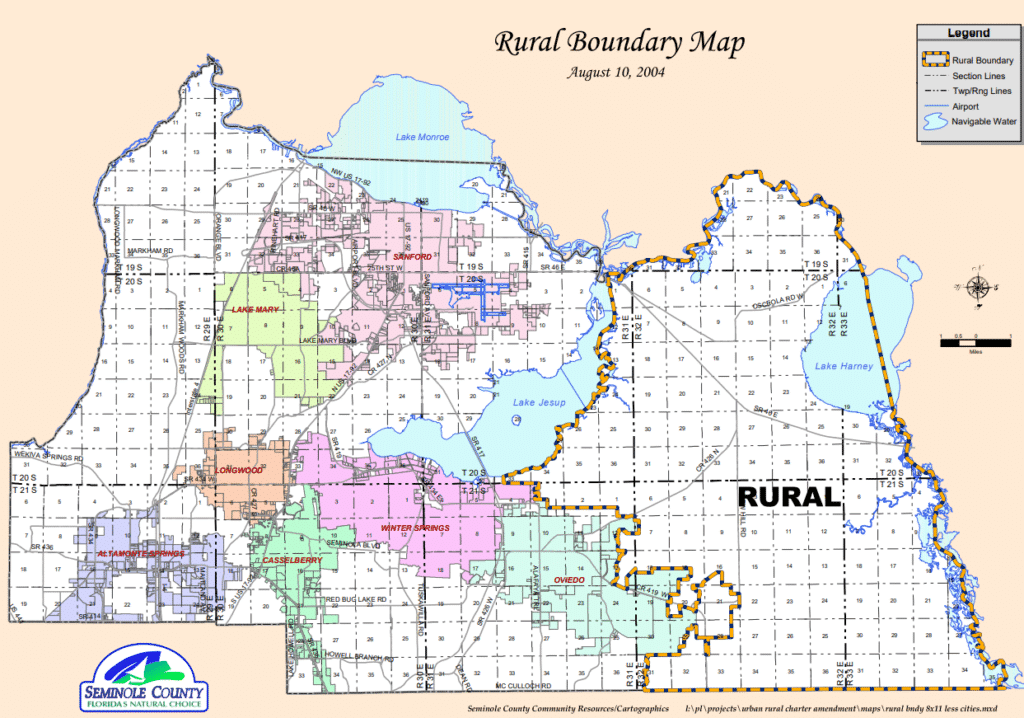
With the East Rural Area and rural boundary not being inside Oviedo city limits, why is it still important for the city itself? Two Oviedo City Council candidates debated that very issue recently at a recent candidate forum, which raised questions about who supports keeping the boundary in place (more on that below). But aside from some quibbles, many current and aspiring City Council members agree that the boundary is an important arbiter of future growth.
[Read more about what the county and state are doing to protect natural lands]
The rural boundary lines sit right on the edge of the eastern side of the city, and any changes to the lines could lead to impacts inside city limits, in addition to potentially handcuffing the city from doing anything with land currently in the rural boundary if it were to be annexed without the supermajority approval by the County Commission.
“The strength of the rural boundary directly impacts the amount of development that can happen there, and the amount of traffic that can flow through our city-owned roads that we pay for as residents,” Mayor Megan Sladek said. “If the rural boundary can be more easily changed, it means we can have more traffic more easily.”
Additionally, if any land inside the rural boundary were to be annexed into the city, Oviedo may be required or asked to provide necessary infrastructure that does not currently exist on the land inside the rural boundary.
“If it was developed, we wouldn’t stand a chance with trying to improve our traffic flows, improving how people get through the city,” council member Natalie Teuchert said. “It would take a ton of effort to put the right infrastructure in for big developments to build. And we know urban sprawl is not good for tax budgets, it’s not good for lower home prices and it’s not good for sustainability.”
Teuchert said mobility studies and traffic counts done by the city show that more than 80% of traffic down Mitchell Hammock Road is from drivers who do not live in Oviedo coming through from the rural boundary.
And it is not only traffic that could affect Oviedo residents if changes were made to the rural boundary lines.
“The single most important [expansion issue] to the city of Oviedo, and I’d say to the city of Winter Springs, is the drainage and runoff issues,” Zembower said. “If you are to expand into the rural area along those two cities, you’re going to impact the drainage and the water runoff through that whole area because you’ve [potentially] added a bunch more houses or commercial [properties] or whatever the city would desire to build there.
“So the importance is to allow natural drainage and runoff to continue to occur in the unincorporated area, which butts up to the cities so that they do not have to continue to struggle any further with managing stormwater,” he said.
So why would a city potentially want to add land from the rural boundary into its borders? Doing so, in theory, could provide a higher population to spread tax burdens around to. However, Zembower said, that benefit may be offset with the need to add new utilities to the new land, and the County Commission has no desire to allow development like that to occur.
“There is no appetite on this County Commission for the foreseeable future to do anything with the rural boundary,” he said. “There’s no need for it, because we still have ample housing throughout the county.”
While much of Seminole County may have ample housing, Oviedo is one of the municipalities that is running out of space to build more. To solve potential housing issues in the future, though, Zembower and others have recommended building vertical, and not horizontal, keeping development away from the rural lands.
Questions raised after candidate forum
At the City Council candidate forum hosted by OCN, the League of Women Voters of Seminole County and Oviedo Citizens in Action, candidates Darrel Lopez and Alan Ott were asked about the amendments, and provided starkly different answers.
“I support those two amendments; I support making it more difficult to change the rural boundary and more difficult for the County Commission to give away or change the designation of rural lands,” Ott said. “I think it’s an important thing. I think the rural boundary is something that’s been agreed to for a long time, and we need to keep it that way.
“Seminole County is designed, at this point, around that.”
Lopez, however, did not offer much of a response to the question about whether he supported the referendum during the forum.
“I’m going to answer this this simple way: I am going not to answer it because it doesn’t affect the city of Oviedo directly,” he said. “I want to stick [the] focus just on Oviedo, please. Thank you.”
This response led to a number of social media posts questioning where Lopez stands on the issue, including from Ott and Sladek, who wrote multiple Facebook posts about the issue and Lopez’s answer, generating dozens of comments in response.
“I was a little surprised that he wouldn’t give an answer to those things because the county is what sets the rural boundary, and the charter amendments [are] what makes it more difficult for the county to change the rural boundary,” Ott said. “So when he said it doesn’t affect Oviedo, it does affect Oviedo, because almost the entire eastern boundary of Oviedo is the rural boundary.
“They very much are an Oviedo issue because what will happen is if the rural boundary gets moved to the east, then the people with land right adjacent to Oviedo are going to want to get annexed and they’re going to want to build there with city density,” he said. “We’ll have to include that in the comprehensive plan if they were to get annexed.
“The question [at the forum] was: do you support these charter amendments that make it more difficult to change the rural boundary?” Ott said. “And this is the part that he still hasn’t given an answer on a week after the [forum].”
Lopez posted the following message on Facebook in response to the backlash:
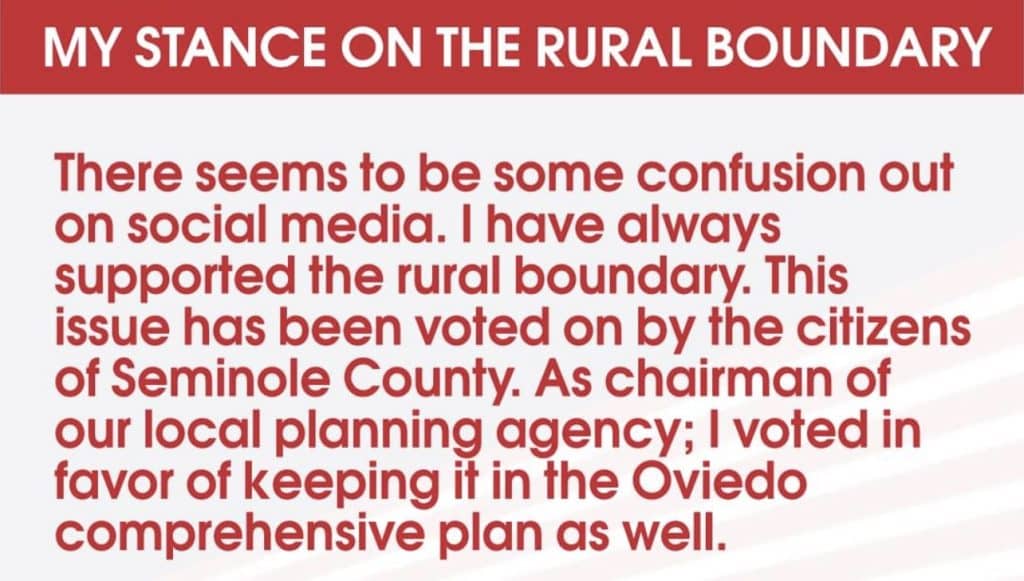
“Basically put, I do support the rule, but as a City Council, unless the County Commissioners changed their minds and the voters change their mind, I think that issue’s been addressed and put to bed,” Lopez, who has served as chairman of Oviedo’s Local Planning Agency since 2020, told OCN over the phone. “I’ve supported it for years, since when I first ran years and years ago. I’ve met with the people over at the Black Hammock area as well and told them what I feel about the area, so my comment was taken out of [context]. I wanted to focus more on the Oviedo issues.
“The last meeting that we had at the LPA, we all supported it,” he said. “We supported the rural boundaries to be at, as it is at the county level, as approved by the voters and the County Commissioners.
“It’s an issue that’s been discussed,” he said. “[The rural boundary has] been approved to be upheld by the voters of Seminole, as well as the County Commissioners. And, so, let’s just [say] hypothetically, if a developer wanted to build and wanted to annex [part of the rural boundary] into the city, they cannot. Plain and simple.
“I don’t see it changing anytime soon,” he said. “I don’t think it’s ever going to change. I think whichever future commissioner brings that up to the table would be running his own death trap or her death trap.
“I think social media has taken [his response] a little bit out of context, because it is what it is. It is politics,” he said. “Hindsight being 20/20, I could have expanded a little bit better, perhaps, than saying ‘I’m not going to answer it because I want to focus on Oviedo issues.’ I could have expanded further into that. ‘I do support it, but I think it’s more important that we focus on immediate issues in Oviedo,’ probably would have been the correct answer.”
Sorry for the interruption but please take 1 minute to read this. The news depends on it.
Did you know each article on Oviedo Community News takes anywhere from 10-15 hours to produce and edit and costs between $325 and $600? Your support makes it possible.
We believe that access to local news is a right, not a privilege, which is why our journalism is free for everyone. But we rely on readers like you to keep this work going. Your contribution keeps us independent and dedicated to our community.
If you believe in the value of local journalism, please make a tax-deductible contribution today or choose a monthly gift to help us plan for the future.
Thank you for supporting Oviedo Community News!
With gratitude,
Megan Stokes, OCN editor-in-chief
Thank you for reading! Before you go...

We are interested about hearing news in our community! Let us know what's happening!
Share a story!
Author
Related Articles
Oviedo Babe Ruth teams say they were banned from All-Star play
In drama between Oviedo Babe Ruth, national Babe Ruth league, ‘collateral damage here has been kids’
Window closing for Seminole County Public Schools teacher pay referendum
School board members say there isn’t data to show the community wants a property tax increase to fund teacher salaries. But polling in 2024 showed broad support for the measure.

Oviedo Council rejects additional Twin Rivers audit funding
Oviedo City Council members questioned the value of the $35,000 request tied to the investigation and audit of the city-owned, independently managed Twin Rivers golf course.