
Seminole County changing ADU rules to allow larger mother-in-law suites
Final vote next week would also allow alcohol sales closer to churches and schools.
The Seminole County Commission is expected to finalize new accessory dwelling unit, or ADU, rules next week that would make it easier to build mother-in-law suites in the county.
The slate of changes to the Seminole County Land Development Code would also make it easier to put a business selling alcohol closer to a school or church.
See below to watch discussion of the first changes, which were approved unanimously in June. The Seminole County Commission meeting is Tuesday, July 14, starting at 9:30 a.m. at 1101 E. 1st St. in Sanford. This is the second and final chance to vote on the proposed changes.
“We’re still operating under Senate Bill 180,” said Neysa Borkert, the deputy county attorney. That bill basically forbids local governments from being more restrictive on development any time within two years of a hurricane.
“So all the changes we have here today are more permissive, not more restrictive or burdensome,” Borkert said. “We just need to be careful … that we don’t violate Senate Bill 180.”
The county could also separately approve a number of developments in Oviedo, including a coffee shop in a historic building and an indoor car dealership.
Accessory Dwelling Units could get bigger
Seminole County is looking to make it easier to add accessory dwelling units, or ADUs.
These are smaller residential houses built on a property, often called “mother-in-law suites” or “granny flats.”
Currently, accessory dwelling units can’t exceed 35% of the area of the principal dwelling unit, or 1,000 square feet, whichever is less. Under the proposed change, accessory dwelling units would be capped at 50% of the size of the main home, or 1,100 square feet, whichever is less. Only one ADU is allowed per property.
But in agriculturally-zoned land, an ADU could go up to 1,600 square feet if a property is bigger than three acres.
County commissioners voted in favor of the ADU changes. Commissioners, though, also discussed tightening other rules around accessory dwelling units..
Currently, the owner must live on-site with whoever is living in the accessory dwelling unit.
“As of today, in the code now, we do require that the owner live on the site in one of the two units,” said Maya Athanas, a principal planner with Seminole County.
But commissioners were worried about what would happen after a home with an accessory dwelling unit gets sold.
“When the primary owner sells it to a (Real Estate Investment Trust)?” asked Seminole County Commission Chairperson Andria Herr. “Or to a landowner who intends to rent out both (units)?”
“And you have a vacation home there instead,” Commissioner Lee Constantine added.
Borkert said the county can’t prohibit vacation homes because of a preemption that’s built into state law. And enforcement of rules making sure an owner is on site can be difficult.
“The requirement for the ownership, for the use of the accessory structure to have an owner on the property, it’s very difficult from an enforcement standpoint to make sure that continues to occur,” Borkert said. “We can try. We can try to have code enforcement look at it, check rental sites, things like that. But that’s gonna be a challenge from an enforcement scenario.”
Want to contact your elected leaders and weigh in on this topic? Find Seminole County Commission contacts here. Have a news tip or opinion to share with OCN? Do that here.
Commissioner Amy Lockhart said there could also be legitimate scenarios where someone has an in-law living with them, but then needs to take a job out-of-state for a while.
“We need to be very careful, although it’s good intentions, that we’re not micromanaging people’s lives and doing something unintentionally prohibitive for families,” Lockhart said.
Herr said it’s a bigger problem in coastal communities, where real estate firms buy homes to turn into AirBNBs and rentals. That can ultimately change an area, she said.
“Where we see these problems crop up primarily is in any town that’s got water,” Herr said. “The east coast and west coast, this is a problem in all those localities. It changes a neighborhood. The residents end up leaving and it becomes a rental community.”
Alcohol could be sold closer to schools
Seminole County is removing the separation requirements for businesses that sell alcohol.
Currently, bars and restaurants must be at least 1,000 feet from a school or church. They also must be 500 feet away from a “like businesses,” so you couldn’t have two cocktail lounges within 500 feet of each other. Bars also had to be 500 feet from residential properties, with exceptions for restaurants that were part of planned developments.
Now, all those requirements are being cut. The only remaining restriction is that they must be 500 feet away from any school.
“This is not required for us to do by the state, so we’re doing it voluntarily because we think it makes sense for the infill projects that we’ve been seeing of recent,” Athanas said. “We have instances where in strip malls, there are churches moving into large spaces, and then we have existing restaurants, and so the setback doesn’t exist.”
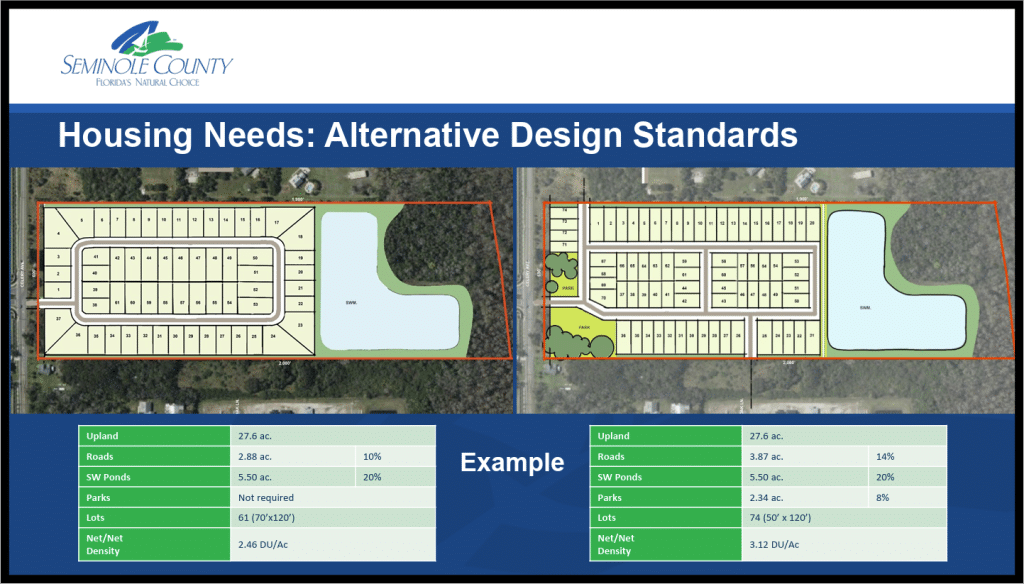
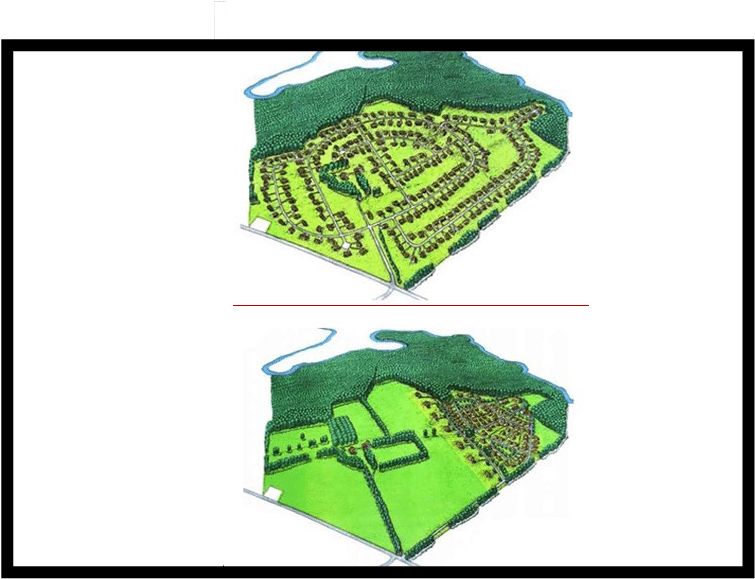
Additionally, Seminole County is considering changes to the lot size required for residential development if a builder agrees to voluntarily put in a park or green space. It wouldn’t increase the total number of allowable houses, but they could be packed in tighter to allow a park.
At Tuesday’s meeting, the Seminole County Commission will also:
- Look at approving a coffee house in a historic building just outside of Oviedo.
- Consider a rezone to allow a car dealership inside an existing building at the northwest corner of Camp Road and State Road 426 in the Oviedo area. The building is currently a BioFit gym.
- Consider a request to rezone a 1.14-acre residential lot to a denser residential zoning. The Alafaya Beasley Rezone is located at the west side of Alafaya Trail, south of Beasley Road. The property is currently developed as a single family home, and the change would allow it to be split into two houses built along Alafaya Trail. The houses would be 2,600 to 3,000 square foot range, according to staff documents.
- Seek a $415,000 grant from the Florida Department of Environmental Protection to conduct passive nutrient reduction in Lake Jesup. The project would put passive filters in Salt Creek to reduce the phosphorous going into Lake Jesup in the Black Hammock; Lake Jesup is designated as a “nutrient impaired” lake.
Abe Aboraya is a Report for America corps member.
Sorry for the interruption but please take 1 minute to read this. The news depends on it.
Did you know each article on Oviedo Community News takes anywhere from 10-15 hours to produce and edit and costs between $325 and $600? Your support makes it possible.
We believe that access to local news is a right, not a privilege, which is why our journalism is free for everyone. But we rely on readers like you to keep this work going. Your contribution keeps us independent and dedicated to our community.
If you believe in the value of local journalism, please make a tax-deductible contribution today or choose a monthly gift to help us plan for the future.
Thank you for supporting Oviedo Community News!
With gratitude,
Megan Stokes, OCN editor-in-chief
Thank you for reading! Before you go...
We are interested about hearing news in our community! Let us know what's happening!
Share a story!
Support local news!
Choose a monthly amount
Hometown Hero
Community Champion
Golden Rooster Society
Custom Amount
Thank you for your support!
Author

Related Articles
Exclusive: Seminole County Public Schools reduces budget deficit to $600,000
OCN sits down with Superintendent Serita Beamon to see how the system plans to handle a tax rate that has been declining for more than a decade as private school voucher program grows.
Residents worry about flooding issues at Jetta Point as it loses conservation designation
“I caught four catfish in my front yard during Ian, and I didn’t even have a fishing pole,” a resident said after flooding issues in the Jetta Point area.

Key differences split board candidates for Seminole County Public Schools
Audience members say one of the Seminole County School Board candidates was too ‘aggressive,’ as the moderator steps in to fact check. Other candidates had big disagreements on book bans.