
Latinos In Action banned from Seminole County
Schools in Seminole County were ordered to cut ties with the organization of Latinos In Action, due to claims of racial discrimination.
This article was made possible through a partnership with Hagerty High School’s student-run newspaper, The Blueprint. You can also find this article on The Blueprint’s website.
By Holly Smyers, Online Editor
Cultural clubs such as Black Student Union and Asian Culture Club have become a staple at high schools, providing a place for students to form a community of people with similar backgrounds and share their culture with others on campus. Latinos In Action differed slightly from more traditional cultural clubs due to their partnership with the official LIA organization. It was paired with a class of the same name, which had a specific curriculum, goals and opportunities for students provided by the organization.

On Sept. 24, the U.S. Department of Education Office for Civil Rights ordered Seminole County to cut ties with Latinos In Action, citing that it was “discriminating based on race,” thus violating Title VI of the Civil Rights Act of 1964.
Once the letter was sent out, schools had to act quickly, as failure to cut ties with LIA would result in funding being cut from the county.
“There [were] teachers crying and it was devastating for everyone,” LIA Secretary Celeste Bustillo said. “But we had to respond almost immediately. We have posters that are half unfinished. We have a ton of T-shirts. We were in shock.”
What is LIA
LIA was founded in Utah in 2001 by teacher Jose Enriquez after he noticed a pattern of Latino students being “disengaged and disenfranchised at school.” The goal of the non-profit is to increase graduation rates among Latino students, teach them leadership skills and give them a space to share and celebrate their culture.
“[Leading the club] makes me feel so proud of myself and the group that we have here at Hagerty for Latinos In Action, because it shows we created this space of comfort for those who may not have found it before, and we’ve helped them [find] their place in the community,” LIA President Juliana Alvarez said. “A lot of times, speaking as a Latina student, it’s hard to find people who have the same experiences as you. I feel so overjoyed, because it’s like you see all these people coming together, and you know they’re just sharing their culture.”

One of the main goals of LIA is to help students who speak English as a Second Language, specifically those who speak Spanish, adjust to living in the United States, where English is dominant.
“I wanted to help out those who came from other countries who don’t know [English],” Alvarez said. “My family didn’t come here knowing the language. They had to learn how to speak it [and] how to get jobs and everything. Latinos In Action helps Latino students who aren’t fortunate enough to have experience in the U.S. get resources to get into colleges, to get good careers [and] get scholarships.”
ESL students tend to have lower graduation rates than their peers and can face challenges adjusting to school in a country where lessons are taught in a non-native language.
“[Being in LIA] has helped me because I’m not good at the language. While I’m in that club I’m learning more. You speak more Spanish than English [and you get support] in your struggle with English.
— Laura Viviescas, ESL student
“It’s really intimidating, and a lot of times they give up [or] lose motivation,” Bustillo said. “So to go to a fifth period and see other kids that are similar to you and speak [Spanish] is kind of inspiring.
The class and club of LIA aimed to help provide a community for ESL students to share struggles, improve their English and seek help if it takes longer to understand material.
“[Being in LIA] has helped me because I’m not good at the language,” ESL student Laura Viviescas said. “While I’m in that club I’m learning more. You speak more Spanish than English [and you get support] in your struggle with English.”
One of the main pillars of the LIA program is giving Latino students confidence and experience in leadership, when they might not otherwise feel encouraged to.
“It grants students an opportunity to take charge of, for example, decorating or dealing with spirit nights or money,” Bustillo said. “So you can go outside of the class and be like, ‘Hey, wait, I can actually do this position because I’ve had a little bit of experience.’”
Reason for shutdown
The letter from the OCR sent to the Superintendent Serita Beamon cites three main issues with the LIA program:
The first is that LIA excludes students based on race. The letter states, “The Latinos In Action program is designed for and exclusive to Latino students… no justification proffered by the District can overcome the patent illegality of its unlawful exclusionary program.”
At Hagerty, there was no reported instance or complaint about other students who were denied entry into the LIA class or club.
“It’s always been open access,” Principal Robert Frasca said. “Even though it says Latinos in Action, it doesn’t mean that only Latino students could be in there, but the course was really designed for former second language learners and providing opportunities for leadership experience for that specific group of students who have not always had those opportunities.”
“I think the initial reaction was kind of a kick in the gut. I don’t think there’s any bad intention. I’ve just learned that in this job, and I’ve learned that in life, that no matter how things are going there’s gonna be something thrown in your way that you have to overcome. You have to channel that anger and frustration into a positive.
— Robert Frasca, principal
The second reason cites the “unlawful racial balancing,” as, according to the FAQ page on the website at the time, “80% of the class must be Latino.” This has since been removed from the website. The letter quotes Fisher v. University of Texas at Austin, stating that, “outright racial balancing is patently unconstitutional.”
The third cited reason is that it segregates based on race, due to the website citing the program as providing a “safe harbor” for Latino students, implying the class and any affiliated clubs are specifically for Latinos and meant to be separate from the typical school setting.
“I understand [where they are coming from], but it’s not like [we’re] discriminating [against] people,” Viviescas said. “When I was in middle school, I was in Latinos In Action too, and there were people that were not Hispanic but we considered them family, because we are like family. We don’t discriminate, we just want a space for us.”
This decision has left many feeling conflicted as the environment LIA programs provided did appear to help Latino students feel more comfortable, and the process of cutting ties with LIA, while preserving a space for Latino students presents a challenge for students and staff.
“I think the initial reaction was kind of a kick in the gut,” Frasca said. “I don’t think there’s any bad intention. I’ve just learned that in this job, and I’ve learned that in life, that no matter how things are going there’s gonna be something thrown in your way that you have to overcome. You have to channel that anger and frustration into a positive.”
Next Steps
A class called “Leaders in Action” will take the place of LIA, which aims to continue to emphasize the values of “academic success, leadership development and meaningful service to the community,” according to the official letter from Seminole County. A new club not associated with LIA is in the works as well, with many expecting the name to be Hispanic Student Union.
Most of the students who were in LIA are upset about this decision and wish to fight it, starting a petition to reinstate LIA into schools. They are also in the process of reaching out to different organizations for support to help fight this decision, such as the Most Precious Blood Catholic Church, which agreed to spread the petition.
“My overall feelings vary a lot,” LIA event manager Eduardo Ramirez said. “I feel encouraged because now I [have] something to fight for, and because this is not just a fight for the classes, [it’s] a fight for Latinos in general. Latinos In Action gave us all these opportunities, and now it’s been taken away. We will continue fighting for this until we are treated the way that we should be treated, given the same opportunities as other people have.”
Despite support, it is unlikely for LIA to be reinstated back into school at this time; however this has not deterred students from speaking up.
“If we can’t get Latinos In Action back, I’d say that we’ll continue to fight,” Ramirez said. “The fire will still be lit. And at the same time, we’ll just keep advertising to Latino students. That way we can see more of an influx of Spanish speakers [and] Latino students, and just allow them to be in that little class.”
“If we can’t get Latinos In Action back, I’d say that we’ll continue to fight. The fire will still be lit. And at the same time, we’ll just keep advertising to Latino students. That way we can see more of an influx of Spanish speakers [and] Latino students, and just allow them to be in that little class.
— Eduardo Ramirez
There is a push from both students and staff members to encourage Latino students to join Leaders in Action, and continue to advertise it as a space for Latino and Spanish-speaking students, as there are concerns that the new title will not attract the same community that LIA did. The new curriculum is actively in the works and is still centered around helping ESL and Latino students. Some are optimistic about this opportunity, as it may allow for more student input in creating the class curriculum.
“Student voice is critical,” Frasca said. “We have to listen to our students and what their needs are. I feel like this is a population of students that we need to continue to develop leadership potential in. I want all our students to feel like they have a voice, so we’re always looking for those opportunities. And I think it’s definitely important to see how we can make this something really positive going forward.”
The new club will be student-led and continue to provide a space for students to celebrate their culture and meet similar people. Cultural clubs will remain, as the cited problems are with the LIA nonprofit and the class associated with it, and not with student-led organizations. The Leaders in Action class will likely still have opportunities for ESL students, and counselors will likely advise them to take it.
“I am very optimistic about the future of Leaders in Action and the potential that we have to make a really positive impact on campuses across Seminole County,” Frasca said. “I think as a community, we’re going to come together and we’re going to take all of that and we’re going to make it into something great. And I am very excited to see and be a part of that.”
Sorry for the interruption but please take 1 minute to read this. The news depends on it.
Did you know each article on Oviedo Community News takes anywhere from 10-15 hours to produce and edit and costs between $325 and $600? Your support makes it possible.
We believe that access to local news is a right, not a privilege, which is why our journalism is free for everyone. But we rely on readers like you to keep this work going. Your contribution keeps us independent and dedicated to our community.
If you believe in the value of local journalism, please make a tax-deductible contribution today or choose a monthly gift to help us plan for the future.
Thank you for supporting Oviedo Community News!
With gratitude,
Megan Stokes, OCN editor-in-chief
Thank you for reading! Before you go...
We are interested about hearing news in our community! Let us know what's happening!
Share a story!
Related Articles
Seminole County Schools budget cuts hit Lawton Chiles band program
One of only two band directors cut from the school, class eliminated as parents protest budget cuts in school system increasingly facing funding pressure from Tallahassee.
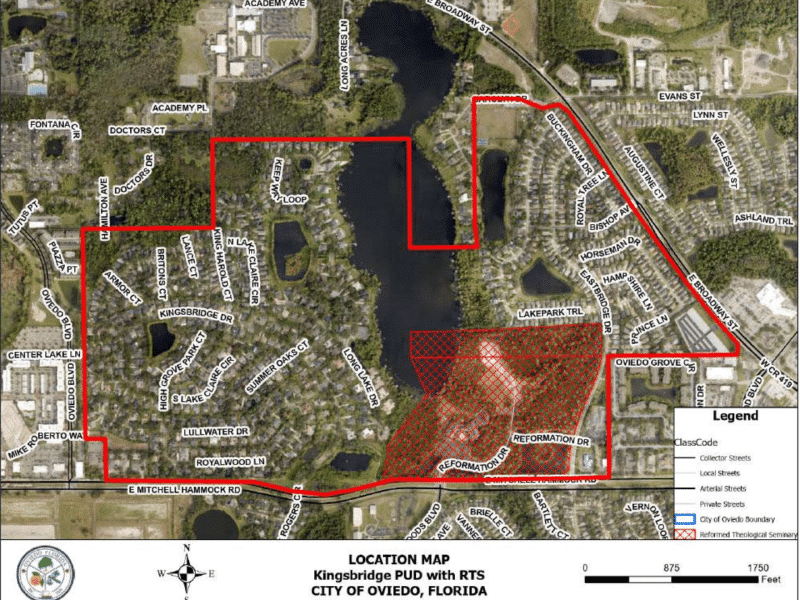
Oviedo advances Reformed Seminary school student housing proposal
The City Council will hold a final public hearing for the proposal, whihc could add up to 163 beds worth of student housing, on June 15.
Ali’s Hope Hub opens to help struggling students before it’s too late
Winter Springs students’ graduation gift to younger students: a permanent place for emotional support and new friendships during tough times.