A late amendment to a bill in the Florida Senate could make development in Seminole County’s rural boundary much easier – at the expense of county governments.
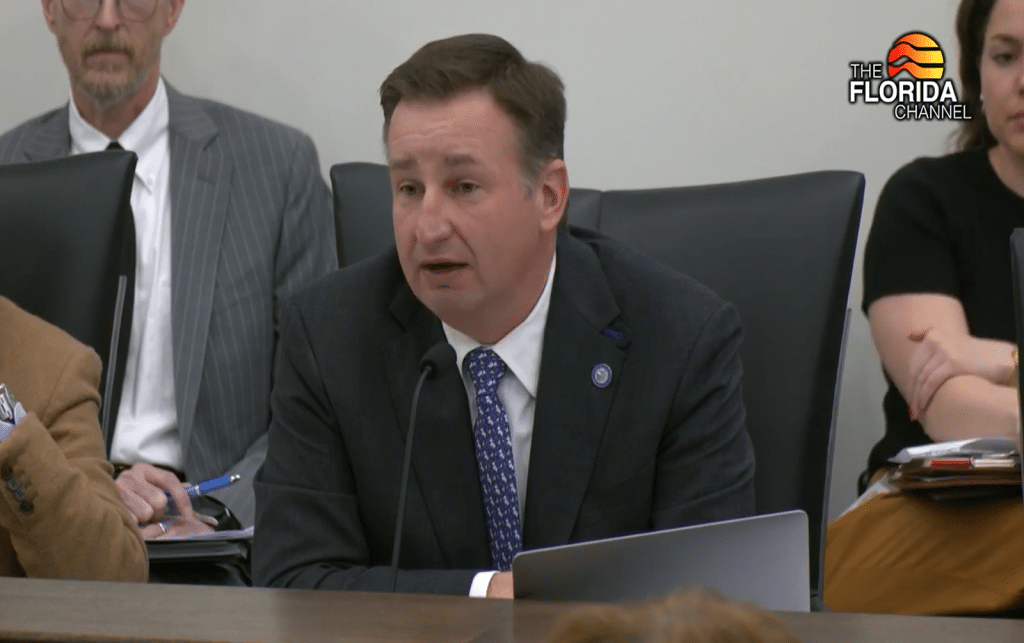
Senate Bill 208 is a bill that would limit local government restrictions on growth by putting limits on fees. But on Tuesday, Senator Jonathan Martin – who represents Lee County and the Fort Myers area – filed the late amendment to the bill that could alter the eastern Seminole and Orange County landscape. The amendment was ultimately withdrawn, but is expected to come up when the full Florida Senate votes on the bill this session.
“…a few years ago, er, a few months ago, when I learned about the rural boundary issue taking place in Central Florida, I was concerned about its effects down in my district,” Martin said.
Sen. Jason Brodeur, who represents Seminole and Orange counties and is the second highest ranking member of the Senate, voiced his support for the amendment. He cited a November 2025 opinion from the Florida Attorney General’s office that said rural boundaries are likely unconstitutional and are “a taking” from the government.
“We could very easily be here with an amendment that says rural boundaries are hereby outlawed,” Brodeur said. “That’s what the AG letter said – it is a per se infringement, a taking.”
Instead, the complicated amendment makes it so that land owners beyond a rural boundary could apply to the county to have the density of zoning that neighbors have, including going up to a mile from the rural boundary. If the county denies it, they would have to pay the landowner for the difference in the “fair market value” for the property rights.
Crucially, landowners could be paid for the difference in property value – and still ask a court for the property to be removed from the rural protection in the county.
“My support for the rural boundary has always been premised on the understanding that growth is permanent and that wise, cautious decision making is the best decision making,” Brodeur said. “But I’m rooted in my core belief of private property rights. And that’s what makes America special.”
Brodeur is term-limited from reelection in the Florida Legislature.
Seminole County’s rural boundary was approved by a majority of voters in 2004 when more than 82 percent of voters opted to require a super majority – four votes – of county commissioners to remove land from the rural boundary or to transfer or change the use of natural lands.
David Bear, an attorney representing and president of Save Rural Seminole, said because the amendment came late, there will be zero chance for public comment on it.
“There’s not a committee we can go to and make a comment at it,” Bear said. “There’s never going to be public comment. It’s egregious.”
Bear and his group began raising the alarm last year when the attorney general opinion came out on rural boundaries, predicting lawmakers would use the opinion as the basis to end rural boundaries. Bear said the opinion ignores the three lawsuits over Seminole County’s rural boundary that have been upheld in court.
And in Seminole County, property owners in 2004 kept the future development entitlements they had at the time, known as the Future Land Use. Property owners also had the chance to opt out of the rural boundary.
“If you look at the rural boundary, that’s why it’s so jagged now,” said County Commissioner Jay Zembower, who worked on the campaign to establish the rural boundary.
Check here for an explainer on Seminole County’s rural boundary and to see maps.
Zembower said Brodeur is supporting the proposal because he’s term-limited and isn’t running for reelection. He said he talked to Brodeur after the senator voiced support for it.
“I told him what I thought about it and the shenanigans he pulled,” Zembower said. “I said, ‘Well, buddy, you found the excuse you needed.’ And I could care less whether he liked it or not.”
What the amendment would do
The amendment to Senate Bill 208 isn’t easy to explain.
It doesn’t just say that rural boundaries are unlawful. Rather, it says that a rural boundary that requires a supermajority vote for a landowner to get more entitlements is, legally, a “taking” from the property owner.
“It is the intent of the Legislature that this section provide affected property owners with a self-executing remedy enforceable through the existing judicial system, without the need for any county-administered program, and that the full cost of the taking be borne by the county that adopted the designation,” the amendment reads.
The idea is that if there is nearby development to a rural area, the owner of the land in the rural-designated area would be allowed to submit a request to remove the property from the rural boundary.
“The county shall approve or deny the request within 60 days after receipt of the request,” the amendment reads. “If the county fails to act within 60 days, the request is deemed approved.”
Whether or not the county denies the request, it becomes deemed “a taking.”
“The property owner may elect to seek either or both of the following: Full compensation for the fair market value diminution, to be paid solely by the county,” the amendment reads. “A court order removing the property from the rural boundary designation with the density and intensity matching presumption.”
The amendment does seem to acknowledge Seminole County’s history of winning lawsuits over the rural boundary, but legally bypasses it.
“To the extent that a prior judicial decision has held that a county charter amendment establishing a rural boundary designation is constitutional or has otherwise ruled against a property owner seeking removal from such a designation, such holding does not preclude a claim under this section,” it says. “This section establishes a new statutory right that is independent of prior adjudication.”
Rural boundary comes into focus as state takes public comment on Hi Oaks Ranch
The timing of the amendment comes while the Florida Department of Environmental Protection was receiving public comment on the possible acquisition of Seminole County’s Hi Oaks Ranch as part of the Florida Forever Program on Wednesday.
The hearing was held in Lakeland, an hour and a half drive from Seminole County. But local elected officials, including Winter Springs Mayor Kevin McCann, Winter Springs Commissioner Sarah Baker and County Commissioner Bob Dallari came to voice support for the project. The county is also offering professional staff time to assist the application.
Winter Springs Mayor Kevin McCann said it’s not whether or not Florida will grow, but if policy makers will be intentional about what gets preserved.
“Some places, once lost, cannot be replaced,” McCann said. “Hi Oaks Ranch is one of those places. Large, connected landscapes like this are becoming rare in the county that is becoming built out.”
Other elected officials sent letters in support of acquiring Hi Oaks Ranch’s acquisition, including Oviedo Mayor Megan Sladek, Oviedo City Council Member Alan Ott and Orange County Commissioner Kelly Semrad. .
No one spoke against Florida Forever acquiring the ranch. The ranch was, at one point, up for the development of a 670-acre project called River Cross Development, led by former State Rep. Chris Dorworth. Dorworth did not immediately respond to a request for comment.
So what are the chances that the amendment that could weaken the rural boundary ultimately passes? Some are concerned because Brodeur is throwing his support behind it, and he’s the second in command in the Senate and a resident of the county most directly affected. Others said the bill will face opposition from others.
“I’ve got to believe there are smart minds in Tallahassee that will go, ‘Oh my goodness, this is a major train wreck for the state if we put this forward,” Zembower said.
The question everyone should be asking, Zembower added, is why a senator from southwest Florida got involved to begin with.
“What does a senator in [Lee] County give a rat’s ass about Orange and Seminole counties?” Zembower asked.
Abe Aboraya is a Report for America corps member
Sorry for the interruption but please take 1 minute to read this. The news depends on it.
Did you know each article on Oviedo Community News takes anywhere from 10-15 hours to produce and edit and costs between $325 and $600? Your support makes it possible.
We believe that access to local news is a right, not a privilege, which is why our journalism is free for everyone. But we rely on readers like you to keep this work going. Your contribution keeps us independent and dedicated to our community.
If you believe in the value of local journalism, please make a tax-deductible contribution today or choose a monthly gift to help us plan for the future.
Thank you for supporting Oviedo Community News!
With gratitude,
Megan Stokes, OCN editor-in-chief
Thank you for reading! Before you go...
We are interested about hearing news in our community! Let us know what's happening!
Share a story!