
Winter Springs Charter Review Committee nixes plan to give mayor more power: Now what?
Winter Springs mayoral candidate Jesse Phillips, who helped draft the proposed mayoral power expansion that wouldn’t have given residents a say, says he will now consider a citizen referendum.
The citizen-led group responsible for updating Winter Springs’ governing documents has declined to expand the powers of the mayor.
The City of Winter Springs Charter Review Committee is meeting once a month, with the goal of having a list of proposals for voters in 2028 to update the charter, which is essentially the city’s constitution. And a controversial proposal to expand the powers of the mayor was voted down at the last meeting.
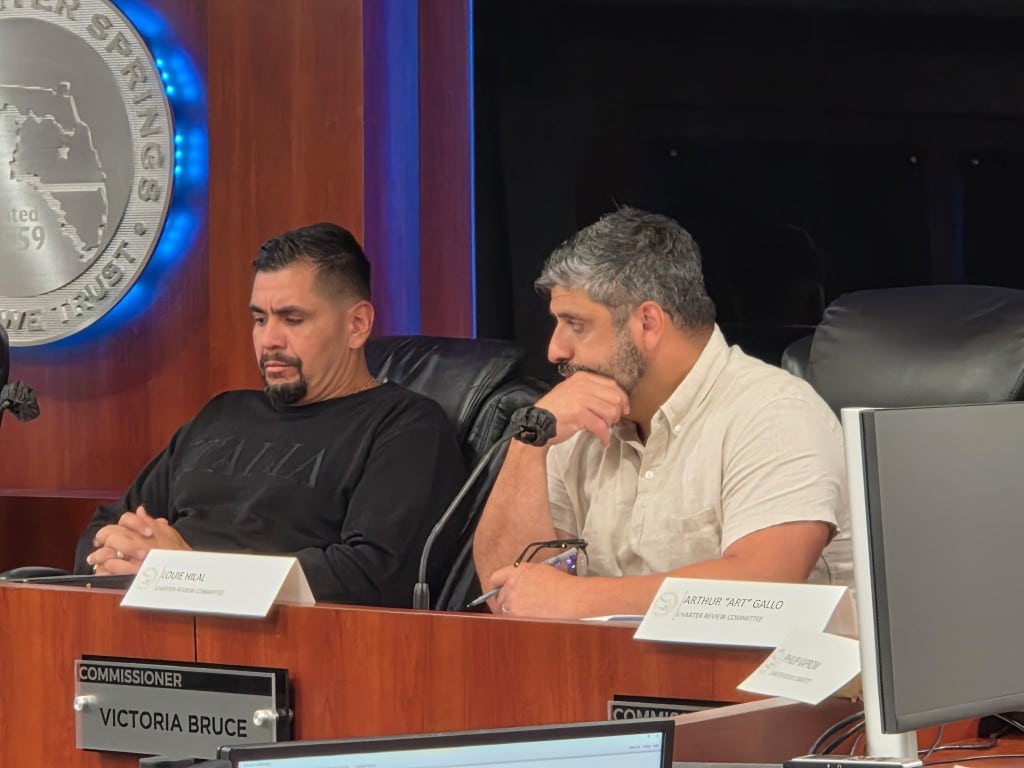
“I think we should allow the mayor to vote because it gives him skin in the game,” said committee member Louie Hilal. “I’m all about accountability and transparency. And if I elect the mayor, I want to know where that mayor sits on the issues. What’s his voting record? We do not have a voting record.”
Currently, Winter Springs has a more rare form of government. Five city commissioners vote, and the mayor – elected at large – only votes if there’s a tie. The mayor can veto an ordinance, which has only happened twice in recent decades.
The mayor also represents the city to other government agencies and presides over the meeting. Windermere, Malabar, Palm Beach, Belle Isle and Flagler Beach all have similar structures for the mayoral position.
Committee member Phil Kaprow said Winter Springs residents like the current form. He said the mayor almost always makes his opinion known, and you can gather what matters by what the mayor vetoes.
“The people of Longwood don’t know what’s best for Winter Springs,” Kaprow said. “The people of Oviedo don’t know what’s best for Winter Springs. The people of Winter Springs know what’s best for Winter Springs. I understand there’s been some hubbub and we had a state legislator who got a bug in her ear and thought she was helping.”
Want to contact your elected leaders and weigh in on this topic? Find their contact information here. Have a news tip or opinion to share with OCN? Do that here.
The backlash over state lawmakers’ move to give the mayor more power
Last October, state lawmakers put forward a bill that would have unilaterally changed the structure of government in Winter Springs.
House Bill 4083, as originally filed, called for eliminating one city commissioner seat and making the mayor a voting member while simultaneously removing his veto ability.
Crucially, the bill also said the mayor had no administrative authority over city employees, “except as expressly provided by this charter or by ordinance,” the draft bill reads. Critics argued that line – “or by ordinance” – would have allowed the City Commission, with a simple majority vote, to give the mayor hiring and firing authority.
After reporting by Oviedo Community News and resident uproar about the proposal, ultimately, the state bill was altered to include a proposal where it would have to be approved by a majority of voters. The bill failed in the Legislature, and the city created the Charter Review Committee as a compromise.
Winter Springs Mayor Kevin McCann, who is not on the Charter Review Committee but was in the audience, was asked to address the board. McCann said he’s open to the idea of whether or not the mayor should vote.
McCann said having the consistency of the mayor representing the city to other governments creates long-term, valuable relationships. McCann said the mayor should not be allowed to hire and fire staff.
“Respectfully, as I’m listening, please stop comparing us to other communities,” McCann said. “Look, in the end, you want to give me more power? Hey, that’s kind of interesting to me. But again, stop comparing us to other communities because every one is different.”
Ultimately, the Charter Review Committee voted six to one to keep the powers of the mayor as they exist. Hilal was the only no vote.
The members of the Charter Review Committee include:
- David Bear, a Winter Springs attorney who has worked with Save Rural Seminole.
- Art Gallo, a resident and Code Enforcement Board member who attends most commission meetings.
- Former Winter Springs Commissioner Jean Hovey.
- Attorney Phil Kaprow, who was also the general counsel for the Seminole County Supervisor of Elections.
- Eddie Rivera, a pastor at Action Church in Winter Springs.
- Louie Hilal, the former president of the Highlands Homeowner’s Association.
Jesse Phillips, a candidate for mayor, was listed as the author of the bill to expand mayoral powers, according to the bill’s metadata. Phillips was not happy with the vote to deny increasing the power of the mayor’s seat.
“We’ve been pushing for residents to be able to exercise our home rule rights to have an up or down vote on our form of government,” Phillips said. “The Charter Review Committee just decided to deny us that, and basically took it off the table and said, ‘You know what? As the charter review committee, we are going to decide everything’s fine, and the voters are not going to get to vote on this.’ And that, I believe, is a violation of the spirit of the Charter Review Committee.”
Phillips addressed the Charter Review Committee, asking them to outline a process in the charter where a citizen could propose changes to the charter. Phillips said that was still an option.
“At the end of the day, if we would outline a process for me, where I can go get petitions, and then we can put this up to a vote through the citizens’ petition process – that may be what has to happen,” Phillips said.
The Charter Review Committee is making recommendations to the Winter Springs City Commission for possible changes to the city’s constitution in 2028 elections. The committee makes recommendations, but the Winter Springs City Commission ultimately decides what ends up on the ballot.
McCann said that at this point state lawmakers and a citizen committee have balked at the idea of expanding the mayor’s role. He said people can see what Phillips is trying to do.
“At some point, [Jesse Phillips] is going to have to accept that this power grab is not popular, and that it’s not going to work,” McCann said. “They see what he’s trying to do, and I don’t think that they like it. And they’ve spoken pretty loudly and clearly, both in Tallahassee and in Winter Springs. … At some point, he’s got to give up. Maybe he won’t.”
Abe Aboraya is a Report for America corps member.
Support local news!
Choose a monthly amount
Hometown Hero
Community Champion
Rooster Society
Custom Amount
Thank you for your support!
Author

Related Articles

Seminole County approves $1.27 billion budget – without Flock cameras
One resident would rather the county put savings ‘back to residents’ ahead of property tax vote.
Winter Springs City Commission Candidates Make their Pitch to Voters
Oviedo Community News’ Megan Stokes moderated the Winter Springs forum that remained composed but ended in a pointed challenge to a one-on-one debate.