
Oviedo begins difficult Amendment 3 discussions about city-sponsored events
Oviedo is facing a tough future for the city’s holiday events after the passage of Amendment 3. Seminole County voters had the fourth lowest approval rate in the state for the controversial budget measure.
Months before Amendment 3 actually takes effect, the highly publicized ballot measure that Florida voters approved with 62% of the vote on Nov. 3 — higher than the necessary 60% — is already leading to difficult conversations for Oviedo city officials, with the Nov. 16 City Council meeting focusing on upcoming city-sponsored events.

The amendment increases the current non-school homestead exemption for qualifying homeowners from its current $50,000 to $150,000 in 2027, $250,000 in 2028 and adjusted for inflation beyond that. It is expected to cost Oviedo about $5.1 million in property tax revenues in fiscal year 2027-28 and $9.2 million in 2028-29.
While the voters across the state overwhelmingly voted in favor, only 50% of Seminole County voters approved the amendment. That number was the fourth-lowest among the state’s 67 counties. The other three at 50% or lower approval were Alachua (45%), Leon (45%) and Gadsden (50%), with Orange County at 51%.
“About the will of the voters,” Council member Alan Ott said, “we’re in a hard spot on that, because we have to deal with whatever the state gives us, that was passed at the state level overwhelmingly, but was very close to 50-50 in Oviedo, in Seminole County, in this area. What does that mean?
“Fifty-point-one percent is not a mandate.”
The city had been preparing for months for the possibility of its passing, developing plans of what services would potentially be cut and what fees may need to be increased or levied. While city-sponsored events are at risk of being cut in the new fiscal year that begins in Oct. 2027, Oviedo Recreation and Parks Director Paul Belden asked the Oviedo City Council for guidance about the possibility of cuts or changes to the events taking place before then.
“We wanted to just make sure we had clear direction on our current fiscal year operations,” Belden said. “Did Council want to just continue with our budgeted events for this year, knowing that it could be the last one, or make a hybrid approach … [or] just offer events through the end of January and then cancel the rest.
“It was really more so getting some direction for this year, not knowing what the future held,” he said.
The recreation and parks department receives the third-highest amount of money from the city’s budget, behind the police and fire departments.
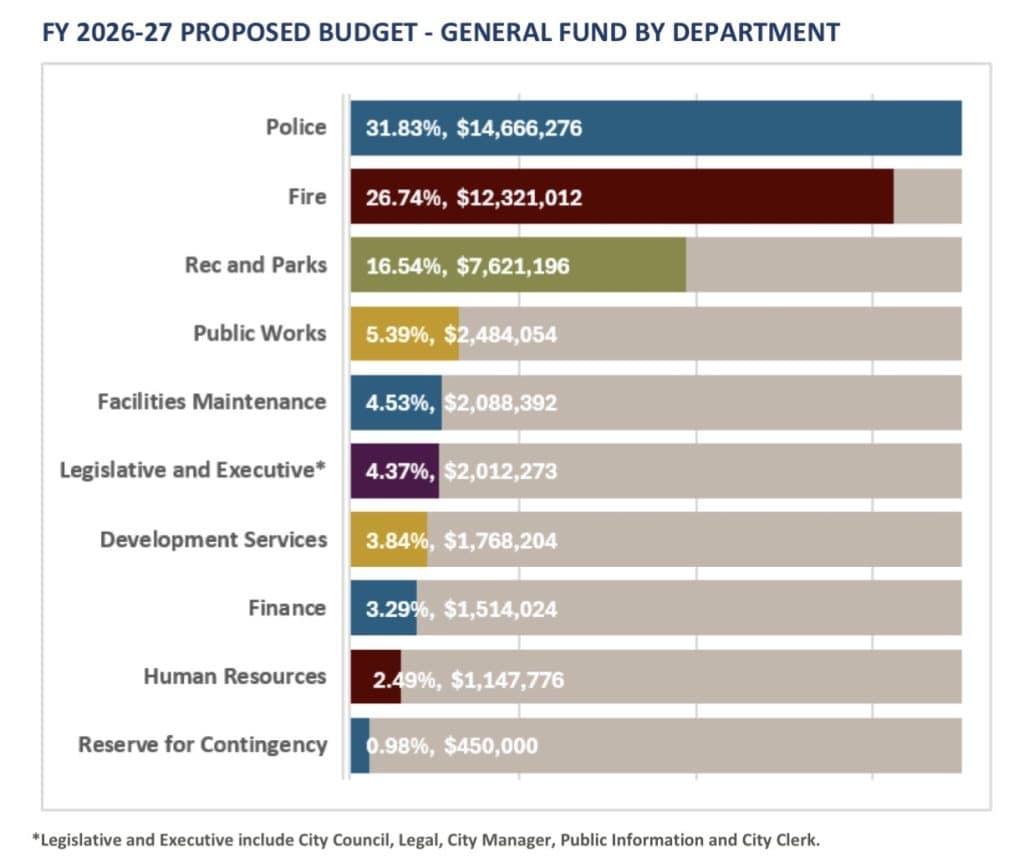
While the 2027-28 fiscal year events will be a major topic of conversation when the city begins developing and discussing its upcoming budget, the Council decided not to eliminate any events before then.
Recovering costs
The recreation and parks department “strives” for a cost recovery goal of 30% for all programs, and for certain ones — Winterfest, the Martin Luther King, Jr. event, Egg-ceptional and July 4th — aim for 50%, Belden said. At the meeting, Belden explained that following event cost-cutting measures in anticipation of Amendment 3 passing, the 2026-27 events are expected to combine for a 70% cost recovery for a total savings of about $110,000, though the numbers could change slightly as further calculations are completed, Belden said.
Belden said the 70% cost recovery is among “our highest level” in recent years. Last fiscal year’s cost recovery for events was 52%.
“We’re trying to be a good steward of our city finances,” Belden said at the meeting. “We’re trying to save more money, and at the same time we also know that tough decisions need to be made.”
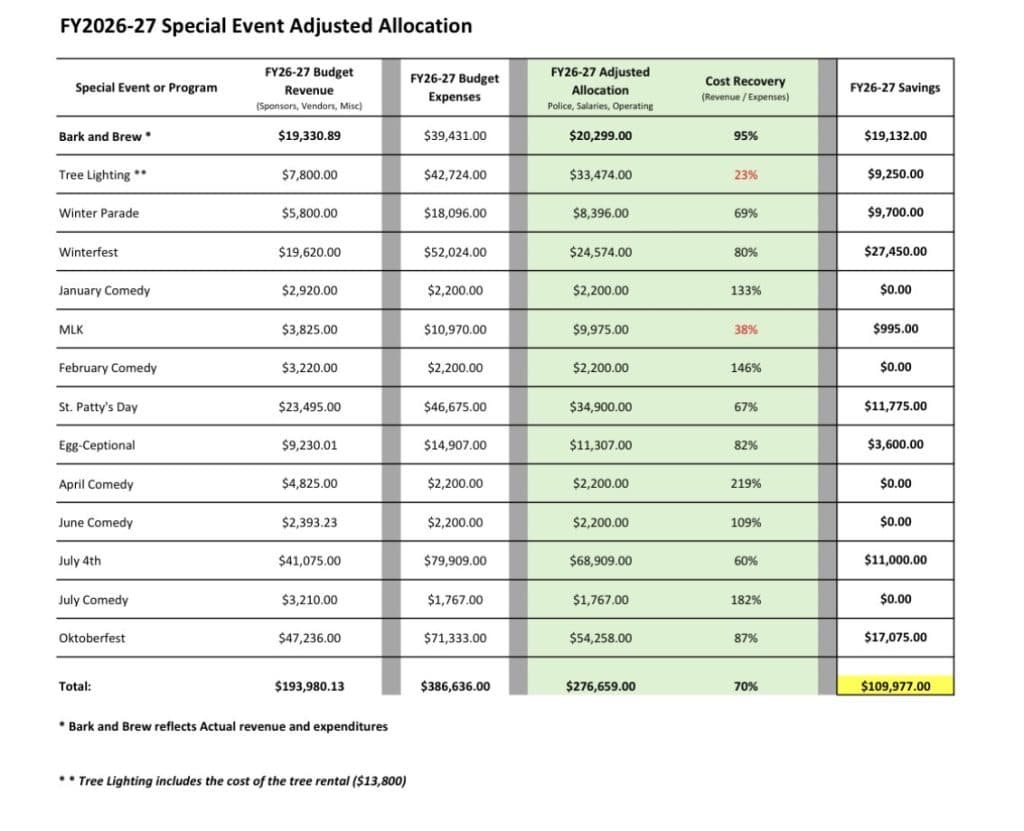
The first event of the fiscal year, Nov. 7’s Bark and Brew, cost the city $20,299 and brought $19,330 in revenue, for a 95% cost recovery, according to the city. The city’s budget had allotted $39,000 for the event.
“Bark and Brew actually did its job of what we set up for,” Belden said. “Our goal is to keep the revenue the same or higher, but also minimize our expenses, and that’s going to drive our cost recovery.”
“I gave staff a hard goal, and that was we’re going to go into this fiscal year not spending what was budgeted,” Belden said at the meeting.
Changing are coming
At the meeting, the Council and Belden discussed trying to get closer to 100% cost recovery for the remainder of the fiscal year, to which Belden said, “we’re going to try to make as many adjustments as we can to get close to that number. It’s going to be a combination of increasing revenue, but also decreasing additional expenses.”
“Going up to 100% is a huge jump, which means that you’re going to be cutting more expenses out of it where our events would make a huge transition that the public may not want to take, or attend, afterwards,” Belden said at the meeting. “You have to make baby steps.”
During the meeting, Oviedo Mayor Megan Sladek said she would be in favor of canceling events this fiscal year that did not reach 100% cost recovery.
“My inclination is not to just try [to get to 100% cost recovery], but to just do it,” she said. “Don’t spend beyond what you anticipate getting.”
Sladek said she would like to see the events become revenue generators in the future.
To get closer to the 100% cost recovery, Belden said it would include a combination of attempting to gain additional sponsorships and vendors, potentially increasing entry prices and reducing the amount and types of entertainment at events.
“The interaction might be a little bit different from the past, but it’s something we have to look at,” Belden said. “We’re going to try to make it still a community family festival, but there might be some adjustments that need to be had to keep our costs down.”
Community impact
Council member Jeff Boddiford said the approach is on the right track.
“I want to see us try to do what we can to keep these events,” he said at the meeting. “It really brings out the community, but we also have to figure out how we cut back.”
“We obviously do not want to tear our community apart,” he said.
With this being the Council’s first post-Amendment 3 meeting, additional conversations and decisions about possible cuts, fees and other service changes are expected.
“We’re getting ahead of what we actually budget for the next year in the hopes that we can reduce costs so when we get to having to look at cutting some of these services [in the future], we can keep more than we expected,” Deputy Mayor Natalie Teuchert said. “We have to find a way, at least in year one [of Amendment 3 impacts] to get by with $5 million less, so everything’s on the table.
“I’m glad staff is trying their best to see what we can do to keep being who we are and host these events everybody loves,” she said.
Keeping the events running is seen as important “community infrastructure” according to multiple city officials, including Belden.
“It’s not just about the money sometimes,” Belden said. “It’s about connecting with the community, and that’s something that we’ve done as a city together, that we gather and we party. The people have fun. The kids and families come out together, and that’s what it’s about.”
Support critical, local news you rely on to stay informed, connected and empowered.
Choose a monthly amount
Hometown Hero
Community Champion
Rooster Society
Custom Amount
Thank you for your support!
Author

Related Articles
It’s official: Winter Springs Mayor Kevin McCann certified winner
In a nail-biter race that was still being counted more than a week after Election Day, Jesse Phillips came within 111 votes of ousting the incumbent Winter Springs mayor.
AP calls congressional races for Soto, Elijah in tight contests
Unofficial results confirmed that the races wouldn’t go to a recount. Democrat Bale Dalton conceded to Elijah in the District 7 contest.
St. Alban’s Church gets approval to expand private school up to 12th grade
Expansion of Christian private school planned for fall 2027 using state vouchers for tuition


