
After 35 years of teaching, coaching and directing, Hagerty’s Jay Getty crosses the finish line – Part 2
Part 2 of our 3-part series on Jay Getty, his Olympic champion runner Jenny Barringer Simpson, and the impacts of coaching on family life.
This is Part 2 of our 3-part series on Coach Jay Getty and the lives he’s impacted, including three-time Olympian Jenny Barringer Simpson of Oviedo. Read part 1 here.
Jenny
It’s mid-afternoon in the fall of 2004 and a 17-year-old Jenny Barringer is stretching on a stretch of crushed shell trail at Oviedo High School, talking to a young reporter from the Seminole Chronicle Newspaper, ready to defend another season in cross country, quietly exuding an already well-earned confidence. She says she wasn’t really a competitive runner in middle school, though she’d tried it out to see how it went. But now she’s already won the high school state championship twice. And Jay Getty has coached her both times.
Editor’s note: We are following news that Jenny Simpson was hospitalized following a run in North Carolina. Check here to see how to wish her well.
But something big happened between her first state championship in 2002 – a 5K race at Tampa’s Ed Radice Sports Complex, which she won in a time of 18:26 – and her second championship in the fall of 2003: She lopped a minute and a half off her time; an eternity in the cross country world. Her 16:55 at Ed Radice became the course’s all-time record for a girl – nearly a minute faster than the next-fastest girl in course history at the time. To this day, more than 20 years later, it’s the single fastest girls high school 5K state championship race in state history. The only state championship race to come close, by astonishing coincidence: in 2021, by Caroline Wells, who went to Winter Springs High School less than 5 miles away. Her coach: Ocky Clark.

How that almost incredible leap between 2002 and 2003 happened is a bit of a secret, Finke said, but it came down to making a young Jenny believe she could go faster, and not just a little bit. And it worked after a single race.
In a video of her preparing for her first ever national championship race in San Diego on Dec. 13, 2003, she’s smiling through braces. In the lineup introducing her before the race alongside the three other regional champions, live on ESPN, she’s the only one of the four who’s not visibly animated with nervous energy. The commentators had just spent the last several minutes talking up the others, except for the South Region champion from Oviedo. Staring into the camera, she’s standing completely still.
She would jump out at the start, propelling the pace and leading almost the entire distance before falling back on the kick in the final 600 yards. Alongside her other past and current coaches Ken Rohr, Scott Waisanen and Joe Janson, Getty was there too.
There were only a few words she remembers, but she remembers the energy. So does Janson.
“He ran everywhere,” Janson said of Getty on race day – the race day for his kids, not himself. “He was at every spot where he figured nobody else would be so he’d be able to yell and encourage them to get them to run faster. He would run 7-8 miles while he’s running back and forth across the woods during the girls’ races, just to encourage them.”
“I think what athletes pick up on the most is their coach’s energy,” Simpson said. “And when you have energy as a coach in the middle of the race, what that communicates is ‘I believe in you. I’m yelling into the void because I know the energy you’re putting out there and I’m there with you.’ And he was always very good at that. Coach Getty is crouched down, he’s yelling, he might jog a couple of steps. You can’t run alongside your athletes, but you can just tell that a coach that’s so invested in their athletes they’re just overflowing with anticipation and energy and Coach Getty’s body language always communicated that.”
That energy extended to Getty’s wife, who remembers the one desolate stretch of the only marathon she’s ever ran, in Chicago. Marathons, experts in distance running have said, are so different from any other race that they may as well be their own sport, taxing the body’s every ability to sustain energy conversion, muscle fueling and cardiovascular effort for hours without stopping. Then there’s the mental element. Kelley Getty was running this race alone. Her husband was just here to cheer her on.
“I was doing ok until the 17th mile,” Kelley Getty said. “The way the course ran, you have people everywhere, but then at mile 17 it’s in the warehouse section. So there’s nobody really cheering. There’s nothing there. I was going to quit. I was like ‘I can’t do this anymore. I know I only have a few miles left, but I can’t do this.’ All the sudden I see Jay, right there. He was right there with me. He ran from mile 17-20 with me. I never would have finished without him.”
Then the race left the empty warehouse district, back out into the cheering crowds, where Getty, the coach and the husband at once, blended in and slipped away.
“He knew,” Kelley Getty said. “I don’t know if I said something or he just felt it; he knew he wanted to see me at the finish line.”
She crossed the line, and there he was.
In her time at Oviedo High School, Simpson only ran one season of eight without Getty as her head coach, and that freshman cross country season is the only season she didn’t win a state championship. She would go on to win the Foot Locker South Regional Championship twice.
On a back shelf off to the left side of Getty’s desk at Hagerty there’s a fuzzy photo in a 3”x3” brass clamshell frame. Getty’s back in a midwest winter and he’s running in the snow. Matching his stride is the girl he’d trained for more than three years at that point.
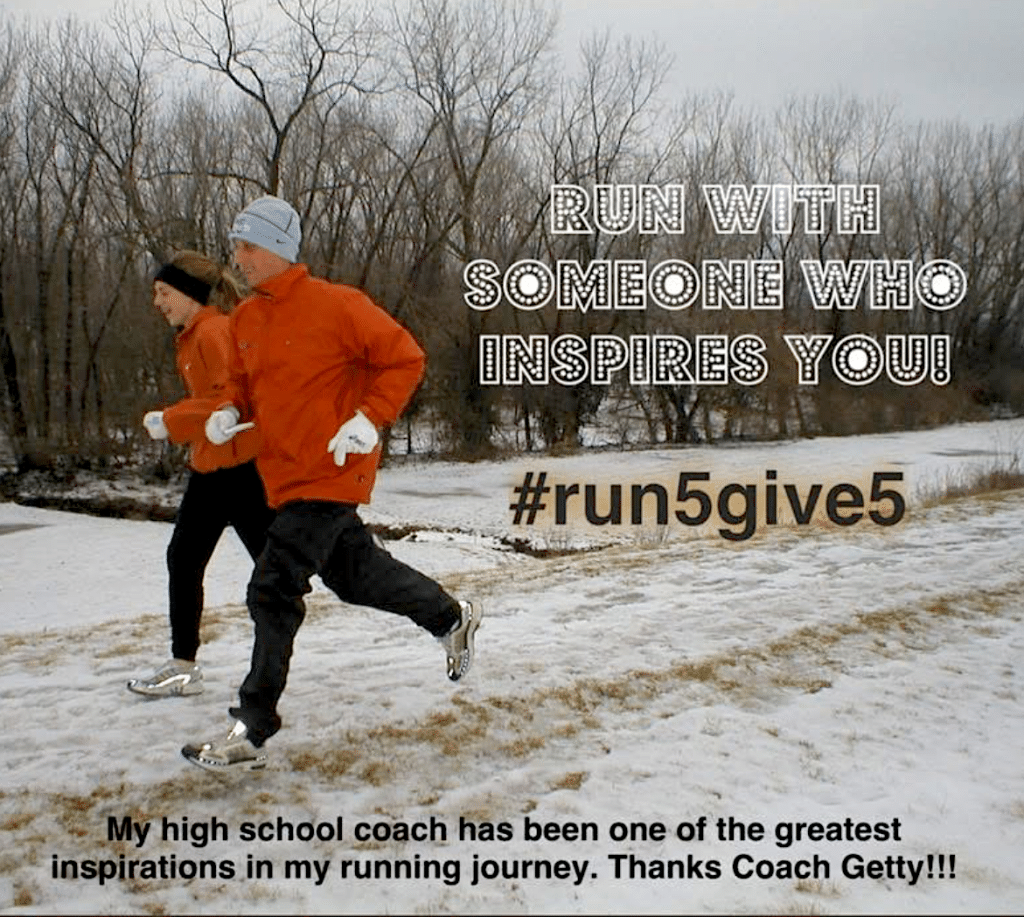
On that day they’re prepping for the USA Track and Field Junior Cross Country Championships in Indianapolis, where, as Simpson would later say, she had no idea how she compared to everybody else. She finished on the podium in her first try.
What happened next, she said, may have come from a secret Getty kept from her up until that moment.
“I remember I came across the finish line and they handed me this piece of paper that said ‘Congratulations you’re eligible for the junior world championship team. Please proceed to drug testing or whatever,’” Simpson, thinking back to that moment more than 20 years ago, said. “I thought this sheet of paper was an ad for a running camp. I threw it away. I had no idea that what I had done was going to take me to a world championship. Jay is like trying to get to me as quickly as possible because ‘Oh no, now I’ve got to explain.’”
He hadn’t told her what was at stake before the race, she surmised, because he was afraid of making her nervous.
“[After the race] he was quick to tell me ‘Now you’ve run us into a whole new adventure, Barringer,’” she said.
From there, she was off to take on the world. And for those first few races, Getty went with her.
“I feel like the stage got bigger, but it didn’t get better,” Simpson said. “The feeling of winning states when that was the highest stakes, highest pressure thing as a high schooler, that felt a lot like standing at the starting line of the NCAAs, and standing at the starting line of the world championships. The work is harder, the margins are slimmer, it gets harder and harder, but man that feeling of pulling it off and being the right horse to bet on, that feeling is good at every stage.”
She would go on to win the world championship in the 1500 meters in 2011 and punched her ticket to the Olympics three times, including medaling in Rio in 2016 in the 1500, which by then had become her specialty. But she can and has gone farther. Simpson holds the all-time American women’s record for the 2-mile. She has won the annual Fifth Avenue Mile eight times – more than any woman in history. She has set numerous NCAA track and field records, including her all-time 1500 meter record, set in 2009, which still stands at 3:59.90 – the longest-held record in NCAA women’s running in a race that’s still being regularly contested. Of the five closest NCAA races in middle distance, four have seen new records since the start of 2025.
But staring at that photo, all Getty chooses to remember is that moment before the race, gliding along in the snow, giddy for what could be: a finish line and a starting line all at once.
“I told him I learned how to win in high school,” Simpson said. “And then I went and did the same thing in college and then I did it as a pro.”
He came to her graduation from Oviedo in 2005. At that point they both knew she had a scholarship to the University of Colorado, just a short drive to the U.S. Olympic Training Center.
“He said ‘For four years it’s been a privilege to be your coach, and now it’s a privilege to be your friend,’” she said.
“You can call me Jay,” he told her.
It might be months between calls, but there are those moments, she says, when the phone rings, either on her end or his.
“If I find myself with 30 minutes sitting in an airport, that’s when you call someone you just like to talk to in life, like you don’t have to have a reason,” she said. “That’s Coach Getty for me.”
That’s not an uncommon sentiment. Ask any of his seniors on the track this season and the words blend together in a familiar refrain.
“There’s still a fine line where he’s your coach, but you can just talk to him about anything, not even running related, but life related,” Hagerty middle distance runner Ava Howell, in her fourth year being coached by Getty, said. “I know I’ll always have him, forever.”
Simpson still calls him “Coach.” But with a caveat, she says. “When I pick up the phone I’ll say ‘Hey Jay, how’s it going?’ but when we sign off, it’s always. ‘Talk to you soon, Coach.’”
Simpson said she doesn’t even know what Getty’s outgoing voicemail message sounds like. He always picks up.
Not just wins
The difference between just a coach and the type of coach Getty became, several of his seniors point out, is it’s not about a team winning a meet.
“There are lots of coaches where they don’t figure out that it’s not about the team winning until they win their first state championship,” Finke said. “Until then, they’re team centric, coach centric, not athlete centric. The thing that impressed me about Getty is he figured that out before he won one in anything.”
That’s because with the coaching job, other jobs come with it, Brauman said. And that might include jobs coaches didn’t know they’d signed up for.
“When you do this, you’re not in the business to just try to specifically coach an athlete to an elite level,” Brauman said. “You do your best to develop them athletically, socially, intellectually. They might be having problems at home. You get calls from their parents saying ‘I can’t do anything with Johnny. Can you please help me?’”
A line Getty says, repeatedly, is “teaching athletes to be able to coach themselves.”
That’s not just in sports, he says, but in life.
“He makes us believe in ourselves, that we can really do it,” Hagerty senior Peyton Shemas said. “He really cares about us and wants us to succeed.”
That includes his own kids. When Getty says “my kids,” he clarifies “‘my’ my kids.”
“I don’t think I’ve ever seen him disappointed in us,” Caleb said. “It’s just if he saw us lagging behind our potential, he’d say ‘what could you have done better?’”
That includes a few words “You won’t really know until you put one foot in front of the other,” that helped push Caleb, 27, to finishing his pre-med degree at Florida State University while working three days a week on hospital shifts in Orlando at the same time.
The idea of bringing out kids’ inner coach tends to repeat itself with Getty.
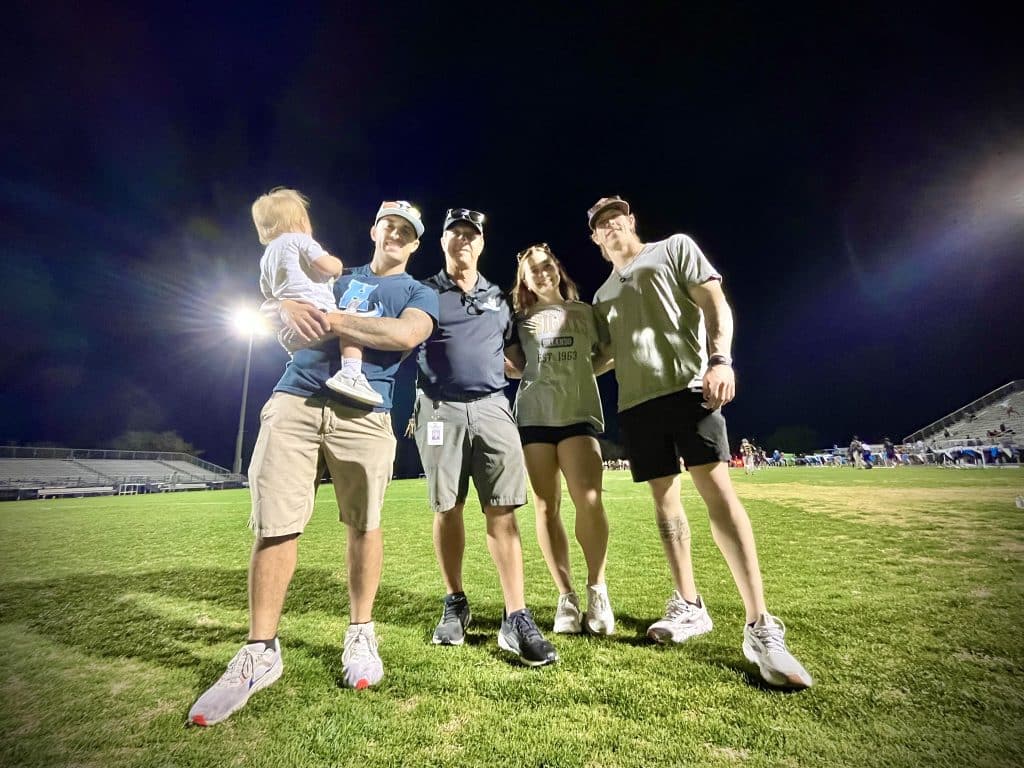
His daughter Leah, 20, the champion weightlifter and dancer, remembers those nervous moments in competition where she’d look across the room, see her dad there and, with a few words and a look, everything would be alright.
“He would be on the floor with me, and his presence is a very easing presence,” Leah Getty said. “He doesn’t even have to say anything, he’d just give me a look. He’d say ‘just breathe, go, you know what you’re doing.’ And I’d say to myself ‘OK, just breathe, go.” She made it to the state championships in weightlifting. In dance she went even farther.
Maybe they’re born with something, Leah Getty said. Or maybe, she wondered, it’s that he made them want to keep going. Whatever it is, she knows it pushed her after she graduated from Hagerty.
“After I stopped my sports, I realized ‘I’m free. But what am I supposed to do now?’” she said. “Even on the weekend I’m thinking ‘There’s got to be something I need to do.’ It’s a curse but it’s also a really good thing in my book.”
The word “win” doesn’t escape Getty’s mouth often. But Getty can name offhand what former students are up to now. Kyle Burton, from Getty’s first year at Hagerty, is a radiologist. Shannon Compher works in hospital administration.
“Success does a lot of good things for people,” Brauman said. “But that’s not everything. There’s a saying in track and field that ‘sometimes you win and sometimes you learn.’”
But getting his kids and his athletes Getty calls his kids to keep pushing to get better has led Getty to one of his biggest conundrums in life, as he approaches the end of his career.
“The ultimate fear for all of us as coaches, is all we’ve done is preach ‘Don’t quit,’ and that’s what I’m doing,” Getty said. “It’s just rephrased as retirement.”
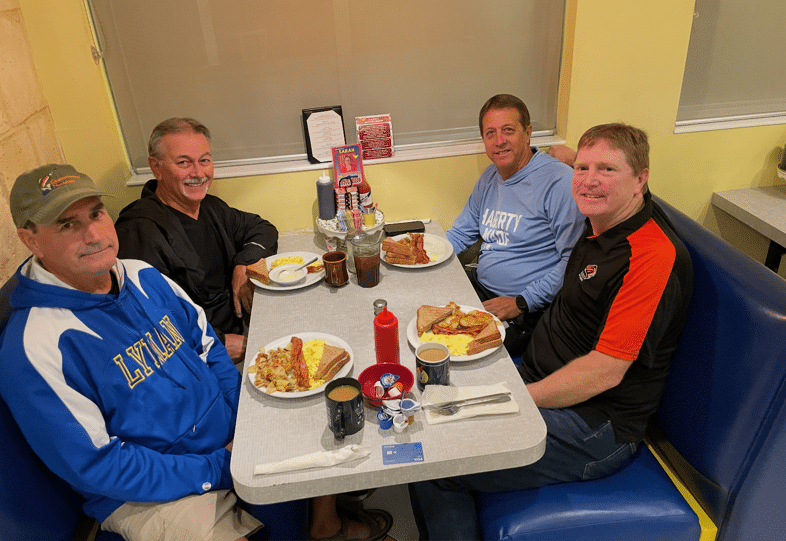
That’s something his friends, many of whom happen to be coaches, know too well. Every Friday morning, for 25 years, Getty, Janson and fellow coaches Scott Waisanen and Rob Williams have eaten breakfast at the same place – The Town House – at the same table, except for the time it moved 100 yards northwest. When Getty announced he was retiring, that’s where they were, Janson said.
“I didn’t believe him,” Janson added. “I don’t think any of us did.”
When Getty doesn’t come back this fall, he knows not all of him will be gone from Hagerty. Getty’s parting gift to the school might be something he has the least control over. When Getty walks out the doors for the last time, the Getty name won’t leave with him.
“He’s always there”
But the never sick, never out of commission, always ready to help reliability of Getty will be hard to replace regardless of who does it, his colleagues said.
Christy Tibbits-Bryce, now an assistant principal at Hagerty, remembers the times that someone dropped the ball. When it happened, Getty was always there, she said, rushing to pick something up and bear whatever weight weaker legs couldn’t carry.
On a Wednesday in February he flings open a 6-foot-wide door of a Hagerty sports equipment trailer, picks up a handful of pylons and heads back out into the unseasonably warm midday sun, dozens of keys jingling away. As he talks he’s dropping the orange corner markers in their spots on the big field ringed by the track, directing some runners to help move benches and tables into place for a lacrosse game that night.
“Some of these coaches, their real money job is somewhere else,” Getty said. “So I want to make it easier for them when they get here.”
Even things that aren’t his job, he still makes his job, Tibbits-Bryce said.
“It’ll be different to be here without him here,” she said. “We don’t know this place without him.”
The two of them first met when they were both in school at UCF, then worked together as intramural sports supervisors. They’ve now worked on and off together for more than two decades.
“I started the athletic program here, but he really took it over and did all the rest,” Tibbits-Bryce said.
She remembers the Getty who was always there to help. Getty, the guy who can seemingly coach any sport. Getty the lifesaver.
She’s seen him run across the school when the call came over the radio that a student was down and needed a medic. That’s pretty much every time it’s happened, she said.
“On campus when there’s a medical emergency, he’s the first to get there, he’s the guy who’s down on the ground with them,” she said. “A kid who’s having a panic attack, can’t breathe, he can bring them down like that. He has that ability.”
In Getty’s office, hanging near the door, there’s a framed award among all his personal photos and sports accolades. This one’s different.
“Life Saving Award Awarded to Jay Getty,” it reads.
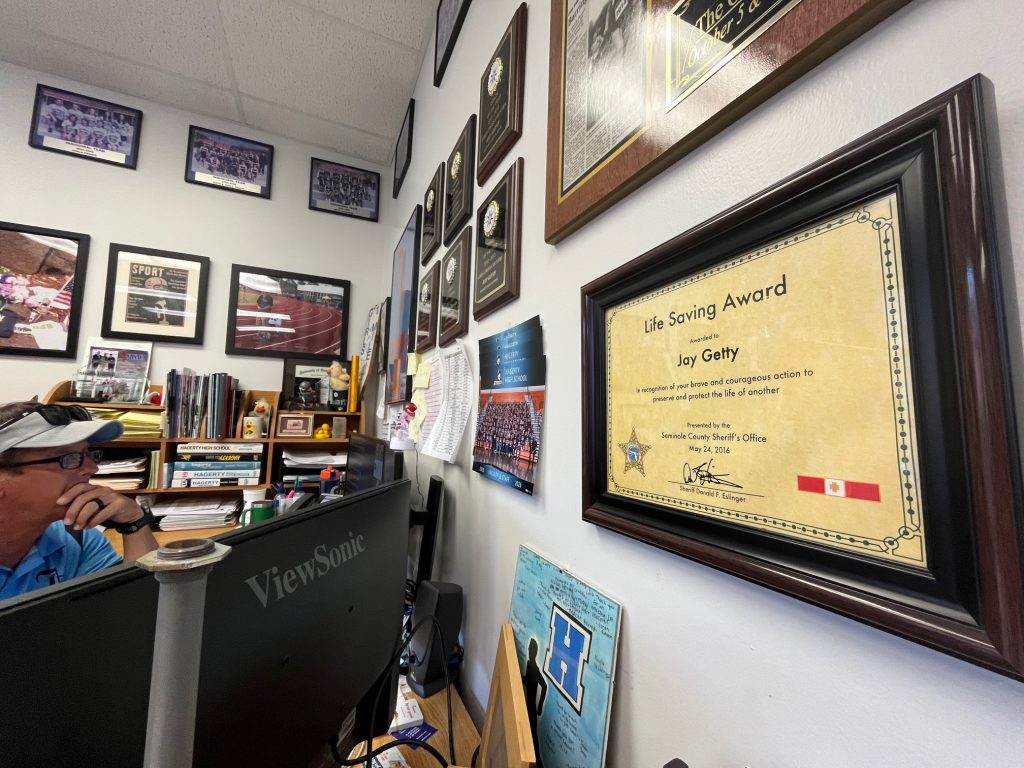
Coaches and teams were at the Lake Nona High School, scouting the cross country course before a race when someone dropped.
“I was measuring something, and I look up and there’s these people crowded around somebody clearly on the ground,” Getty said.
What Getty, a former college lifeguard, didn’t know then was the man on the ground was the father of one of the Lake Mary High School runners, relatively young, then boom. Like a switch.
“I’m just reviewing what I’m going to do on the walk up there,” Getty said. “As I get there, I recognize a couple of coaches there, and the one looked really hesitant, really nervous, and I said, I’m willing to go, if you want me to go. I told them, you keep talking to 911, and I just started. 30 compressions into the breaths. 911 told me to just switch to compressions.
So he did. Up and down, pumping the dying man’s chest for 10 minutes as they waited for the ambulance to arrive and dozens of cross country runners and coaches looked on.
“10 minutes is a long time to do compressions,” Getty said. “The rescue gets there, they hit him 3 times on the ground, and I don’t know if this guy’s alive or not, and I walk over to my team, and [assistant coach Joe Janson] greets me and looks at me and says “are you ok?” and I said “To be perfectly honest, Joe? I don’t know. But we have a job to do and I’ve got to talk to the team.”
His oldest son, Caleb, a varsity cross country runner, had just seen everything.
“And Caleb is just staring at me, and I said, alright, so remember, which box are we in?” Getty said.
In an instant, Getty the lifesaver switched back to Getty the parent and Getty the coach, what he called “redirecting” the team to get them back into a headspace where they weren’t thinking about the near-death experience they just witnessed.
“Then later [Joe] says ‘I’m gonna ask you one more time: Are you ok?,’” Getty said. “And I said ‘If he lives, absolutely. If he doesn’t, then what did I do wrong?’ And I probably didn’t do anything wrong. But that’s what I’m stuck with as I contemplate what the hell just happened. We had a good talk, warmed up, had a good race, and went on about our business.”
The next night, Getty’s at a Hagerty football game against Edgewater when he got the call. Getty’s patient had made it.
“They called super excited, so I got to meet him, the whole family, wife, kids,” Getty said. “Every time I see Shawn he’s like ‘thank you so much for letting me be a part of my kids’ lives.’
Getty, Shawn O’Brien, and Jorge Fleitas, the coach on the phone with 911 while Getty pumped O’Brien’s heart, ended up in Runner’s World magazine for the rescue.
That year, at the state championships, the Lake Mary and Hagerty cross country teams wore the same shirts, all one team.
Later on Getty was up for national coach of the year, which he’s now been a finalist for twice. He didn’t win.
“My mom was mad because she thought I should have won it for saving that guy’s life, and I’m like ‘Mom, the guy who won has won the state championship like 15 times,” Getty said.
And that wasn’t the only time Getty used his medical training to save someone’s life at a sports event. It’s happened three times, including Getty shocking somebody back to life with an automated defibrillator. All three survived.
Finke remembers one of those times, not because of seeing it, but from what he learned about Getty later that day.
“It happened at the meet, but before it started; I was there at that meet, and he didn’t mention it at all,” Finke said. “What stuck out to me in my mind was the meet was over, we had won, and literally he had never said a thing. I found out about it after the meet. He was that humble about it.”
“I had a job to do,” Getty said.
Words and photos, unless otherwise noted, by Isaac Benjamin Babcock
Support local news!
Choose a monthly amount
Hometown Hero
Community Champion
Rooster Society
Custom Amount
Thank you for your support!
Author

Related Articles
Celebrate Oviedo Community News’ 5th anniversary at Spill Wine Bar tonight!
On the patio and inside, Oviedo Community News’ anniversary party Tuesday, Sept. 15 takes over Spill Wine Bar again this year with a trivia night, charcuterie board, drink tickets and good conversation as a thank you to our readers and supporters.
Seminole County Public Schools enrollment drops additional 700 students
Plan is to absorb ‘manageable’ $5.7 million cut without job cuts, but teachers could be shuffled
Oviedo could end holiday events, cut services if Amendment 3 passes
Oviedo mulls ending Christmas, Halloween, Easter events in addition to cutting back open hours for parks and pools to handle potential revenue losses if Amendment 3 passes.